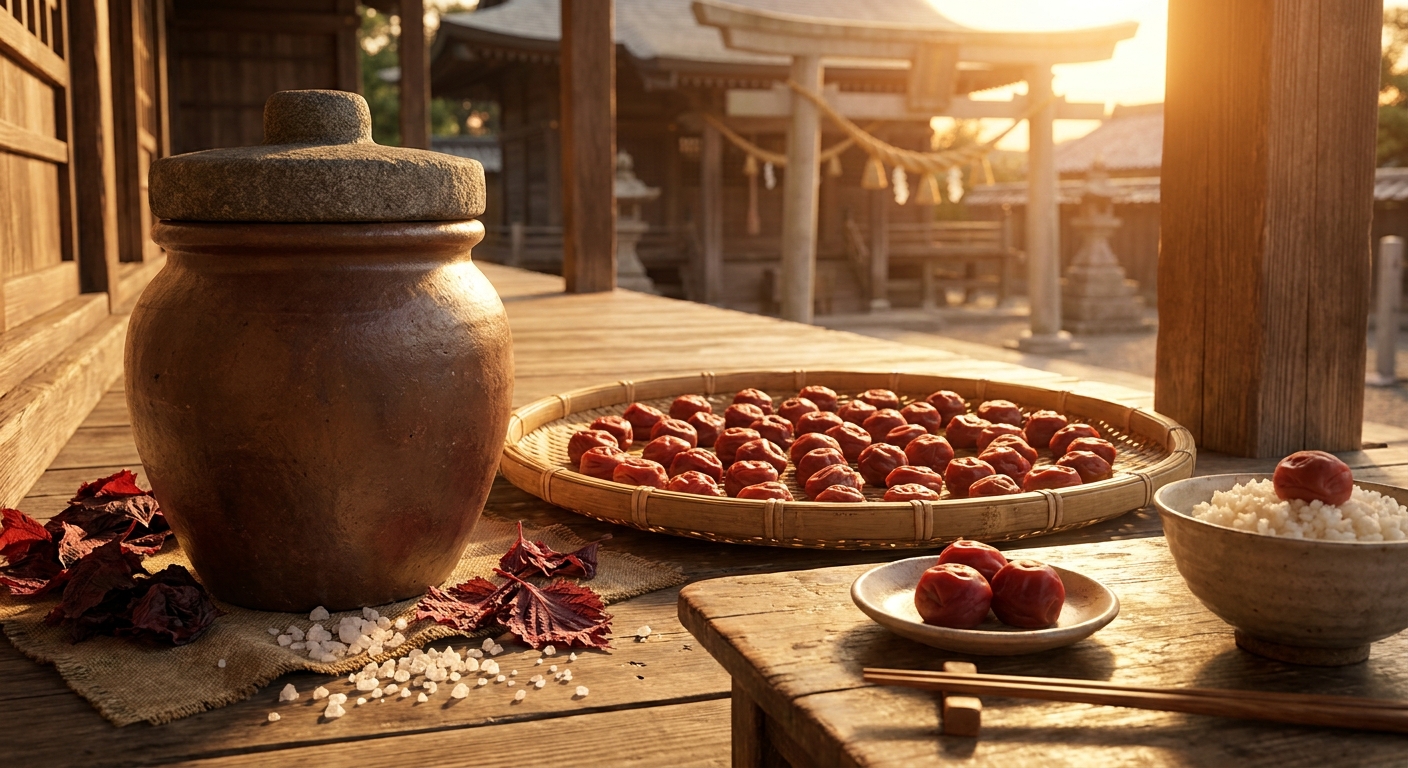
Umeboshi onigiri for the road
A ball of rice pressed by hand around a salted fermented plum (umeboshi), wrapped in nori seaweed. The plum, very sour and antiseptic, once preserved the rice: it's the Japanese travel snack par excellence.
A ball of rice pressed by hand around a salted fermented plum (umeboshi), wrapped in nori seaweed. The plum, very sour and antiseptic, once preserved the rice: it's the Japanese travel snack par excellence.
Umeboshi is the taste of my childhood: it twists your mouth, it's salty, sour, almost too much, and that's exactly why it's good. Before a long outing, I press some warm rice in the hollow of my hand, bury a plum in the center, and wrap the seaweed. It keeps for hours without spoiling, like a little stone of strength you slip into your pocket. When you run for a long time, you learn that the most modest things are the ones that carry you.
- •Cooked Japanese rice — enough to fill your hand (base)
- •Umeboshi (salted fermented plum) — 1 per ball (heart and preservative)
- •Nori seaweed — one strip (wrapper)
- •Salt — a pinch (seasoning for hands)
Umeboshi onigiri for the road
A ball of rice pressed by hand around a salted fermented plum (umeboshi), wrapped in nori seaweed. The plum, very sour and antiseptic, once preserved the rice: it's the Japanese travel snack par excellence.
Why this dish? Murakami is an obsessive long-distance runner — marathons and even ultramarathons — and a great traveler who wrote while living abroad. The umeboshi onigiri is the quintessential Japanese gesture of a meal you take with you: compact, durable, simple, exactly in the spirit of frugal discipline he claims.
Umeboshi is the taste of my childhood: it twists your mouth, it's salty, sour, almost too much, and that's exactly why it's good. Before a long outing, I press some warm rice in the hollow of my hand, bury a plum in the center, and wrap the seaweed. It keeps for hours without spoiling, like a little stone of strength you slip into your pocket. When you run for a long time, you learn that the most modest things are the ones that carry you.
Ingredients (period version)
- Cooked Japanese rice — enough to fill your hand (base)
- Umeboshi (salted fermented plum) — 1 per ball (heart and preservative)
- Nori seaweed — one strip (wrapper)
- Salt — a pinch (seasoning for hands)
Ingredients
- Japanese short-grain rice (cooked, still warm) — 150 g per onigiri (base)
- Pitted umeboshi — 1 per onigiri (heart and natural preservative)
- Nori sheet — 1/3 sheet per onigiri (wrapper)
- Fine salt — 1 pinch (salt hands)
- Water — a small bowl (wet hands)
Method
- Cook Japanese rice and let it cool for a few minutes (it should be sticky but manageable).
- Wet your hands with water, lightly salt your palms.
- Take a handful of rice, make an indent in the center, place a pitted umeboshi inside.
- Close the rice over it and press firmly into a triangle, turning it on each face.
- Wrap with a strip of nori. Let cool before taking along: it keeps several hours at room temperature.
How it was made : Onigiri is one of the oldest Japanese snacks, mentioned from the classical period as travel and war food. The umeboshi filling is not just for taste: the very salty and sour plum inhibits bacterial growth, allowing the rice to last a day without refrigeration.
The contemporary twist : Roll it in black sesame seeds and slip it, wrapped in a patterned cloth, into your running bag — a "km 21 refueling" version.
Sources : Haruki Murakami, What I Talk About When I Talk About Running (2007) · Japanese culinary traditions — onigiri and umeboshi as travel food
Haruki Murakami · Charactorium