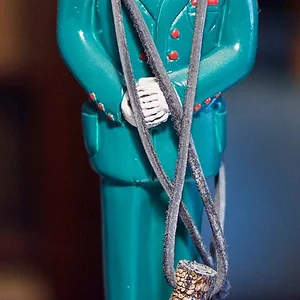

Baron Samedi is the loa of death in Haitian Vodou. Depicted in undertaker's attire — top hat and dark glasses — he is the guardian of the passage between the living and the dead. An ambivalent figure, at once protector and obscene trickster, he embodies the boundary between life and death.
Baron Samedi
Baron Samedi
10 min read
Frequently asked questions
Key Facts
- Baron Samedi belongs to the Guédé family, Vodou spirits associated with death and fertility
- Haitian Vodou emerged from the syncretism between African religions (Fon, Yoruba) and the Catholicism imposed on enslaved people from the 17th century onward
- Baron Samedi is invoked during funeral ceremonies to ease the passage of souls into the realm of the dead
- His depiction in Western attire (top hat, dark glasses) reflects a cultural reclaiming of colonial symbols
- He is one of the most internationally recognized loas, popularized in particular through pop culture and cinema
Works & Achievements
A secret Vodou gathering considered the triggering event of the Haitian Revolution. The loa of death were invoked as witnesses to a pact among enslaved rebels, making Baron Samedi and the Guédé the patron figures of Haitian freedom.
Official recognition of Vodou as a national religion of Haiti under President Jean-Bertrand Aristide. This legal act consecrated Baron Samedi and all the loa as legitimate spiritual and cultural heritage of the Haitian people.
An annual national celebration in Haiti centered on Baron Samedi and the Guédé family. This festival, which draws tens of thousands of people to cemeteries each year, is the most important living expression of the Baron's cult.
A landmark anthropological study by Franco-Swiss ethnologist Alfred Métraux, offering the first rigorous scientific description of Baron Samedi and the Guédé. This work remains the foundational academic source on the subject.
A unique documentary by filmmaker Maya Deren, who filmed authentic Vodou ceremonies in Haiti in the 1950s. Possessions by Baron Samedi are shown here to an international audience for the first time.
A foundational essay by Haitian intellectual Jean Price-Mars that rehabilitated Vodou and Baron Samedi against colonial and religious prejudice. This text is considered one of the origins of the Négritude movement and of African-Haitian cultural pride.
Anecdotes
Baron Samedi is intimately linked to the Haitian Revolution. The Bois Caïman ceremony, held on the night of August 14, 1791, was a major voodoo gathering at which enslaved people invoked the loa before rising up against the French colonizers. The spirits of death, including the Guédé family to which the Baron belongs, were called upon as witnesses and protectors of the revolt.
In Haitian voodoo religion, Baron Samedi is the only one who can decide whether a sick person will live or die. It is said that as long as he refuses to dig a dying person's grave, that person cannot pass away. This is why during healing ceremonies, houngans and mambos (voodoo priests and priestesses) offer him spiced rum and cigars to secure his mercy.
Baron Samedi is a syncretic figure born from the encounter between the African religions of the Fon and Ewe peoples (originally from present-day Benin) and the Catholicism imposed by colonizers. His undertaker's attributes — top hat, black suit, dark glasses — reflect the European image of death, while his obscene and festive character is inherited from African ancestor cults.
At every Guédé festival, celebrated on November 2 (Day of the Dead), thousands of Haitians make their way to cemeteries to honor Baron Samedi. The faithful don his symbolic attributes — black glasses with a single cracked lens, an old hat — and men become possessed by the Baron's spirit, walking with an obscene gait and hurling crude jokes. This possession is considered a blessing.
Haitian dictator François Duvalier, known as 'Papa Doc' (1957–1971), deliberately drew on Baron Samedi's appearance to reinforce his authority: dark glasses, black hat, dark suit. He cultivated the image of being a loa of death himself in order to terrorize the population and consolidate his power, exploiting the sacred fear that Haitians held for this voodoo figure.
Primary Sources
The Negroes of Saint-Domingue have a dance called Vaudoux [...] The great Zombi is an imaginary serpent [...] The Queen of Vaudoux is inspired by this serpent and delivers oracles; she dances to the point of exhaustion, and those present are likewise seized by a kind of frenzy.
Ghédé is death personified, but also the phallus in its life-giving power. He is at once the lord of cemeteries and the protector of children. His double face — grotesque and sacred — allows him to stand exactly on the boundary between life and death.
Baron Samedi rules the cemetery and the dead, but he is not sinister. He is the principle of death as the complement of life, without which life cannot exist. He mocks, he jokes, he dances — because he knows that death is not the end.
The Vaudoux worship is still carried on with more or less secrecy [...] The leaders of these assemblies, who are possessed by the spirit of the dead, act in a manner that shocks all sense of decency, yet the participants regard this as sacred.
Vodou is not merely a magico-religious practice; it is a coherent worldview, inherited from African traditions and enriched by three centuries of shared suffering. The cult of the dead, presided over by the Guédé, is the beating heart of this spirituality.
Key Places
The main site of worship for Baron Samedi in Haiti. Every November 2nd, thousands of devotees gather around the Baron's central cross to pay tribute to him with rum, cigars, and ritual dances.
Site of the famous Vodou ceremony of August 14, 1791, considered the founding act of the Haitian Revolution. The loa of death — including the Guédé family, to which Baron Samedi belongs — were invoked here before the slave uprising.
Capital of the former Kingdom of Dahomey and birthplace of the Vodun religion of the Fon and Ewe peoples. It was from this region that the spiritual ancestors of Haitian Vodou were deported, including the cult of the dead that gave rise to Baron Samedi.
A major Vodou pilgrimage site in Haiti, where a grand religious festival blending Vodou and Catholicism is held every July. Thousands of pilgrims come to invoke the loa, including Baron Samedi, seeking healing for the sick.
Former colonial capital of Saint-Domingue, where the slave trade and the suppression of African religious practices were most intense. It was in this region that the earliest forms of syncretic Haitian Vodou took shape.
Typical Objects

An iconic attribute of Baron Samedi, this 19th-century European headpiece symbolizes the attire worn by undertakers of the colonial era. It embodies the boundary between the world of the living and the world of the dead.

The Baron always wears glasses with one lens absent or broken, symbolizing his double vision: he sees the world of the living and the world of the dead simultaneously. They also represent his one-eyed aspect, a traditional trait of deities associated with the threshold between worlds.

The Baron consumes and offers *clairin* (Haitian cane spirit) steeped with extremely hot peppers. During possession ceremonies, officiants possessed by his spirit drink this preparation without feeling any burn — proof of divine possession.

An inseparable attribute of the Baron, the cigar is one of the offerings made to him during rituals. The smoke symbolizes the veil between worlds and serves as a means of communication between the living and the dead.

At the center of every Haitian cemetery stands the 'Baron's cross,' a sacred post marking the entrance to the kingdom of the dead. It is around this cross that rituals and offerings intended for him take place.

The *vévé* is a ritual symbol drawn in flour or ash on the ground during Vodou ceremonies to invoke the loa. Baron Samedi's *vévé* depicts a cross associated with a coffin, drawn at the entrance to cemeteries.

A macabre attribute inherited from funerary practice: the orifices of corpses were traditionally plugged with cotton. Baron Samedi is sometimes depicted wearing it in traditional representations, a reminder that his nature is that of a protective revenant.
School Curriculum
Vocabulary & Tags
Key Vocabulary
Tags
Lieu
Daily Life
Morning
Baron Samedi does not belong to the world of the living and therefore has no 'morning' in the ordinary sense. In Voodoo cosmology, he resides at the crossroads (kalfou) between the world of the living and the world of the dead, imagined as a twilight space. In the mornings at Haitian cemeteries, families leave offerings at the Baron's cross — rum, cigars, small cakes — to begin the day under his protection.
Afternoon
The afternoon is the time of houngans and mambos (Voodoo priests and priestesses) who consult Baron Samedi on behalf of the critically ill. Through prayers and rituals, they attempt to negotiate with him to delay the hour of death. The Baron can heal any illness if he agrees not to dig the sick person's grave.
Evening
Night is the Baron's true domain. It is at dusk that the great Guédé ceremonies begin, with drums, dances, and possessions. Men are 'mounted' (possessed) by the Baron, who then speaks through them with his characteristic nasal voice, his obscene jokes, and his oracular advice to the living.
Food
Baron Samedi consumes particularly strong and unusual offerings: clairin (artisanal Haitian rum) infused with 21 whole cayenne peppers, black cigars, roasted peanuts, and cornbread. During possessions, people inhabited by the Baron can drink this ultra-spicy rum without feeling any burning sensation, which is considered proof of divine possession.
Clothing
Baron Samedi wears the attire of a 19th-century Haitian undertaker: a black tailcoat suit, a white shirt, a black vest, a black top hat, and black sunglasses with one lens cracked or missing. His clothes are often adorned with symbols of death — skulls, crosses — and he may have white cotton in his nostrils, recalling funerary practices.
Housing
Baron Samedi resides symbolically in cemeteries, and particularly around the first grave dug in a new cemetery, which belongs to him by right. His earthly 'peristyle' (Voodoo temple) is the cemetery itself, of which he is the absolute guardian. He occupies the space of the crossroads (kalfou), a symbolic intersection between the four cardinal points that represents the passage between worlds.
Historical Timeline
Period Vocabulary
Visual Style
Esthétique de l'art naïf haïtien : contrastes forts entre noir profond et lumières chaudes des bougies, violet mystique et pourpre funèbre, avec les symboles rituels vévé tracés à la craie blanche.
Sound Ambience
Atmosphère nocturne d'un cimetière haïtien lors d'une cérémonie des Guédé : tambours rituels, hochets sacrés, chants en créole haïtien mêlant prière et rires, fumée de cigares et rhum clairin.
Liens externes & ressources
Références
Œuvres
Cérémonie du Bois Caïman
14 août 1791
Constitution haïtienne et reconnaissance du vaudou
2003
Fête des Guédé (Jour des Morts haïtien)
2 novembre, annuel
Le Vaudou haïtien — Alfred Métraux
1958
Ainsi parla l'Oncle — Jean Price-Mars
1928