Andreas Vesalius(1515 — 1564)
Andreas Vesalius
Pays-Bas des Habsbourg
8 min read
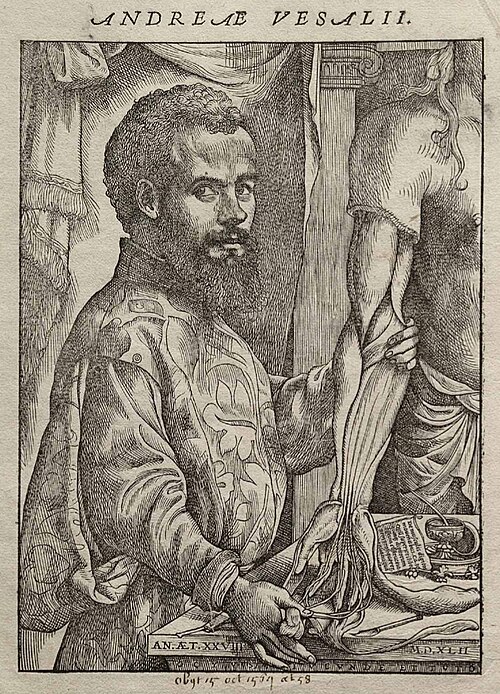
A 16th-century Flemish physician and anatomist, he revolutionized knowledge of the human body by performing systematic dissections. His landmark work *De humani corporis fabrica* (1543) corrected Galen's errors and established the foundations of modern anatomy.
Frequently asked questions
Key Facts
- Born in Brussels in 1514 into a family of physicians serving the Habsburgs
- Published *De humani corporis fabrica* in 1543, a groundbreaking illustrated work on human anatomy
- Demonstrated that Galen had based his work on animal dissections, not human ones, correcting more than 200 errors
- Professor of anatomy at the University of Padua at the age of 23
- Died in 1564 on his return journey from the Holy Land
Works & Achievements
Six large engraved anatomical plates depicting the skeleton and vascular system. Vesalius's first major work, already superior to medieval illustrations in its precision drawn from direct observation.
The absolute masterpiece of Renaissance anatomy, in seven books illustrated with 273 engravings. Vesalius systematically describes bones, muscles, vessels, nerves, organs, and the brain, correcting more than two hundred of Galen's errors.
An abridged, illustrated version of the *Fabrica*, published simultaneously and intended for students and artists. It allowed Vesalius's discoveries to reach a much wider audience across Europe.
A medical letter on a treatment using China root, in which Vesalius responds to his Galenist critics and defends his method grounded in empirical observation of the human body.
Vesalius's final work, written shortly before his death in response to the observations of his successor at Padua, Gabriele Falloppio. In it he confirms or refines some of his own anatomical descriptions.
Anecdotes
As a student in Louvain and then in Paris, Vesalius had access only to rare cadaver dissections, always reserved for professors. To learn anatomy on his own, he would venture out at night to the Montfaucon gibbet, outside Paris, to steal the bodies of executed criminals. It was in this way that he reassembled his first complete human skeleton, bone by bone, and was able to begin verifying his own observations firsthand.
Appointed professor of anatomy in Padua at just 22 years old in 1537, Vesalius immediately revolutionized teaching: where his predecessors had read from Galen's texts at a lectern while an assistant performed the dissection, he himself came down to the table and dissected while explaining. His public sessions attracted hundreds of spectators — students, physicians, and curious onlookers — in a genuine impromptu anatomical theater.
In 1543, Vesalius published his masterpiece, the Fabrica, in Basel, cataloguing more than two hundred errors in Galen's anatomy — errors stemming from the fact that Galen had dissected monkeys and pigs, never humans. His former teachers, staunch defenders of Galenism, came at him with fury. Disgusted by their attacks, Vesalius burned his manuscripts in progress and accepted a position as physician at the court of Emperor Charles V.
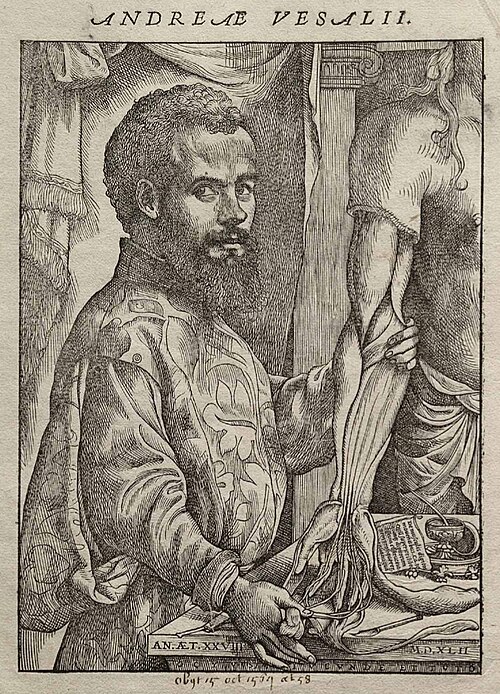
The illustrations in the Fabrica rank among the finest ever produced for a scientific work. Vesalius called upon a pupil of Titian — probably Jan van Calcar — to engrave woodcut plates of astonishing precision and beauty: pensive skeletons leaning against ancient columns, flayed bodies posed in landscapes of the Italian countryside. These images were copied and imitated for more than a century across Europe.
In 1564, for reasons still poorly understood, Vesalius undertook a pilgrimage to Jerusalem from Spain. On his return, he was shipwrecked on the Greek island of Zakynthos and died there at the age of 49, taking with him plans for a revised edition of the Fabrica that would never see the light of day. Some historians point to a condemnation by the Inquisition for illicit dissection; others cite a simple personal vow of piety.
Primary Sources
We have described the bones with the greatest care, for they serve as the foundation of all other parts and constitute the first subject of study for those approaching knowledge of the human body.
These six anatomical plates, intended as a memory aid for students, depict the skeleton, the venous system, and the arterial system based on direct observations made in Padua.
This illustrated summary of the Fabrica is designed for students and artists, so that they may grasp the essentials of human anatomy without needing access to the full seven-book work.
In this letter, Vesalius discusses treatment using the China root and takes the opportunity to answer Sylvius's attacks, defending the validity of his corrections to Galen in the name of direct observation.
In this examination of his successor Falloppio's work, Vesalius confirms or refines some of his own anatomical descriptions, demonstrating his intellectual rigor right up to the final months of his life.
Key Places
Andreas Vesalius's birthplace, then part of the Habsburg Netherlands. His family included several physicians in the service of emperors, which early on shaped his scientific vocation.
Vesalius studied here from 1533 to 1536 under Sylvius, a staunch defender of Galen. It was here that he became aware of the limits of book-based teaching and sought to compensate for the shortage of cadavers available for dissection.
A leading center of Italian Renaissance science, this is where Vesalius taught anatomy from 1537 to 1544 and conducted the dissections that underpinned his major work. The anatomical theater of Padua (1594) carries on this tradition.
It was at the printer Johannes Oporinus's workshop in Basel that the *Fabrica* was printed in 1543. Vesalius spent several weeks there overseeing the printing; a skeleton he left behind is still preserved at the university.
Vesalius spent the final years of his career in the service of the Spanish crown, treating the royal family and high nobility, far removed from the scientific activity that had made his reputation.
Vesalius died on this Ionian island on October 15, 1564, during his return from a pilgrimage to Jerusalem. The exact circumstances of his death — illness, exhaustion, shipwreck — remain debated by historians.