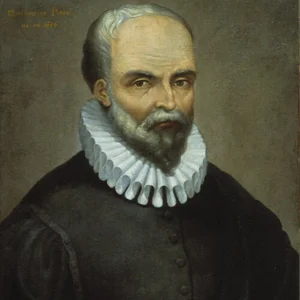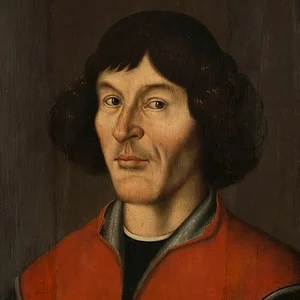

Polish Renaissance astronomer, mathematician, and canon (1473–1543). He revolutionized our understanding of the universe by proposing the heliocentric model, placing the Sun at the center of the solar system rather than the Earth. His major work, De revolutionibus orbium coelestium, published shortly before his death, marks the beginning of the Scientific Revolution.
Nicolas Copernicus(1473 — 1543)
Nicolas Copernicus
Royaume de Pologne
7 min read
Frequently asked questions
Key Facts
- 1473: Born in Thorn (Kingdom of Poland)
- 1507: Wrote his Commentariolus presenting heliocentrism (circulated as a manuscript)
- 1543: Publication of De revolutionibus orbium coelestium (On the Revolutions of the Celestial Spheres) in Nuremberg, a few weeks before his death
- 1543: Died on 3 June in Frombork (Poland)
- Proposed a system in which the Earth and the other planets orbit the Sun, challenging the dominant geocentric view
Works & Achievements
A short manuscript quietly circulated among scholars, in which Copernicus presents for the first time his seven heliocentric postulates. This founding text would not be printed until the 19th century.
Copernicus is consulted by the Lateran Council on the reform of the Julian calendar. He replies that the movements of the Sun and the Moon must first be measured more accurately, revealing his distrust of existing data.
The first printed summary of the Copernican system, written by his disciple Rheticus. This text allowed European scholars to become acquainted with Copernicus's ideas before the publication of his main work.
Copernicus's masterpiece in six books, in which he mathematically demonstrates that the Earth and the planets revolve around the Sun. This work is considered the founding act of the modern scientific revolution.
Anecdotes
Copernicus only saw his great work published at the very last moment of his life: according to legend, the first printed pages of his book were brought to him on the very day of his death, in May 1543. He had just enough time to hold the volume in his hands before passing away.
Out of caution toward the Church, Copernicus hesitated for nearly thirty years to publish his heliocentric theory. It was his friend Georg Joachim Rheticus, a young mathematician who had made a special visit to see him, who finally convinced him to share his work with the world.
Copernicus was a Catholic canon and a physician in addition to being an astronomer: he treated the inhabitants of Frauenburg (today Frombork in Poland) and managed the finances of the cathedral chapter. Astronomy was for him merely one scholarly pursuit among many, practiced in his spare time.
Contrary to popular belief, Copernicus was not condemned by the Church during his lifetime. It was only in 1616, 73 years after his death, that his book was placed on the Index of Forbidden Books, in reaction to the Galileo affair.
Copernicus made his astronomical observations with rudimentary instruments — without a telescope, which did not yet exist — from a turret of Frombork Cathedral. Despite these limited means, the precision of his mathematical calculations allowed him to challenge a model that was 1,400 years old.
Primary Sources
"At the center of everything resides the Sun. Who could, in this most beautiful temple, place this torch in any other or better place than that from which it can illuminate everything at the same time?"
"All the spheres revolve around the Sun as their midpoint, and therefore the Sun is at the center of the universe."
"I hesitated for a long time to publish these meditations, so much did I fear the contempt deserved by those who put forward new proposals contrary to accepted opinions."
"The length of the year and the motions of the Sun have not yet been determined with enough precision to allow a calendar to be established without error."
Key Places
Copernicus's birthplace, a prosperous merchant city of Royal Prussia on the Vistula River. He was born there on February 19, 1473, into a wealthy merchant family.
Small port town on the Baltic Sea coast where Copernicus lived and worked as a canon for most of his adult life. It was from the cathedral tower that he conducted the bulk of his astronomical observations.
Copernicus studied here from 1491 to 1495, discovering mathematics and the first foundations of astronomy. It is one of the oldest centers of learning in Central Europe.
Copernicus stayed at this great Italian university from 1496 to 1500, where he worked alongside the astronomer Domenico Maria Novara and made his first serious observations of the sky.
Copernicus stayed there around 1500 and gave public lectures on mathematics and astronomy, during which he notably observed a lunar eclipse.
Typical Objects
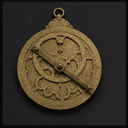
An instrument for measuring the position of celestial bodies, used by Copernicus for his nightly observations from the turret at Frombork. It allowed him to determine the altitude of the Sun, the Moon, and the planets above the horizon.

A three-branched articulated instrument that Copernicus built himself to measure angles between celestial bodies. He mentions it in De revolutionibus as his primary observational tool.

The great treatise by the Greek scholar Ptolemy (2nd century), which was the indispensable reference of medieval astronomy. Copernicus studied it deeply before challenging its geocentric model.

Copernicus wrote his calculations and observations by hand over decades, accumulating thousands of pages of mathematical notes before composing his definitive work.

As a canon of the Chapter of Warmia, Copernicus wore ecclesiastical dress. His double life as a clergyman and scholar symbolizes the tension between religion and science during the Renaissance.

Essential mathematical tools for tracing the circular orbits of the planets in his models. Copernicus was above all a geometer who sought the mathematical harmony of the cosmos.
School Curriculum
Vocabulary & Tags
Key Vocabulary
Tags
Époque
Daily Life
Morning
Copernicus rose early to recite the canonical hours with the other canons of Frombork Cathedral. After Mass, he devoted his mornings to administrative duties: managing the chapter's finances, drafting official documents, and handling correspondence.
Afternoon
His afternoons were divided between medicine — he treated the townspeople and sometimes his fellow canons — and the study of ancient astronomical texts, particularly Ptolemy. He annotated his works carefully and refined his mathematical calculations.
Evening
When night fell, especially on clear nights, Copernicus climbed to his observation turret to measure the positions of planets and stars with his instruments. These patient observations, accumulated over decades, fed his tables and gradually confirmed his heliocentric model.
Food
Copernicus followed the diet of a canon of modest means: rye bread, Baltic fish (herring, cod), legumes, and occasional game. Fast days, prescribed by the ecclesiastical calendar, were frequent and strictly observed.
Clothing
As a canon, Copernicus wore the black cassock and white surplice for religious services. Outside of ceremonies, he dressed in a long dark woolen robe, warm and practical under the harsh climate of the Baltic coast, with a fur cap in winter.
Housing
Copernicus lived in the buildings of the cathedral chapter of Frombork, in a simple but comfortable dwelling. He had a well-stocked personal library and had fitted out a small turret adjoining the ramparts as a rudimentary observatory from which he could observe the sky unobstructed.
Historical Timeline
Period Vocabulary
Visual Style
Le style visuel de l'époque de Copernic s'inspire de la peinture de la Renaissance du Nord : tons froids et austères, lumière de chandelle sur des parchemins couverts de calculs, sobriété ecclésiastique et rigueur géométrique.
Sound Ambience
L'univers sonore de Copernic est celui d'une nuit froide de Prusse : vent baltique, cloches de cathédrale, plume sur parchemin et instruments de bois qui grincent dans la tour d'observation.
Liens externes & ressources
Références
Œuvres
Commentariolus (Petit Commentaire)
vers 1514
Lettre sur la réforme du calendrier
1516
Narratio Prima (par Rheticus, d'après Copernic)
1540
De revolutionibus orbium coelestium
1543