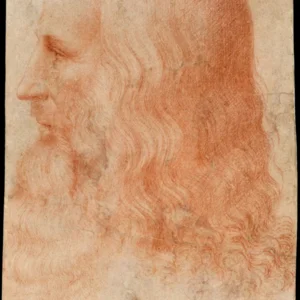

Italian Renaissance painter, sculptor, architect, and engineer (1452–1519), Leonardo da Vinci embodies the ideal of the universal man. Creator of the Mona Lisa and The Last Supper, he revolutionized art through perspective and scientific observation, while pursuing research in anatomy, botany, and engineering.
Leonardo da Vinci(1452 — 1519)
Leonardo da Vinci
République florentine
9 min read
Frequently asked questions
Famous Quotes
« Painting is poetry that is seen rather than felt, and poetry is painting that is felt rather than seen.»
« Art is the queen of all sciences.»
« Learn to see.»
« He who loves practice without theory is like the sailor who boards ship without a rudder and compass.»
Key Facts
- 1472: Enrolled in the Florence guild, recognized as a master painter
- 1495–1498: Paints The Last Supper in the refectory of Santa Maria delle Grazie convent in Milan
- 1503–1519: Paints the Mona Lisa, a portrait that became one of the most famous works in the history of art
- 1489–1519: Produces hundreds of study drawings on human anatomy, flying machines, and hydraulics
- 1516: Appointed first painter, engineer, and architect to King Francis I of France, spending his final years in Amboise
Works & Achievements
Oil portrait on wood panel housed in the Louvre, considered the most famous painting in the world. Leonardo displays his mastery of sfumato, creating an enigmatic smile and an atmospheric landscape of unparalleled subtlety.
Monumental mural painted on the wall of the refectory of Santa Maria delle Grazie in Milan, depicting the last meal of Christ. A masterpiece of narrative composition, it revolutionized the representation of human emotions in painting.
Altarpiece depicting the Virgin, the infant Jesus, Saint John the Baptist, and an angel in a rocky landscape. Leonardo's first major work entirely by his own hand, it illustrates his poetic conception of light and nature.
A collection of over 200 anatomical drawings made from dissections, depicting muscles, skeleton, organs, and the vascular system with unprecedented precision. They anticipate modern medicine by several centuries.
Drawings and calculations recorded in the Codex on the Flight of Birds, proposing a flapping-wing machine inspired by avian anatomy. Although never built, this invention demonstrates an extraordinary aerodynamic intuition.
Design for an armored war machine drawn for Ludovico Sforza, a precursor to the modern tank. The vehicle, shaped like a flattened cone, was to be operated by men inside and equipped with cannons all around.
Famous drawing depicting a man with ideal proportions inscribed within a circle and a square, illustrating the theories of the Roman architect Vitruvius. It has become the universal symbol of Renaissance humanism.
Anecdotes
Leonardo da Vinci was left-handed and wrote in mirror script, from right to left, so that his notebooks could only be read by holding them up to a mirror. This habit intrigued his contemporaries, some of whom saw it as a deliberate secret to protect his discoveries.
Leonardo is said to have bought caged birds at the markets of Florence solely to release them. This gesture, recounted by his biographer Giorgio Vasari, reflects his deep sensitivity toward nature and living creatures — he was a vegetarian by conviction.
The Mona Lisa was painted over several years, between approximately 1503 and 1517. Leonardo carried it with him everywhere and never parted with it, continually retouching it until his death. It was not commissioned for a great palace, but most likely for a Florentine merchant named Francesco del Giocondo.
To paint with unmatched anatomical precision, Leonardo performed dissections on more than thirty human corpses, with the consent of certain hospitals. He produced anatomical drawings of such accuracy that they were not surpassed until several centuries later.
Leonardo designed flying machines, armored vehicles, and movable bridges long before their technical realization. His notebooks reveal a mind centuries ahead of his time, even though most of his inventions remained as drawings, for lack of suitable materials.
Primary Sources
"The bird is an instrument working according to mathematical laws, and it is within the power of man to reproduce it with all its movements."
"This night of the 2nd of April 1489, I began this book on the human body."
"Water is the driving force of nature. It obeys constant rules that man can observe and imitate for his benefit."
"The painter must above all have a mind like a mirror, which takes on the color of the object placed before it."
"I can build very light and strong bridges, easy to carry; and with them pursue and flee the enemy. I also know ways to burn and demolish the enemy's bridges."
Key Places
Leonardo's birthplace, nestled in the Tuscan hills between Florence and Pisa. The luminous, rolling landscape of his youth had a lasting influence on the backgrounds of his paintings.
The city where Leonardo completed his apprenticeship in Verrocchio's workshop and painted his first major works. Florence was at the time the world center of artistic and intellectual Renaissance.
Leonardo lived there for nearly twenty years at the Sforza court, completing The Last Supper and developing his hydraulic and military engineering projects. Milan was the main stage of his creative maturity.
The residence where Leonardo spent the last three years of his life, invited by Francis I. It is there that he died in 1519, surrounded by his notebooks and his pupils.
Leonardo stayed there between 1513 and 1516 under the patronage of the Medici, in an artistic landscape dominated by Michelangelo and Raphael. His Roman sojourn was less productive, but nourished his later reflections.
Typical Objects

Leonardo constantly filled small leather notebooks he wore at his belt, recording observations, sketches, calculations, and ideas in mirror writing. It is estimated he produced more than 13,000 pages, of which around 7,000 have survived.

These tools allowed him to produce his anatomical and mechanical drawings with remarkable precision. The quill enabled fine, expressive lines characteristic of his unique graphic style.

Leonardo invented and masterfully perfected sfumato, a technique of blurring outlines to create a hazy atmosphere. This method, visible in the Mona Lisa and the Virgin of the Rocks, gave his figures a living and mysterious quality.

Leonardo used these tools both for his pictorial compositions and his engineering projects. They embody his constant concern to unite art and science, measurement and beauty.

Leonardo was an accomplished musician and played the lute with great skill. Music was an integral part of his conception of universal harmony, which he found equally in the proportions of the human body and in mathematics.

For his groundbreaking anatomical studies, Leonardo gained access to human cadavers which he dissected himself. His anatomical plates illustrating muscles, bones, organs, and blood circulation display a surgical precision unprecedented for the era.
School Curriculum
Vocabulary & Tags
Key Vocabulary
Tags
Époque
Mouvement
Daily Life
Morning
Leonardo rose early, often at dawn, and began his day with an observation walk through nature or the city streets. He would immediately note any curiosity — an expression on a face, the movement of a wave, the flight of a bird — in his belt-worn notebook. Before entering his workshop, he might linger for a long time contemplating a landscape or watching craftsmen at work.
Afternoon
The afternoon was devoted to work in the workshop: preparing wooden panels, grinding pigments, applying layers of glaze. Leonardo could just as easily spend hours before a canvas in motionless reflection, brush in hand, as immerse himself in his notebooks to record hydraulic calculations or mechanical diagrams. He also supervised his apprentices in the execution of commissions.
Evening
In the evenings, Leonardo often devoted himself to his personal research, dissecting animal or human specimens by candlelight, writing treatises on water, light, or the flight of birds. At the court of the Sforzas and later of Francis I, he could also attend banquets, playing the lute and organizing performances and special-effects machines for the entertainment of the nobility.
Food
Leonardo was a vegetarian by ethical conviction, refusing to kill animals for food. His diet consisted mainly of vegetables, fruits, legumes, bread, cheeses, and wines from Tuscany or Lombardy. This practice, rare for the time, is attested by several accounts from contemporaries.
Clothing
Leonardo wore neat and colorful clothing, readily choosing vivid hues such as pink or red, which contrasted with the usual sobriety of craftsmen. At court, he sported short tunics in the Milanese fashion, colorful hose, and a fur-lined cloak. His long beard and curly gray hair gave him, in mature age, the appearance of an ancient sage.
Housing
In Florence and later in Milan, Leonardo lived in spacious workshops made available by his patrons, surrounded by apprentices and assistants. The workshop served at once as a place of work, research, and residence, cluttered with mechanical models, natural specimens, books, and thousands of loose sheets. At Clos Lucé, he enjoyed a fine manor with a garden close to the royal château, a sign of the exceptional regard that Francis I held for him.
Historical Timeline
Period Vocabulary
Visual Style
Palette chaude et dorée de la Renaissance italienne, maîtrise du sfumato et du clair-obscur, fonds de paysages rocheux et atmosphériques dans des tons d'ocre, de sépia et de bleu profond.
Sound Ambience
L'ambiance sonore de l'atelier florentin de la Renaissance : tintement des pigments, grattement de la plume sur le vélin, cloches des églises de Milan ou de Florence, et le doux son d'un luth que Léonard lui-même pouvait jouer.
Liens externes & ressources
Références
Œuvres
Planches anatomiques (série des Windsor)
vers 1489-1513
Projet de machine volante (ornithoptère)
vers 1485-1490
Char d'assaut blindé
vers 1487
L'Homme de Vitruve
vers 1490