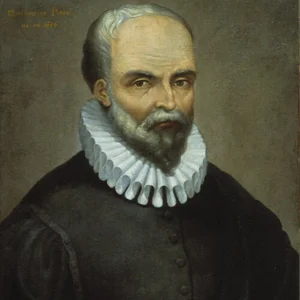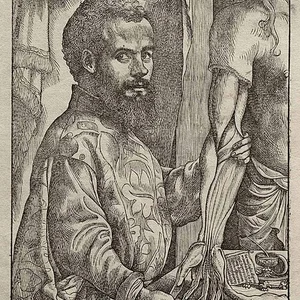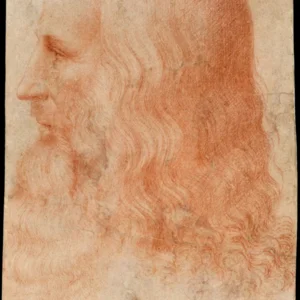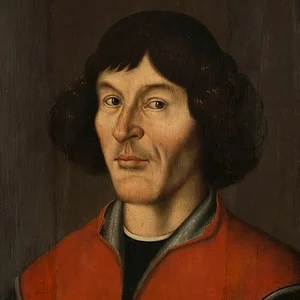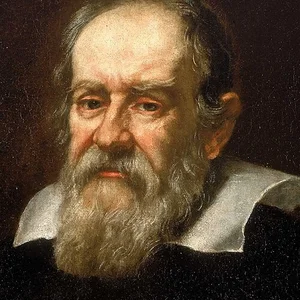

Italian physicist, astronomer, and philosopher (1564–1642), Galileo revolutionized science by combining experimental observation with mathematics. Inventor of the astronomical telescope and champion of the heliocentric model, he laid the foundations of modern physics despite being tried by the Inquisition.
Galileo(1564 — 1642)
Galileo Galilei
grand-duché de Toscane, duché de Florence
7 min read
Frequently asked questions
Famous Quotes
« And yet it moves»
« Measure what is measurable, and make measurable what is not so»
« The universe is written in the language of mathematics»
Key Facts
- 1609: Improvement and use of the astronomical telescope to observe the sky
- 1610: Discovery of Jupiter's four moons (the Galilean moons)
- 1632: Publication of the Dialogue Concerning the Two Chief World Systems, supporting heliocentrism
- 1633: Trial before the Roman Inquisition and condemnation to silence
- 1638: Publication of Two New Sciences, laying the foundation of classical mechanics
Works & Achievements
The first treatise describing astronomical observations made with a telescope. It reveals lunar relief features, the moons of Jupiter, and the stellar nature of the Milky Way.
A treatise on scientific method in which Galileo asserts that the book of nature is written in the language of mathematics. Regarded as a manifesto of modern science.
A dialogue comparing the geocentric and heliocentric systems, which led to Galileo's condemnation by the Inquisition. A masterpiece of scientific popularization and argumentation.
A founding work of mechanics and the strength of materials, published in Holland to escape censorship. In it, Galileo establishes the laws of uniformly accelerated motion.
An instruction manual for the proportional compass invented by Galileo, intended for military and practical applications. It reflects his activity as an engineer and inventor.
A series of letters in which Galileo describes his observations of sunspots and deduces the rotation of the Sun, strengthening the arguments against the immutability of the Aristotelian heavens.
Anecdotes
In 1609, Galileo improved a Dutch spyglass to create an astronomical instrument capable of magnifying up to 20 times. With this tool, he discovered the four largest moons of Jupiter, which he named the 'Medicean stars' in honor of his patrons, the Medici of Florence.
During his time in Padua, Galileo reportedly conducted experiments on falling bodies by dropping objects of different masses from a tower. While the episode of the Leaning Tower of Pisa is likely legendary, he did demonstrate through inclined plane experiments that all objects fall at the same speed in the absence of air resistance.
In 1633, following his trial before the Inquisition, Galileo was forced to recant his defense of Copernicus's heliocentric system. Legend has it that he whispered 'Eppur si muove' ('And yet it moves'), but this phrase is not attested by any reliable contemporary source.
Galileo was an accomplished lutenist, trained by his own father Vincenzo Galilei, a renowned musician and music theorist. This musical education likely influenced his mathematical and harmonic approach to natural phenomena.
Having gone blind in the final years of his life, Galileo continued to work with the help of his disciples, notably Vincenzo Viviani and Evangelista Torricelli. He dictated his last reflections on mechanics from his residence in Arcetri, near Florence, where he was under house arrest.
Primary Sources
Galileo describes his first observations through the astronomical telescope: the mountains of the Moon, stars invisible to the naked eye, and the four moons of Jupiter, overturning Aristotelian cosmology.
In the form of a dialogue between three characters, Galileo compares the Ptolemaic and Copernican systems, demonstrating the superiority of the heliocentric model. This book directly led to his trial before the Inquisition.
Galileo lays the foundations of modern mechanics and the strength of materials, formulating the laws of falling bodies and the parabolic motion of projectiles.
Galileo defends the compatibility between science and Scripture, asserting that the Bible teaches "how to go to heaven, and not how the heavens go". This text constitutes a major plea for the autonomy of scientific inquiry.
Key Places
Galileo's birthplace, where he studied at the university and where legend places his experiments on falling bodies from the famous leaning tower.
Galileo taught mathematics there from 1592 to 1610, a period he himself described as the "eighteen best years of his life". He conducted his most fruitful research there.
The residence where Galileo was placed under house arrest following his condemnation in 1633, and where he spent the last years of his life, gradually going blind.
The site of Galileo's trial in 1633, where he was forced to abjure his defense of heliocentrism before the tribunal of the Inquisition.
The church where Galileo has rested since 1737, in a monumental tomb erected opposite that of Michelangelo, after the Church had long refused him an honorable burial.
Typical Objects

Optical instrument perfected by Galileo in 1609, composed of lenses inside a lead tube. It was with this tool that he discovered the moons of Jupiter and the phases of Venus.

Experimental device used by Galileo to study falling bodies by slowing down the motion. He would roll bronze balls along it and measure time with a water clock.

Calculating instrument invented by Galileo around 1597, used for surveying and ballistics applications. He derived an income from it by selling the device and giving lessons on its use.

Stringed musical instrument that Galileo played with great skill, a heritage from his father Vincenzo Galilei. Music nourished his sensitivity to mathematical ratios in nature.
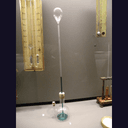
Forerunner of the thermometer, designed by Galileo around 1593, consisting of a glass tube and glass bulbs suspended in a liquid. It allowed temperature variations to be observed.
📷 CC BY-SA 3.0 · Wikimedia Commons ↗
Writing tools indispensable to Galileo, who maintained an extensive correspondence with scholars across Europe and wrote his treatises in Italian rather than Latin.
School Curriculum
Vocabulary & Tags
Key Vocabulary
Tags
Époque
Daily Life
Morning
Galileo rose at dawn in his villa at Arcetri and devoted his first hours to correspondence with European scholars. He dictated his letters and reflections to his disciples as his eyesight declined. A frugal breakfast of bread, cheese, and fruit accompanied these morning activities.
Afternoon
The afternoon was dedicated to experiments and observations. Galileo conducted mechanics trials with inclined planes and pendulums, or polished his lenses to improve his optical instruments. He sometimes received visitors — students or correspondents who had come from all over Italy.
Evening
In the evening, when the sky was clear, Galileo pointed his telescope at the heavens to observe Jupiter, Venus, or the Moon. He took detailed notes and made precise sketches of his observations. He would sometimes relax by playing the lute before retiring for the night.
Food
Galileo's diet was typical of 17th-century Tuscany: bread, olive oil, vegetables, cheeses, and roasted meats. He was particularly fond of Tuscan wine, especially the Trebbiano from the Florence region. Fruits, legume soups, and pasta rounded out his meals.
Clothing
Galileo wore the classic attire of an Italian court professor and philosopher: a long black or dark robe, a doublet, and a turned-down white collar. As mathematician to the Grand Duke of Tuscany, he donned more refined garments for official audiences.
Housing
Galileo lived in several residences over the course of his life, but his most famous home is the Villa Il Gioiello in Arcetri, on the hills above Florence. It was a modest house surrounded by vines and olive trees, close to the convent where his daughter Virginia (Sister Maria Celeste) lived.
Historical Timeline
Period Vocabulary
Visual Style
Un style visuel inspiré de la peinture italienne baroque avec des clairs-obscurs chaleureux, des tons ocre et terre de Sienne, mêlant l'architecture toscane, les instruments scientifiques en laiton et les ciels étoilés.
Sound Ambience
L'atmosphère sonore évoque le cabinet de travail d'un savant toscan du XVIIe siècle : le calme studieux d'une villa toscane ponctué par les cloches de Florence, le son d'instruments scientifiques et la musique d'un luth.
Liens externes & ressources
Références
Œuvres
Sidereus Nuncius
1610
Il Saggiatore (L'Essayeur)
1623
Dialogo sopra i due massimi sistemi del mondo
1632
Discorsi e dimostrazioni matematiche intorno a due nuove scienze
1638
Le operazioni del compasso geometrico e militare
1606
Lettere sulle macchie solari (Lettres sur les taches solaires)
1613