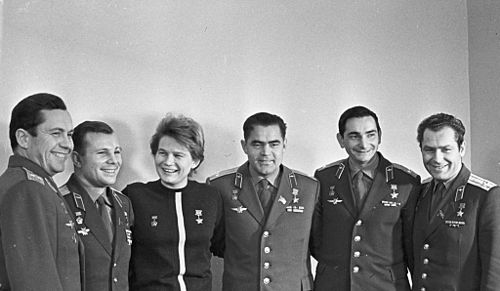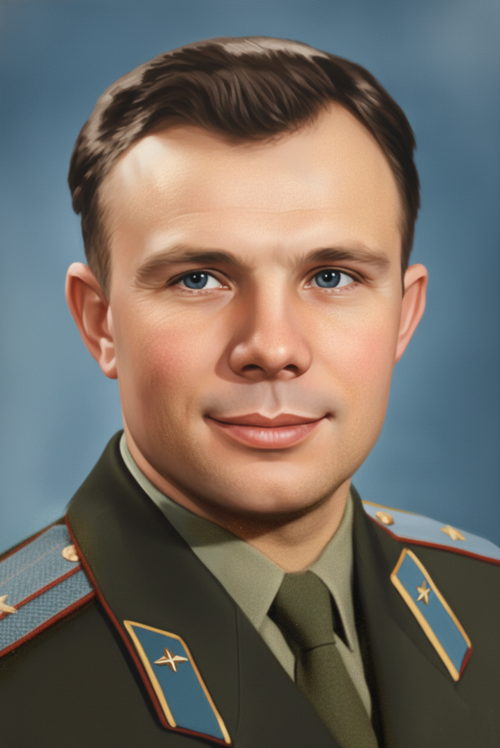
Yuri Gagarin(1934 — 1968)
Yuri Gagarin
Union soviétique
8 min read
A Soviet military pilot, Yuri Gagarin became on April 12, 1961, the first human being to travel in space aboard Vostok 1. His 108-minute flight around the Earth marked a decisive milestone in the space race and the Cold War.
Frequently asked questions
Famous Quotes
« The Earth is blue. How wonderful. It is amazing. »
« I see the Earth! It is so beautiful! »
Key Facts
- April 12, 1961: first crewed spaceflight aboard Vostok 1
- 108-minute flight, one complete orbit around the Earth at an altitude of 327 km
- Born on March 9, 1934, in Klushino (USSR), from a peasant family
- Died on March 27, 1968, in a plane crash during a training flight
- Global ambassador for peace after his historic flight, celebrated in numerous countries
Works & Achievements
The first human spaceflight: 108 minutes, one complete orbit of the Earth at a maximum altitude of 327 km. A major scientific achievement and defining symbol of the Cold War.
An autobiographical account written shortly after his historic flight, recounting his childhood, his training as a pilot, and his space mission. Translated into numerous languages and distributed worldwide.
Gagarin traveled to more than 30 countries as an ambassador for the USSR, meeting heads of state and millions of people. He became the human, approachable face of Soviet communism.
Appointed deputy director of Star City, Gagarin trained and mentored new generations of Soviet cosmonauts while actively advocating for spaceflight safety.
Gagarin was designated as the backup for Soyuz 1. Following the death of his fellow cosmonaut Komarov during that flight, he became deeply involved in efforts to improve the reliability of the Soviet space program.
Anecdotes
At the moment of the Vostok 1 launch on April 12, 1961, Gagarin cried out "Поехали!
(
Poyekhali!
—
Let's go!
). This word
spoken from the capsule as the engines ignited
became the rallying cry of the Soviet space conquest and is today etched into the history of human exploration.
After re-entering the atmosphere, Gagarin did not land inside his capsule: the recovery system of Vostok 1 was not reliable enough. At roughly 7 kilometers altitude, he ejected and parachuted down separately. Landing in a field near Engels, he was greeted by a peasant woman and her daughter who, seeing his orange spacesuit and helmet, could hardly believe he was Soviet.
Yuri Gagarin was born in a rural village in the Smolensk region, into a modest family of carpenter-collective farm workers. During World War II, Nazi soldiers occupied their home and the family had to survive in a small dugout shelter. This difficult childhood shaped the character of the future cosmonaut.
Gagarin stood just 1.57 meters tall, which was a real advantage for fitting inside the extremely cramped Vostok capsule. His selectors also valued his optimistic personality, intellectual curiosity, and ability to remain calm under extreme stress — qualities tested through numerous intensive medical and psychological examinations.
After his historic flight, Gagarin became a global celebrity, visiting more than 30 countries in two years and received by heads of state and cheering crowds. But the fame weighed on him: he was no longer allowed to fly solo, for fear that an accident would be a disaster for Soviet propaganda. He ultimately died during a training flight in 1968, at just 34 years old.
Primary Sources
I looked through the porthole and could see the Earth, my beloved Earth. It was so beautiful, so delicately wrapped in its bluish veil. I felt deeply moved.
Zarya-1, this is Kedr. Poyekhali! I feel perfectly well. The flight is proceeding normally. I can see the Earth. Visibility is good.
The sky in space is absolutely black. The Earth is surrounded by a luminous bluish halo. I observed no visible borders from orbit. The Earth is round — there is no doubt about it.
Orbiting the Earth, I thought about the immensity of what humanity had just accomplished. The cosmos is within humanity's reach. Now we must keep moving forward.
Key Places
Small rural village where Yuri Gagarin was born on March 9, 1934, into a peasant family. Occupied by the Germans during the war, this harsh place left a deep mark on his childhood.
Soviet launch facility from which Vostok 1 lifted off on April 12, 1961. It was here that Gagarin uttered his famous "Poyekhali!" and left Earth to enter the history books.
Farmland where Gagarin parachuted down after ejecting from the Vostok 1 capsule at high altitude. He was greeted by astonished peasant women before military recovery teams arrived.
Secret training center for Soviet cosmonauts where Gagarin underwent intensive preparation and lived with his family. After his flight, he also directed the training of subsequent generations of cosmonauts there.
Site of the triumphant parade held in Gagarin's honor on April 14, 1961, two days after his flight. Millions of Soviet citizens cheered him as a national hero in front of Khrushchev.