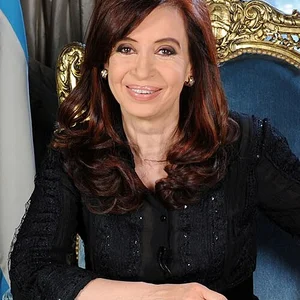

Argentine lawyer and politician, she was the first woman elected president of Argentina (2007–2015). Wife of President Néstor Kirchner, she embodied Kirchnerism, a left-wing Peronist movement, before becoming vice-president (2019–2023).
Cristina Kirchner(1953 — ?)
Cristina Fernández de Kirchner
Argentine
8 min read
Frequently asked questions
Key Facts
- Born on 19 February 1953 in La Plata, Argentina
- Elected President of the Argentine Republic in 2007 — the first woman to reach that office through election
- Re-elected in 2011 with 54% of the vote in the first round
- Her husband and predecessor, Néstor Kirchner, died in office in October 2010
- Vice-president under Alberto Fernández from 2019 to 2023; convicted in 2022 for corruption in the Patagonian public works case
Works & Achievements
A universal allowance paid to families with children not covered by social security, created by presidential decree under her administration. It benefits millions of Argentine families living in precarious conditions and is considered the most emblematic social measure of Kirchnerism.
Passed under her presidency, Argentina became the first country in Latin America to legalize same-sex marriage. The law was internationally celebrated as a landmark achievement for LGBTQ+ rights.
The Argentine state repurchased 51% of the national oil company YPF from the Spanish firm Repsol, in the name of energy sovereignty. This decision came to symbolize CFK's interventionist economic policy.
The national airline, privatized in the 1990s, was bought back by the Argentine state during her first presidency. The move responded to strong demands from labor unions and nationalist sentiment.
An autobiographical book published ahead of the 2019 election campaign, in which CFK reflects on her terms in office, her personal life, her grief over Néstor's death, and the legal cases she views as political persecution. It sold hundreds of thousands of copies in Argentina.
As vice president under Alberto Fernández, CFK influenced negotiations that led to the restructuring of the $57 billion debt taken on by Macri with the IMF, pushing back repayment deadlines to ease pressure on the Argentine economy.
Anecdotes
Cristina Fernández de Kirchner is the first woman to have been elected president of Argentina, in 2007 — an important distinction from Isabel Perón, who came to power in 1974 through succession rather than the ballot box. Her first-round victory with 45% of the vote marks a historic turning point for Argentine democracy and gender equality in Latin America.
When her husband Néstor Kirchner suddenly died of a heart attack on October 27, 2010, Cristina Kirchner mourned publicly for several months, always appearing dressed in black at official engagements. This episode profoundly shook the country's political life and reinforced the image of a woman who was both powerful and grief-stricken.
On September 1, 2022, a man pointed a loaded pistol directly at Cristina Kirchner's face outside her Buenos Aires residence as she greeted supporters. The weapon misfired twice and did not go off. This failed assassination attempt, filmed live, sent shockwaves through Argentina and across Latin America.
A trained lawyer, Cristina Kirchner is famous for her marathon speeches — sometimes three to four hours long — broadcast as a *cadena nacional*, meaning a mandatory interruption across every radio and television channel in the country. Her supporters follow them with passion; her opponents dread them for their length.
In 2012, under her presidency, the Argentine state renationalized YPF, the country's main oil company, buying back the majority stake held by the Spanish firm Repsol. This decision, loudly applauded by Kirchner supporters, drew criticism on the international stage and exemplifies the economic sovereignty policy that Cristina Kirchner championed throughout her terms in office.
Primary Sources
“I governed with the conviction that the State must be the instrument for redistributing wealth and protecting the most vulnerable. This is not demagoguery: it is justice.”
“I will govern for all Argentines, without distinction of party, because the homeland belongs to everyone and not to a few.”
“YPF was and will once again become the instrument of our people’s energy sovereignty.”
“Hatred will not prevail. They may try to silence my voice, but this people is stronger than any bullet.”
“This trial is a judicial persecution orchestrated by my political adversaries. History will vindicate me.”
Key Places
Birthplace of Cristina Kirchner, born on February 19, 1953. She studied law at the National University of La Plata, where she became politically active from an early age.
Seat of Argentina's executive power, from which CFK governed as president from 2007 to 2015. It is from the balcony of this pink palace that she addressed the crowds gathered on the Plaza de Mayo.
A city in Patagonia where Cristina and Néstor Kirchner settled after their studies and began their careers as lawyers and then local politicians. It is the birthplace of Kirchnerism.
A tourist town in Patagonia where the Kirchner couple owned the Los Sauces hotel and other properties. This real estate portfolio lies at the heart of the fraud cases that led to CFK's conviction in 2022.
An upscale residential neighborhood in Buenos Aires where CFK has lived since leaving office. It was outside her apartment on Juncal Street that the failed assassination attempt took place on September 1, 2022.
Typical Objects

Cristina Kirchner is well known for her pronounced taste for fashion and luxury accessories, which stands in stark contrast to the Peronist discourse of social justice. Her Hermès Birkin bags, valued at several thousand euros, are regularly discussed in the Argentine press.

Trained as a lawyer, Cristina Kirchner practiced law in Río Gallegos before entering politics. Her legal background shapes her public speeches, which are often highly technical on matters of law.

A symbol of her lengthy addresses broadcast as cadena nacional (mandatory nationwide broadcasts), the microphone embodies her use of speech as a tool of governance and popular mobilization.

Like most Argentines, CFK is a devoted mate drinker — a traditional infusion consumed from a gourd through a metal straw called a bombilla. The drink is a powerful marker of cultural identity and everyday sociability in Argentina.

In her offices and at her rallies, portraits of the Perón couple are a common sight, evoking the Peronist legacy she claims as her own and the guiding figure of Evita, to whom she is sometimes compared.

Very active on social media, particularly Twitter/X, CFK makes heavy use of digital tools to share her statements, comment on current events, and bypass outlets she considers hostile to her.
School Curriculum
Vocabulary & Tags
Key Vocabulary
Tags
Daily Life
Morning
Cristina Kirchner is known for being a night owl and late riser: her days often begin late in the morning. She typically starts by reading the Argentine and international press before moving on to her first political or legal appointments.
Afternoon
The afternoon is devoted to meetings with her advisors, political audiences, and — during her presidencies — official ceremonies at the Casa Rosada. She frequently prepares her speeches with a communications team, working over every word of her addresses.
Evening
A committed night owl, CFK extends her activities well past midnight: meeting with close associates or political allies, drafting posts for social media, or working through her legal files. She is known for sending late-night tweets that regularly make front-page news the following morning.
Food
Like most Argentines, she drinks mate throughout the day, the cornerstone beverage of popular culture. Her diet includes Argentine staples: *asado* (barbecue), *empanadas*, and *dulce de leche*. She does not follow any particularly restrictive eating regime.
Clothing
CFK is one of the most commented-upon political figures for her fashion choices in Latin America: brightly colored suits by European or Argentine designers, luxury handbags, and prominent jewelry. Her polished, unapologetic look is read as an assertion of her personality and a deliberate break from the austere image of the traditional left-wing activist.
Housing
During her presidencies, CFK resided at the presidential residence in Olivos, on the outskirts of Buenos Aires. After her terms in office, she moved into an apartment in the upscale Recoleta neighborhood of Buenos Aires, and also owns a property in El Calafate in Patagonia, which has been at the center of several legal proceedings.
Historical Timeline
Period Vocabulary
Liens externes & ressources
Références
Œuvres
Asignación Universal por Hijo (AUH)
2009
Loi sur le mariage pour tous (Ley 26.618)
2010
Renationalisation de YPF
2012
Renationalisation d'Aerolíneas Argentinas
2008
Sinceramente (mémoires politiques)
2019
Accord de restructuration de la dette avec le FMI
2020