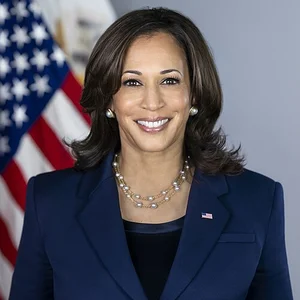

Kamala Harris is an American politician, the first woman, first Black person, and first American of South Asian descent to become Vice President of the United States in 2021. A former Attorney General of California and U.S. Senator, she represents a historic turning point in American political representation.
Kamala Harris(1964 — ?)
Kamala Harris
États-Unis
9 min read
Frequently asked questions
Famous Quotes
« While I may be the first woman in this office, I will not be the last.»
« You may be the first to do many things, but make sure you are not the last.»
Key Facts
- 1964: Born in Oakland, California, to immigrant parents (Jamaican and Indian)
- 2011–2017: Attorney General of California, the first woman and first Black person to hold that position in the state
- 2017–2021: U.S. Senator representing California in Congress
- January 2021: Inaugurated as the 49th Vice President of the United States alongside Joe Biden
- 2024: Democratic candidate for the presidential election, defeated by Donald Trump
Works & Achievements
Book published while she was District Attorney of San Francisco, in which she advocates for an approach to criminal justice centered on prevention and rehabilitation rather than mass incarceration. A foundational work of her reformist political vision.
Political memoir tracing her journey from a bicultural childhood to the United States Senate. A New York Times bestseller translated into numerous languages, it has become a teaching resource in American classrooms on citizenship and representation.
An illustrated children's book in which she draws on her own experience to show that everyday heroes can be found in families, neighborhoods, and schools. Published simultaneously with her adult autobiography.
As Attorney General of the largest U.S. state, she negotiated a $20 billion settlement against major banks in the wake of the subprime mortgage crisis (2012) and defended the Affordable Care Act before federal courts.
Federal bill co-drafted with fellow senators to reform American policing practices following the murder of George Floyd. Though blocked in the Senate, it laid the groundwork for the national debate on police reform and racial justice.
Anecdotes
The daughter of an Indian researcher and a Jamaican economist, Kamala Harris grew up in Oakland, California, in a home where two cultures intertwined. From childhood, she took part with her mother in civil rights marches in Berkeley, pushed along in her stroller during demonstrations. Her mother would tell her: “Kamala, you didn't fall out of the sky” — a way of reminding her that she was the product of all the struggles that had come before her.
As a student at Howard University, a historically Black university in Washington D.C., Kamala Harris joined the first Black sorority in the United States, Alpha Kappa Alpha, founded in 1908. It was there that she adopted white pearls as a symbolic accessory, worn at her 2021 inauguration as a tribute to this founding sisterhood. She also forged her political convictions and activist networks there.
On January 20, 2021, as she was sworn in as Vice President of the United States, Kamala Harris wore a purple suit — a color created by blending Republican red and Democratic blue, a symbol of national unity. She placed her hand on two Bibles: that of Black Supreme Court Justice Thurgood Marshall and that of Regina Shelton, a woman who had cared for her as a child. This meticulously prepared gesture encapsulated an entire collective history.
During her tenure as California's Attorney General (2011–2017), Kamala Harris refused to defend the death penalty in several high-profile cases, at the risk of alienating part of her electorate. She established job reintegration programs rather than resorting to the systematic incarceration of petty offenders. This vision, summarized in her book Smart on Crime, earned her as much admiration as fierce criticism.
During the Senate confirmation hearings for Supreme Court Justice Brett Kavanaugh in 2018, Kamala Harris established herself as a formidable questioner: her precise and methodical lines of inquiry — those of a former prosecutor — kept viewers riveted for hours. Videos of her exchanges were watched millions of times, making her a national figure well beyond the Senate chamber.
Primary Sources
I am the daughter of immigrant parents who believed deeply in what American democracy had to offer — and who taught me that I had a duty to fight for it to keep its promises.
I may be the first woman to hold this office, but I won't be the last. Because every little girl watching tonight sees that this is a country of possibilities.
Being tough on crime is not enough. You have to be smart on crime — by addressing root causes and offering alternatives to systematic incarceration.
The right to vote is the foundation of our democracy. When we allow it to be suppressed, we allow democracy itself to be suppressed.
Key Places
Kamala Harris's hometown, Oakland is shaped by the civil rights movement and a strong cultural diversity. It was in this environment that she was raised by her mother, an Indian researcher committed to social justice causes.
A historically Black university (HBCU) where Kamala Harris earned her bachelor's degree in 1986. It was there that she shaped her activist identity, joined the Alpha Kappa Alpha sorority, and forged lasting ties with the African American community.
The law school where she earned her J.D. in 1989 before beginning her career as a deputy district attorney. This rigorous legal training would shape her entire public career, from criminal justice to the Senate.
Her main workplace as a senator (2017–2021) and then as vice president (2021–2025). On January 20, 2021, she was sworn in as vice president there; on January 6, 2021, she certified the electoral results despite the assault on the building by rioters.
The official residence of the Vice President of the United States, where Kamala Harris and her husband Doug Emhoff lived from 2021 to 2025. It is the first official home to have been occupied by a female vice president in all of American history.
Typical Objects

A symbol of the Alpha Kappa Alpha sorority she joined at Howard University, white pearls became her signature accessory. She wore them at her 2021 inauguration as a tribute to the Black women who came before her in the struggle for equality.

Throughout the 2020 election campaign, Kamala Harris regularly wore Converse shoes, including in official photos. These sneakers, a deliberate symbol of approachability, became a recognizable marker of her public image.

As Vice President, she presides over the U.S. Senate and holds the tie-breaking vote. The gavel she wields during sessions symbolizes an institutional power unprecedented for a woman in American history.

At her swearing-in, she took the oath on the personal Bible of Thurgood Marshall, the first Black Justice of the U.S. Supreme Court. This deliberate choice rooted her entry into office in the long history of the civil rights movement.

The purple suit by designer Christopher John Rogers she wore at the January 20, 2021 inauguration drew widespread attention: purple, born from blending Democratic blue and Republican red, sent a message of national unity after a period of intense political division.

Her political autobiography, published in 2019, traces her journey from the daughter of immigrants to the U.S. Senate. Translated into several languages, it has been read in American classrooms as a testament to citizenship, justice, and access to public office.
School Curriculum
Vocabulary & Tags
Key Vocabulary
Tags
Daily Life
Morning
Kamala Harris is known for her active mornings — she regularly goes jogging and lifts weights, often in Converse sneakers. Before heading to the office, she dedicates time to reading the morning briefings prepared by her team of advisors.
Afternoon
Her afternoons are filled with meetings at the Office of the Vice President, Senate committee hearings, or official travel across the United States and abroad. As President of the Senate, she also casts tie-breaking votes.
Evening
Evenings are often reserved for family life with her husband Doug Emhoff, a lawyer who became the first “second gentleman” in American history. She enjoys cooking Indian dishes inspired by her mother's recipes and occasionally hosts political officials at their official residence.
Food
Kamala Harris has frequently spoken about the culinary influence of her Indian mother, Shyamala Gopalan: she regularly prepares curries, dals, and other spicy South Asian dishes. She also has a fondness for African-American soul food, a legacy of her childhood in California.
Clothing
Her wardrobe is carefully considered: structured suits in symbolic colors (white for women's suffrage, purple for bipartisan unity, black for authority), always paired with her signature white pearls. For informal occasions or on the campaign trail, she readily opts for jeans and Converse.
Housing
From 2021 to 2025, she resided at One Observatory Circle, the official residence of the Vice President, in the Massachusetts Heights neighborhood of Washington D.C. — a Victorian villa set within a park, provided by the federal government.
Historical Timeline
Period Vocabulary
Liens externes & ressources
Références
Œuvres
Smart on Crime: A Career Prosecutor's Plan to Make Us Safer
2009
The Truths We Hold: An American Journey
2019
Superheroes Are Everywhere
2019
Mandat de procureure générale de Californie
2011-2017
Co-auteure du Justice in Policing Act
2020