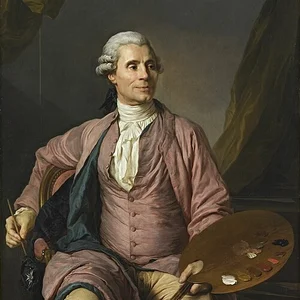

French painter (1716–1809), forerunner of Neoclassicism and master of Jacques-Louis David. Director of the French Academy in Rome, then First Painter to the King and senator under Napoleon.
Joseph-Marie Vien(1716 — 1809)
Joseph-Marie Vien
France
9 min read
Frequently asked questions
Key Facts
- Born in Montpellier in 1716, died in Paris in 1809
- Prix de Rome in 1743, resident at the French Academy in Rome
- Director of the French Academy in Rome from 1775 to 1781
- Master of Jacques-Louis David, whom he trained in Rome
- Appointed First Painter to King Louis XVI in 1789, then count and senator under Napoleon
Works & Achievements
An emblematic painting of the return to Antiquity, inspired by a fresco from Herculaneum depicting a woman selling winged Cupids in a cage. Acquired for Madame du Barry, it stands alone as a symbol of the neoclassical turn in French painting.
A large composition commissioned for the Cathedral of Notre-Dame de Paris, demonstrating Vien's mastery of history painting with moral and religious themes. Diderot praised it in his *Salons* as a welcome return to the grandeur of Antiquity.
A companion piece to *The Cupid Seller* presented at the same Salon, showing a young Greek woman in a pose borrowed from Antiquity. It reinforced Vien's reputation as the initiator of the neoclassical movement in France.
A biblical composition in which the female figure, treated with the antique sobriety characteristic of Vien, contrasts with the sensual nudes of the then-dominant Rococo style. It illustrates the artist's moral and aesthetic approach.
A late allegorical composition and one of Vien's last major works before the Revolution, revealing the enduring strength of his attachment to mythological themes treated in a resolutely antique spirit.
A history painting depicting a theme of Roman civic virtue, directly aligned with the moral ideals of the Enlightenment. It foreshadows the great paintings on antique subjects that David would bring to their peak in the decades that followed.
Anecdotes
In 1763, Vien presented at the Paris Salon his celebrated painting 'The Cupid Seller', directly inspired by a fresco discovered at Herculaneum and published in the collection of Herculaneum antiquities. This work, acquired for Madame du Barry's pavilion at Louveciennes, marked a clear break with the Rococo style and heralded the return to the Antique that would dominate European painting for half a century.
Vien was one of the first French artists to attempt to revive the ancient technique of encaustic painting, a process using molten wax as a binder for pigments. Encouraged by the Comte de Caylus, a great connoisseur of antiquities, he carried out several experiments in this extremely rare technique, arousing the curiosity of Parisian scholarly circles and proving that his interest in the Antique went far beyond mere formal imitation.
When Vien took over the directorship of the Académie de France in Rome in 1775, he brought with him a young, ambitious, and difficult painter named Jacques-Louis David. Vien passed on to him his passion for the Antique and his rigor in draughtsmanship, little suspecting that this turbulent pupil would become the most influential painter of his era, permanently eclipsing the glory of his own master in the history books.
Born under Louis XIV, Vien traversed almost the entire eighteenth century and survived the Revolution, the Terror, the Directory, and the Consulate. Napoleon, full of admiration for this exceptional longevity, made him a senator in 1799 and then a count of the Empire in 1808 — when Vien was approaching ninety-three years of age. He died in 1809, laden with honors under four radically different political regimes, making him a living symbol of French artistic continuity.
At the Salon of 1767, Vien presented a monumental canvas commissioned for Notre-Dame de Paris depicting 'Saint Denis Preaching to the Gauls'. Diderot, that feared critic of the Salons, hailed this work as a welcome return to the moral grandeur of history painting, a break from the pastoral scenes and courtly vignettes that had, in his view, cluttered the walls of Parisian galleries for far too long.
Primary Sources
I take every care to train the young pensioners entrusted to me in the taste for the antique and for beautiful nature, convinced that this is the only path to restore French painting to its true greatness.
M. Vien's The Cupid Seller is a most agreeable composition, drawn from the antique with wit; its colour is gentle, the draughtsmanship correct, and one senses throughout the work of a man well versed in the masterpieces of Rome.
M. Vien was received as a member of the Academy following the presentation of his reception piece, which was judged satisfactory by the assembly and deposited in the company's collections.
M. Vien, newly appointed director, took up his duties at the Villa Medici and immediately established stricter working rules for the pensioners, insisting on drawing from the antique as the foundation of any serious training.
Key Places
Birthplace of Joseph-Marie Vien, born on June 18, 1716. He received his first drawing lessons there before moving to Paris to further his training at the Académie royale de peinture.
Home of the Académie de France in Rome, where Vien first stayed as a resident student (1744–1750) and later returned as director (1775–1781). It was here that he mentored Jacques-Louis David and fully rooted his style in admiration for Antiquity.
The Louvre housed the studios and apartments of royal artists. Vien took up residence there from 1781 as premier painter to the king, with a large studio where he received patrons, students, and collectors.
The hall where the official Salons of the Académie royale were held — biennial and later annual exhibitions that were the main event in Parisian artistic life. Vien exhibited his major works there, including *The Cupid Seller* in 1763.
The pleasure residence of Madame du Barry, favourite of Louis XV, for whom Vien painted *The Cupid Seller* in 1763. This château, a symbol of the emerging Neoclassical taste at court, reflects Vien's influence within the circles closest to royal power.
Typical Objects

The pear-wood palette held carefully arranged pigments — lead white, ochres, Sienna earths, Prussian blue. Sable brushes allowed for the fine glazes and crisp outlines characteristic of Neoclassical painting.

The Comte de Caylus published his "Recueil d'antiquités" between 1752 and 1767, an illustrated encyclopedia of engravings depicting antique vases, statues, and bas-reliefs. These prints served as an indispensable repertory of forms for Neoclassical painters like Vien.

A small heated metal instrument used to spread and melt colored wax in the ancient encaustic technique — a process that Vien and the Comte de Caylus sought to revive. Exceedingly rare in 18th-century France, it bears witness to the artist's archaeological experimentations.

A large-format notebook in which the Academy's fellows drew from antique statues, ruins, and Renaissance masterworks. Vien filled many such notebooks during his stays in Rome, keeping them as a working reference throughout his career.

An official document signed by Louis XVI appointing Vien First Painter to the King in 1781. This title granted lodgings at the Louvre, a royal pension, and authority over the crown's major artistic commissions.

The official garment of senators of the First Empire, in violet embroidered with gold, inspired by Roman Antiquity in keeping with Napoleonic aesthetics. Vien, appointed senator in 1799, wore this toga at the solemn sessions of the Sénat conservateur.
School Curriculum
Vocabulary & Tags
Key Vocabulary
Daily Life
Morning
Vien rose early to make the most of the best natural light in his studio. The first hours were devoted to painting or drawing from a live model, an exercise he considered fundamental and required of his students. In Rome, he personally supervised the work sessions of the resident scholars before breakfast.
Afternoon
In the afternoon, Vien visited museums, archaeological excavations, and ancient ruins — activities he considered essential to the training of a history painter. In Paris, he received patrons, collectors, and fellow artists in his studio at the Louvre, discussed works in progress, and corrected his students' work with a rigor that was widely recognized.
Evening
In the evenings, Vien frequented the literary and artistic salons of Paris, particularly that of the Comte de Caylus, where antiquarians, philosophers, and artists debated classical aesthetics. He read the works of Winckelmann and recent archaeological publications, constantly feeding his reflection on ideal beauty.
Food
Like most academic artists of his era, Vien had a light breakfast of bread, cheese, and coffee around ten o'clock, followed by a hearty dinner in the late afternoon. In Rome, he enjoyed pasta, local vegetables, and wine; in Paris, the bourgeois cuisine of roasted meats, soups, and pastries.
Clothing
In the studio, Vien wore a linen smock or apron over his everyday clothes to protect them from paint and varnish stains. At academic ceremonies, he wore formal court dress; under the Empire, the violet gold-embroidered toga of a senator and the attire of a count on official occasions.
Housing
During his stays in Rome, Vien lodged at the Villa Medici, the official residence of the Académie de France on the Pincian Hill, enjoying an exceptional panoramic view of the Eternal City. In Paris, he was granted official lodgings in the Louvre palace from 1781, a royal privilege accorded to the king's first painters, with a large studio overlooking the courtyard.
Historical Timeline
Period Vocabulary
Liens externes & ressources
Références
Œuvres
La Vertueuse Athénienne
1763
Suzanne au bain
vers 1760
L'Amour fuyant la servitude
1789