 flip
flipRye Flatbread, in Memory of the Witch Cake
Rye Flatbread, in Memory of the Witch Cake
Why this dish? In February 1692, in Salem Village, a neighbor had the slave Tituba make a "witch cake" of rye meal, meant to reveal who was bewitching the girls — including Ann. This act of folk magic, condemned by Reverend Parris from the pulpit, was one of the sparks of the trials. The flatbread evoked here is honest: it is NOT the ritual (the actual witch cake was not a food), but a humble rye bread that recalls that troubled moment in her life.
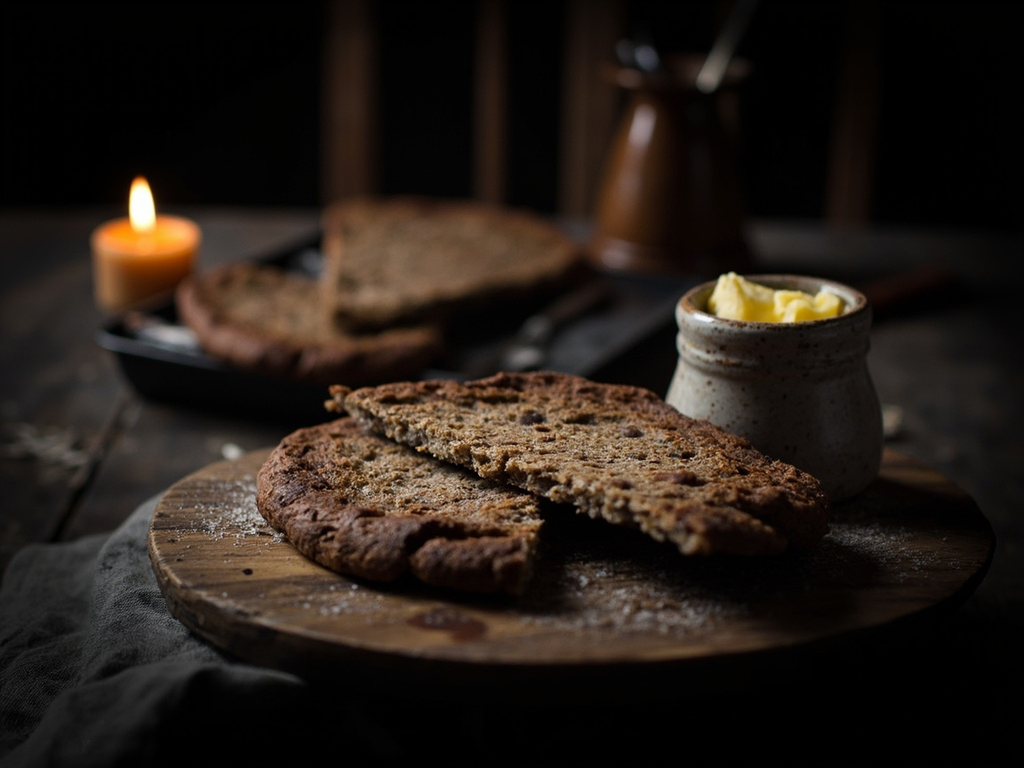
A flat, dense cake of rye flour baked on the hearthstone, with a tight crumb and a rustic, slightly bitter taste. A poor bread, unleavened, carrying the memory of a superstition.
Of this flatbread I speak to you with bowed head, for its name takes me back to my twelfth year and to very dark days. They said then that a rye paste, mixed according to evil practices I dare not repeat, would unmask who tormented us — madness that Reverend Parris denounced from his pulpit as a resort to the Evil One to fight the Evil One. Know then: this is not that malefice, but only the honest rye of our fields, kneaded with water and baked on the hot stone. Break off a piece, and pray for the souls that my misguided youth made to suffer.
- •Rye flour — two handfuls (rustic grain)
- •Water — enough to bind (binder)
- •Salt — a pinch (seasoning)
Rye Flatbread, in Memory of the Witch Cake
A flat, dense cake of rye flour baked on the hearthstone, with a tight crumb and a rustic, slightly bitter taste. A poor bread, unleavened, carrying the memory of a superstition.
Why this dish? In February 1692, in Salem Village, a neighbor had the slave Tituba make a "witch cake" of rye meal, meant to reveal who was bewitching the girls — including Ann. This act of folk magic, condemned by Reverend Parris from the pulpit, was one of the sparks of the trials. The flatbread evoked here is honest: it is NOT the ritual (the actual witch cake was not a food), but a humble rye bread that recalls that troubled moment in her life.
Of this flatbread I speak to you with bowed head, for its name takes me back to my twelfth year and to very dark days. They said then that a rye paste, mixed according to evil practices I dare not repeat, would unmask who tormented us — madness that Reverend Parris denounced from his pulpit as a resort to the Evil One to fight the Evil One. Know then: this is not that malefice, but only the honest rye of our fields, kneaded with water and baked on the hot stone. Break off a piece, and pray for the souls that my misguided youth made to suffer.
Ingredients (period version)
- Rye flour — two handfuls (rustic grain)
- Water — enough to bind (binder)
- Salt — a pinch (seasoning)
Ingredients
- Rye flour — 200 g (rustic grain)
- Warm water — 120 ml (binder)
- Salt — 1/2 tsp (seasoning)
- A little cornmeal — 2 tbsp (optional, "rye and Indian" style) (sweetness and structure)
Method
- Mix the rye flour (and cornmeal if using) with the salt.
- Add warm water gradually and work into a firm but pliable dough, without leavening.
- Shape into a flat cake about 1 cm thick.
- Cook on a hot stone or cast-iron skillet, dry, for about 6 to 8 minutes per side, until set and browned in spots.
- Let cool slightly and break by hand. Eat plain, or spread with a little fat.
How it was made : The actual Salem witch cake was a folk magic counter-spell, not a food: rye meal was mixed with the urine of the "bewitched" and fed to a dog, in the belief it would identify the witch. The Puritan church itself considered it a sin. The flatbread presented here retains only the grain — rye, the ordinary bread of modest New England families, often mixed with corn as "rye and Indian bread."
The contemporary twist : Serve the flatbread warm, just split, with a pat of salted butter — and tell at table the dark side of the 1692 superstitions, keeping the memory of the accused rather than the accusers.
Sources : Marilynne K. Roach, The Salem Witch Trials: A Day-by-Day Chronicle (2002) · Sandra L. Oliver, Food in Colonial and Federal America (2005)
Ann Putnam · Charactorium