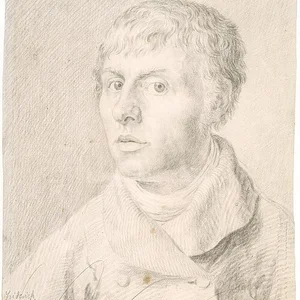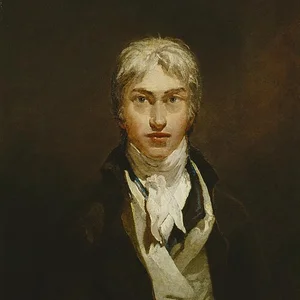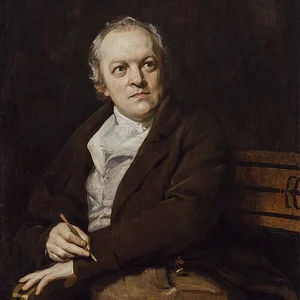

British poet, painter, and engraver (1757-1827), William Blake is one of the towering figures of English Romanticism. A visionary and mystic, he created a strikingly original body of poetic and artistic work, combining text and image in hand-engraved illuminated books.
William Blake(1757 — 1827)
William Blake
Royaume-Uni, royaume de Grande-Bretagne, Royaume-Uni de Grande-Bretagne et d'Irlande
9 min read
Frequently asked questions
Famous Quotes
« The road of excess leads to the palace of wisdom.»
« To see a World in a Grain of Sand, and a Heaven in a Wild Flower.»
« Imagination is not a State: it is the Human Existence itself.»
Key Facts
- 1757: William Blake is born in London
- 1789: Publication of Songs of Innocence, his first collection of illuminated books
- 1794: Publication of Songs of Experience, which includes the famous poem The Tyger
- 1804-1820: Writing of his major prophetic works (Milton, Jerusalem)
- 1827: Blake dies in London, in relative obscurity, his genius recognized only later
Works & Achievements
A poetry collection in two parts, engraved and illuminated by Blake himself, contrasting the purity of childhood with the corruption of the adult world. The poem 'The Tyger' is one of the most celebrated in English poetry, studied in schools around the world.
A major philosophical and satirical work in which Blake overturns conventional moral values by arguing that what is called 'evil' is in reality creative energy. This visionary text anticipates many currents of modern thought.
A prophetic epic celebrating the American Revolution as a liberation from tyranny, featuring the character Orc as a symbol of youthful rebellion. The first of Blake's major 'Prophetic Books', blending personal mythology with contemporary history.
A late masterpiece and monumental mythological epic across 100 engraved plates, tracing the fall and spiritual redemption of Albion, a symbolic figure for England. Considered Blake's most ambitious and complex work.
A series of 21 engravings depicting the biblical figure of Job, commissioned by John Linnell, regarded as the pinnacle of Blake's graphic art. These illustrations reveal his absolute mastery of line and his spiritual vision of human suffering.
An unfinished series of 102 watercolors illustrating Dante's work, begun while Blake was learning Italian at the age of 67. Left incomplete at his death, these pieces bear witness to a creativity and ambition that remained undiminished until the very end of his life.
Anecdotes
At the age of four, William Blake claimed to have seen the face of God pressed against his bedroom window. Far from punishing him, his mother Catherine encouraged his visions, convincing his father not to beat him for what she considered a spiritual gift rather than a lie.
Blake invented a unique printing technique he called 'relief etching' or 'illuminated printing'. He engraved his texts and illustrations in mirror image onto copper plates, applied ink, then hand-colored each page alongside his wife Catherine. Every copy of his books was thus a unique original.
In 1803, Blake was arrested and tried for sedition after ejecting a soldier named John Schofield from his garden. Blake was acquitted, but the incident left a deep mark on him: he saw in the trial a symbolic persecution of the visionary artist by tyrannical power — a central theme throughout his work.
Although virtually unknown to the general public during his lifetime, Blake died singing, according to witnesses at his bedside. He reportedly told his wife Catherine: 'You have ever been an angel to me', before passing away serenely on 12 August 1827, still working on his illustrations of Dante in his final days.
Blake almost never left London, apart from three years spent at Felpham in Sussex (1800–1803). Yet in his work, he created an entire mythological geography complete with imaginary continents, gods, and cosmic battles — proving that imagination could travel without physical limits.
Primary Sources
Tyger Tyger, burning bright, / In the forests of the night; / What immortal hand or eye, / Could frame thy fearful symmetry?
No bird soars too high if he soars with his own wings. / The road of excess leads to the palace of wisdom.
I am not ashamed, afraid, or averse to tell you what Ought to be Told: That I am under the direction of Messengers from Heaven, Daily & Nightly.
I must Create a System or be enslav'd by another Man's. I will not Reason and Compare: my business is to Create.
To generalize is to be an idiot. To particularize is the alone distinction of merit. General knowledges are those knowledges that idiots possess.
Key Places
William Blake's birthplace, in the busy commercial neighbourhood of Soho. It was in this urban London environment that he developed his first mystical visions from childhood.
Blake worked here as a young apprentice engraver under James Basire, sketching medieval tombs and sculptures. This immersion in Gothic art profoundly influenced his monumental visual style and his fascination with the spiritual.
The neighbourhood where Blake lived from 1790 to 1800, the period of his greatest creativity, during which he produced the majority of his Prophetic Books. It was here that he engraved and printed The Marriage of Heaven and Hell and Songs of Experience.
A coastal village where Blake spent three years (1800–1803) under the patronage of William Hayley. He began Jerusalem there and experienced the incident with a soldier named Schofield that led to his trial for sedition.
The address where Blake lived from 1803 to 1821, in relative poverty but continuing to create. He received a number of admiring visitors there, including the painter John Constable and the poet Samuel Taylor Coleridge.
The Nonconformist burial ground where William Blake was interred in 1827, not far from his original grave, which has since been reidentified. This symbolic site also holds the remains of John Bunyan and Daniel Defoe, authors whom Blake greatly admired.
Typical Objects

The central tool of Blake's work, on which he engraved texts and images in mirror using an acid of his own invention. Each plate served as the medium for his 'illuminated books', uniquely combining poetry and visual art.

Blake hand-colored each printed page of his books alongside his wife Catherine, using watercolors and gouache. This artisanal technique made every copy unique — a genuine, one-of-a-kind work of art.

A foundational text for Blake and an inexhaustible source of imagery, symbols, and characters that he reinterpreted through his own mystical vision. He approached it in a deeply personal and unorthodox way, far removed from the religious mainstream of his time.

Blake owned his own hand-operated press, which allowed him to print his works entirely on his own terms. This tool embodies his refusal to depend on publishers and his determination to maintain complete control over his creative output.

Blake filled notebooks with drawings, poems, and philosophical reflections intertwined — most famously the Rossetti Manuscript. These notebooks reveal a mind in constant motion, moving between mystical vision and sharp social criticism.

Blake deeply admired the Italian Renaissance masters and collected engraved reproductions of their work. He stood firmly opposed, however, to oil painting and to artists such as Rubens and Rembrandt, whom he considered too materialistic.
School Curriculum
Vocabulary & Tags
Key Vocabulary
Tags
Daily Life
Morning
Blake rose early, often after nights filled with visions he would hasten to record or sketch. He began his day by reading the Bible or Milton — constant sources of inspiration — before lighting his furnace to heat the acids needed for engraving.
Afternoon
The afternoon was devoted to intensive craft work: etching copper plates, printing at the press, then carefully hand-colouring each page with watercolours alongside Catherine. The couple worked side by side in their modest live-in workshop, producing every page as a unique object.
Evening
In the evenings, Blake wrote his long prophetic poems by candlelight, sometimes conversing with the 'spirits' he claimed to see — Milton, Ezekiel, angels. He occasionally received admiring young artists such as Samuel Palmer or John Linnell, whom he initiated into his mystical vision of art.
Food
Blake and his wife lived simply and often in poverty, subsisting on the frugal meals typical of London artisans of the era: bread, cheese, market vegetables, and light ale. The generosity of a few patrons occasionally allowed them to eat a little better, but luxury never had any place in their daily lives.
Clothing
Blake dressed plainly, in the manner of late eighteenth-century London artisans: dark breeches, a simple cloth coat, a white shirt with a wide collar. He paid little attention to his appearance, preferring to put the household's meagre resources into his engraving materials.
Housing
Blake spent his entire life in modest London lodgings where bedroom and workshop were one and the same. The printing press dominated the main room, the walls were covered with engravings and sketches, and the smell of acid and ink gave these cramped spaces the distinctive atmosphere of an engraver's studio.
Historical Timeline
Period Vocabulary
Visual Style
Le style de Blake se caractérise par des contours noirs affirmés encadrant des figures monumentales aux poses expressives, baignées d'aquarelles lumineuses alliant influences gothiques médiévales et anatomie néoclassique dans une atmosphère mystique et visionnaire.
Sound Ambience
L'univers sonore de Blake mêle le bruit industrieux de Londres — marteaux, presses, voitures — au silence recueilli de son atelier où burin et pinceau composent une œuvre mystique loin du tumulte de la rue.
Liens externes & ressources
Références
Œuvres
Songs of Innocence and of Experience
1789-1794
The Marriage of Heaven and Hell
1793
America: A Prophecy
1793
Jerusalem: The Emanation of the Giant Albion
1804-1820
Illustrations du Livre de Job
1823-1826
Illustrations de la Divine Comédie de Dante
1824-1827