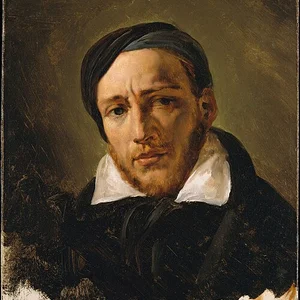

French painter (1791–1824), a major figure of Romanticism. His masterpiece, *The Raft of the Medusa* (1819), marks a break from academic painting through its expressive violence and political engagement.
Théodore Géricault(1791 — 1824)
Théodore Géricault
France
8 min read
Frequently asked questions
Key Facts
- 1791: born in Rouen
- 1819: The Raft of the Medusa exhibited at the Paris Salon
- 1816: the shipwreck of the frigate Méduse inspires his masterpiece
- 1821–1822: stay in England, portraits of the insane
- 1824: dies in Paris at 32 following a horse-riding accident
Works & Achievements
The first major painting Géricault exhibited at the Salon, it reveals his genius for equestrian scenes and dramatic energy. The work earned him a gold medal and immediate recognition in the Parisian art world.
A melancholic companion piece to the Officer of the Chasseurs, this painting was executed during the fall of Napoleon and evokes defeat and disillusionment. It foreshadows the Romantic sensibility through its somber tone and tragic dimension.
Géricault's absolute masterpiece and a pinnacle of French Romanticism, this monumental canvas (7 × 5 m) depicts the survivors of the wreck of the frigate *Méduse* on their raft. Its brutal realism and political engagement mark a definitive break with academic painting.
Painted in England, this work depicts a horse race with striking energy and modernity. The use of the flying gallop (all four legs extended simultaneously) revolutionized the pictorial representation of equestrian movement.
A series of portraits of patients with mental illness, created for the psychiatrist Georget at the Salpêtrière hospital. These works, of exceptional humanity and dignity, are among the first non-caricatural depictions of madness in the history of Western art.
A series of lithographs made in London depicting the misery of the English working classes. These works bear witness to Géricault's social commitment and his interest in artistic reproduction techniques.
Anecdotes
To prepare The Raft of the Medusa, Géricault pushed realism to its limits: he brought amputated limbs and severed heads from Parisian morgues and hospitals to his studio to study the decomposition of flesh. His friends and models were often horrified by the smell that pervaded the studio.
Géricault was so passionate about horses that they became a central theme in his work. This passion proved fatal: he suffered several serious falls from horseback between 1822 and 1823, and the resulting injuries directly contributed to his death at just 32 years old, in January 1824.
During his stay in England (1820–1821), Géricault was one of the first French artists to embrace lithography, a recently invented printing technique. He published a series of lithographs depicting the poverty of London's poor, displaying a social engagement rare among painters of his era.
Between 1822 and 1823, Géricault produced a series of portraits of mentally ill patients interned at the Salpêtrière, at the request of psychiatrist Étienne Georget. These works, known as the “portraits d’aliénés,” are today considered among the first dignified and humanistic representations of mental illness in the history of art.
The wreck of the frigate Méduse in July 1816 had caused a state scandal: the captain, an incompetent aristocrat appointed through favoritism under the Restoration, had abandoned 150 sailors on a raft. By painting this scene in 1819, Géricault deliberately took a political stance against the government, turning a painting into an act of political protest.
Primary Sources
We were heaped upon one another, and fought furiously for space; those at the bottom were crushed under the weight of their companions.
I am working with an ardor that nothing can slow; I want this painting to be something great, something terrible, something that strikes and seizes the viewer.
He kept in his studio human remains from dissecting rooms and hospitals, which he studied with the greatest care in order to render with precision the livid hues of dead flesh.
M. Géricault has exhibited a painting of striking effect and such truthfulness of color and expression that it makes a vivid impression. One sees a group of men on a raft, in the anguish of despair.
Key Places
Géricault's birthplace, born on September 26, 1791 into a prosperous middle-class family. His Norman childhood gave him a taste for landscapes and scenes of everyday life.
Géricault's main creative workspace in Paris, where he prepared The Raft of the Medusa between 1818 and 1819. It was here that he received his models, kept his anatomical studies, and completed his large canvases.
Géricault stayed in Rome in 1816–1817 and studied Michelangelo and Antiquity there. He produced numerous studies of Italian everyday life, including the famous Corsa dei Barberi (race of riderless horses).
Géricault stayed in London from 1820 to 1821, where he exhibited The Raft of the Medusa. There he discovered Constable and Turner, developed an enthusiasm for lithography, and observed the condition of the English working classes.
The Raft of the Medusa, acquired by the French state shortly after Géricault's death, has been held at the Louvre since 1824. It is displayed there as a major masterpiece of French Romanticism.
Typical Objects

Géricault worked with a palette loaded with dark colors — ochres, browns, blacks — for his dramatic compositions. His broad brushes allowed rapid, expressive strokes, far removed from the smooth finish of the academic style.

He constantly filled sketchbooks with drawings: studies of horses, bodies in motion, and intense human expressions. These sketches bear witness to the relentless preparatory work that preceded each major canvas.

Géricault was a pioneer of lithography in France, using polished limestone to engrave his compositions and reproduce them in multiple copies. He notably published his *Various Subjects from the Life and Deaths* in London.

For *The Raft of the Medusa*, he kept amputated limbs and heads from the morgue or hospitals in his studio, in order to study with precision the color and texture of dead flesh.

An passionate horseman, Géricault owned his own horse and rode regularly, feeding his observation of animals into his painting. This equipment was a constant presence in his daily life.

His personal collection of prints after Rubens, Michelangelo, and Gros served as a constant source of inspiration. The study of the old masters through engraving was central to the training of painters of the era.
School Curriculum
Vocabulary & Tags
Key Vocabulary
Daily Life
Morning
Géricault rose early and devoted the first hours of the day to study and preparation. When working on a major project such as *The Raft of the Medusa*, he would spend his mornings visiting hospitals and morgues, sketchbook in hand, drawing sick or dying bodies with rigorous anatomical precision.
Afternoon
Afternoons were dedicated to studio work, often with models he would hold in exhausting poses. Géricault painted with feverish intensity, sometimes for long hours without interruption; his friends reported that he was capable of working for several days on almost no sleep when seized by inspiration.
Evening
Evenings were a chance to meet up with artist friends — including Delacroix, his admiring younger contemporary — in Parisian cafés or salons, where art, politics, and Romantic literature were passionately debated. An avid horseman, he also rode at the end of the day, a practice that let him observe the animals' movements for his paintings.
Food
Like most artists of his bourgeois milieu, Géricault ate well but without excess. During periods of intense work, he sometimes skipped meals, preferring to remain in his studio. In England, he discovered London taverns and the more generous eating habits of the working classes he observed there.
Clothing
Géricault dressed in the Romantic fashion of his era: dark frock coat, high cravat, and riding boots that reflected his equestrian passion. He was not particularly elegant, but took care with his appearance when moving in Parisian social circles or artistic gatherings.
Housing
He had a large studio in Paris — an essential condition for painting monumental canvases. The space was cluttered with canvases, sketches, anatomical casts, and sometimes human remains preserved for study, to the considerable discomfort of unsuspecting visitors.
Historical Timeline
Period Vocabulary
Liens externes & ressources
Références
Œuvres
Portraits d'aliénés (série)
1822-1823
Divers sujets de la vie et des morts (série de lithographies)
1820-1821