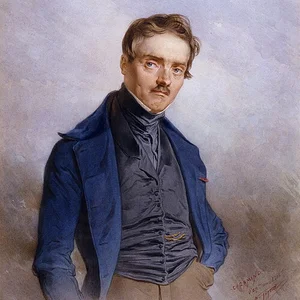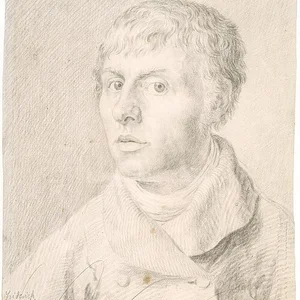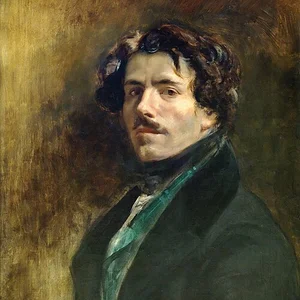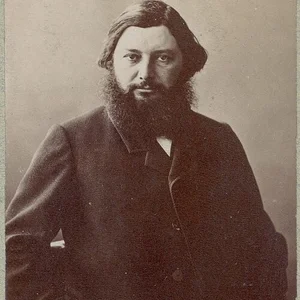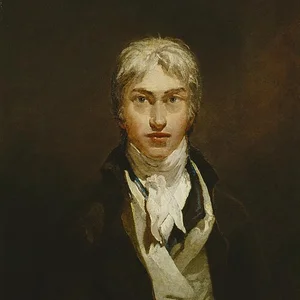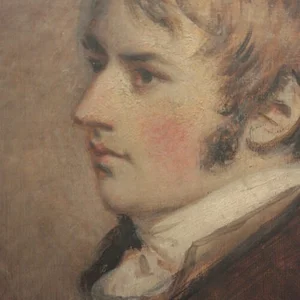

John Constable (1776-1837) was a major English Romantic landscape painter. He revolutionized landscape painting by observing nature directly and depicting atmospheric effects with great fidelity.
John Constable(1776 — 1837)
John Constable
Royaume-Uni, royaume de Grande-Bretagne, Royaume-Uni de Grande-Bretagne et d'Irlande
9 min read
Frequently asked questions
Famous Quotes
« Painting is a science, and should be pursued as an inquiry into the laws of nature.»
« The sky is the chief organ of sentiment.»
Key Facts
- 1776: Born in East Bergholt, Suffolk
- 1821: Submission of The Hay Wain to the Paris Salon, influencing French painters
- 1824: The Hay Wain wins a gold medal at the Paris Salon
- 1829: Elected to the Royal Academy of Arts in London
- 1837: Dies in London
Works & Achievements
Constable's absolute masterpiece, depicting a cart crossing the River Stour near Flatford Mill. Awarded a medal at the Paris Salon in 1824, this painting is now held at the National Gallery in London and is considered one of the most important works in British art.
The first of six large paintings devoted to the River Stour, known as 'six-footers' for their imposing scale. Acquired by his friend John Fisher, this canvas marked the beginning of Constable's public recognition at the Royal Academy.
A view of the family mill on the Stour, painted with remarkable precision and atmospheric freshness. It perfectly illustrates Constable's method: direct observation and faithful rendering of the effects of light and water.
A landscape depicting a Suffolk country lane lined with trees, with a boy drinking from a stream in the foreground. Bequeathed to the National Gallery upon the painter's death, it is now one of his most widely recognized works.
A large composition showing the Gothic cathedral beneath a dramatic rainbow sky. Constable displays his full mastery of atmospheric effects, simultaneously painting an intimate work dedicated to his friend Fisher and a manifesto of his artistic philosophy.
A series of small oil paintings made outdoors on Hampstead Heath, documenting cloud formations with near-scientific precision. Annotated on the reverse with meteorological data, these studies demonstrate Constable's innovative approach and foreshadow the Impressionists' explorations of light.
Anecdotes
In 1824, Constable exhibited three paintings at the Paris Salon, including *The Hay Wain*. The work won a gold medal and drew the admiration of Delacroix, who hastily reworked his own painting *The Massacre at Chios* to incorporate Constable's broken-light technique. This encounter between English and French painting transformed the history of art.
Constable was so obsessed with clouds that he produced hundreds of small-format oil studies of them. On the back of each sketch he noted the wind direction, temperature, and time — an almost scientific approach at a time when modern meteorology did not yet exist. He declared that “the sky is the chief organ of sentiment” in a landscape.
His relationship with Maria Bicknell lasted twelve years before they could marry in 1816. Maria's grandfather, Dr. Rhudde, a wealthy and influential rector, opposed the union with a mere country painter. Constable waited patiently, and the couple eventually married — but Maria died in 1828, aged 41, of tuberculosis, leaving the painter heartbroken for the rest of his life.
Constable was not elected a full member of the Royal Academy until 1829, at the age of 52 — a late age for an artist of his reputation. His rival J. M. W. Turner had been an academician since 1802. It is reported that Constable himself remarked with some humor that he had waited a long time for recognition that had seemed obvious to him for years.
To give his paintings their shimmering, luminous quality, Constable added small touches of pure white to the nearly dry surface of his canvases — a technique his contemporaries dismissively called “Constable's snow.” This method, considered strange or untidy at the time, is today regarded as one of the most important innovations in nineteenth-century painting.
Primary Sources
"I will never paint anything that I do not feel myself. The great sin of modern painting is that it seeks to make an effect rather than to express the truth."
Constable explains his approach: to represent nature as it is, with its shifting lights, moving skies, and moist atmosphere, without idealising it in the manner of the classical landscape painters.
"Painting is a science and should be pursued as an inquiry into the laws of nature. Why, then, may it not be considered as a branch of natural philosophy, of which pictures are but the experiments?"
"These scenes make me so happy when I am there — the old Stour and its banks — I love them with a love that makes me weep while painting them."
Key Places
Constable's birthplace, situated in the Stour Valley. It was here that the painter spent his childhood and developed his profound love for the English countryside, which remained the primary source of inspiration throughout his entire body of work.
A mill belonging to the Constable family, on the River Stour. This iconic location is the setting for *The Hay Wain* and several other masterpieces; now a listed site known as "Constable Country," it welcomes thousands of visitors every year.
From 1819 onwards, Constable regularly stayed at Hampstead with his family for Maria's health. It was on this elevated heath that he produced most of his celebrated cloud studies, tirelessly observing the ever-changing sky above London.
The institution where Constable trained from 1799 and regularly exhibited his works throughout his career. It was here that he showed his large annual canvases and was finally elected a full Academician in 1829.
In 1824, Constable exhibited *The Hay Wain* there alongside other canvases, winning a gold medal. The enthusiastic reception from the French public and artists paved the way for the Barbizon movement and, indirectly, for Impressionism.
Constable painted Salisbury Cathedral on several occasions, at the invitation of his friend Archdeacon John Fisher. His large canvas *Salisbury Cathedral from the Meadows* (1831), set beneath a dramatic rainbow sky, is one of his most ambitious compositions.
Typical Objects

Constable worked with a palette loaded with earthy colours — ochres, greens, browns — to which he added touches of pure white to create his famous effects of shimmering light. His brushes ranged from wide palette knives for broad areas to fine brushes for foliage details.

On his outings into the Suffolk countryside, Constable always carried a sketchbook to quickly capture scenes that caught his eye — the posture of a tree, a reflection in the water, the movement of clouds. These sketchbooks form a valuable record of his working method.

Constable produced many rapid oil studies outdoors, most notably his celebrated cloud studies at Hampstead Heath. These small formats allowed him to seize a fleeting weather moment before composing his large canvases in the studio, and are today regarded as masterpieces in their own right.

To paint directly in nature — still an uncommon practice in his day — Constable used a portable easel that he carried into the fields and along the banks of the River Stour. This approach allowed him to observe firsthand the effects of light and atmosphere that were impossible to recreate in the studio.

Deeply fascinated by atmospheric phenomena, Constable took a keen interest in the work of the meteorologists of his time, particularly Luke Howard, who had recently classified cloud types. He noted precise weather conditions on the backs of his sky studies, making him a forerunner of the connection between art and natural science.

To spread his work to a wider audience, Constable worked closely with the engraver David Lucas, who produced mezzotints after his paintings. These intaglio reproductions, published in *English Landscape* (1830–1832), contributed to his international reputation and allowed his compositions to reach French artists.
School Curriculum
Vocabulary & Tags
Key Vocabulary
Daily Life
Morning
Constable rose early, especially during his stays in Suffolk or at Hampstead Heath. He would go out at dawn to observe the effects of morning light on the English countryside, often misty and damp. He carried his outdoor materials to make quick oil or pencil sketches before the light could change.
Afternoon
His afternoons were generally devoted to studio painting in London, at his house on Charlotte Street. He worked on the large canvases destined for the Royal Academy, composing from his sketches and his memory of the landscapes. He sometimes received visitors — friends, patrons, or young artists — who came to watch him at work.
Evening
In the evenings, Constable read widely: natural philosophy, the poetry of Wordsworth, writings by naturalists. He kept up an active correspondence with his friend Archdeacon John Fisher, to whom he confided his thoughts on painting and nature. With his family, he enjoyed music — he played the flute and liked to sing in the domestic circle.
Food
Like most English gentlemen of his social standing, Constable ate simply but well: roast meats, boiled vegetables, puddings, and cheeses. On his outdoor excursions, he brought along a simple basket of provisions — bread, cheese, and light ale — so as not to interrupt his painting sessions.
Clothing
Constable dressed as an English middle-class gentleman: a dark frock coat, waistcoat, cravat, and hat for his London outings and exhibition openings. To paint outdoors in the fields and along the water, he wore more practical, worn clothing — sometimes a work smock — and a broad-brimmed hat to shield himself from the sun.
Housing
Constable divided his life between several residences. In London, he occupied a studio and apartment on Charlotte Street, in the artists' quarter. For the clean air needed for Maria's health, the family rented houses at Hampstead Heath. In Suffolk, he stayed at the family home in East Bergholt and in the outbuildings of Flatford Mill.
Historical Timeline
Period Vocabulary
Liens externes & ressources
Références
Œuvres
Le Moulin de Flatford (Flatford Mill)
1817
Le Champ de blé (The Cornfield)
1826
Cathédrale de Salisbury depuis les prairies
1831