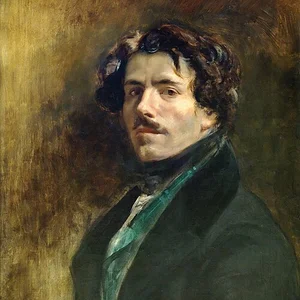

French painter of the 19th century and leading figure of the Romantic movement. Delacroix revolutionized painting through his bold use of color, movement, and political and Orientalist subjects. His masterpiece "Liberty Leading the People" became an icon of republican freedom.
Eugène Delacroix(1798 — 1863)
Eugène Delacroix
France
8 min read
Frequently asked questions
Famous Quotes
« I came, I saw, I painted»
« Beauty is a creation of will and genius»
« Painting is a feast for the eye»
Key Facts
- 1822: Exhibits "Dante and Virgil in Hell", his first major work to showcase his talent as a colorist
- 1830: Paints "Liberty Leading the People" following the July Revolution, a work that became a symbol of the French Republic
- 1832: Travels to North Africa (Morocco, Algeria), which inspires his Orientalist compositions
- 1847–1854: Creates the frescoes for the Library of the Palais Bourbon, a masterpiece of French mural art
- 1863: Dies on August 13th, recognized as the undisputed master of Romantic painting
Works & Achievements
His first major work exhibited at the Salon, depicting Dante and Virgil crossing the Styx. The painting introduced Delacroix to the public and marked his break with Neoclassicism.
A monumental canvas denouncing the massacre of Greeks by the Ottomans at Chios. It caused a scandal and established Delacroix as the standard-bearer of Romanticism.
Inspired by a play by Lord Byron, this tumultuous canvas depicts the last king of Assyria destroying his possessions. Its composition and chromatic violence shocked the official critics.
An iconic masterpiece inspired by the Three Glorious Days of July 1830. The allegorical figure of Liberty brandishing the tricolor flag has become a universal symbol of freedom.
Painted after his journey to North Africa, this work offers an intimate view of an Algerian harem. It profoundly influenced Renoir, Cézanne, and Picasso, who created fifteen variations of it.
A large historical canvas commissioned by the State, depicting the capture of Constantinople in 1204. It illustrates Delacroix's ability to combine epic sweep with emotional complexity.
A mural in the Chapel of the Holy Angels at Saint-Sulpice, considered Delacroix's artistic testament. It bears witness to his mastery of movement and color at the end of his life.
Anecdotes
Delacroix was long suspected of being the natural son of Talleyrand, the famous diplomat. His official father, Charles Delacroix, had undergone a surgical operation that left him temporarily sterile shortly before Eugène's conception, and Talleyrand quietly watched over the painter's career throughout his life.
When his painting "Scenes of the Massacres of Chios" was shown at the 1824 Salon, Delacroix discovered works by John Constable displayed nearby. Struck by the brilliance of Constable's colors, he repainted a large portion of his own canvas's background over the course of a few days to enhance its luminosity, just before the official opening.
Delacroix kept a personal journal that he wrote over several decades. This exceptional document, published after his death, reveals his reflections on art, his doubts, his rivalry with Ingres, and his observations on Parisian life. It stands today as one of the most valuable sources on the artistic life of the 19th century.
During his trip to Morocco in 1832, Delacroix was dazzled by the light and colors of North Africa. He filled seven sketchbooks with drawings and watercolors, meticulously noting the exact shades of costumes and landscapes. This journey lastingly transformed his palette and inspired more than a hundred Orientalist paintings.
Delacroix and Ingres, the leading figure of Neoclassicism, maintained a legendary rivalry. At a society dinner, they had such a heated argument that Ingres stormed out of the room exclaiming: "Open the windows — it smells of sulfur!" Yet upon Delacroix's death, Ingres privately acknowledged his genius.
Primary Sources
The first virtue of a painting is to be a feast for the eye. This is not to say that reason has no place in it; it is like beautiful verse — all the reason in the world will not prevent it from being bad if it offends the ear.
I am a pure classicist. I was raised with great respect for Raphael and the old masters. And yet I am counted among the innovators!
The Romans and the Greeks are right here, at my doorstep: I had a good laugh at David's Greeks, setting aside, of course, his sublime craftsmanship. I know them now; the marbles are truth itself, but one must know how to read them.
I have begun a modern subject, a barricade… and if I have not fought for my country, at least I shall paint for her.
Key Places
Delacroix's last studio and residence from 1857, now the Musée national Eugène-Delacroix. He moved there to be close to the Church of Saint-Sulpice, which he was decorating.
Delacroix painted the murals of the Chapel of the Holy Angels there between 1849 and 1861, including "Jacob Wrestling with the Angel", considered his artistic testament.
The Louvre holds Delacroix's major works, including "Liberty Leading the People". As a young artist, he diligently copied the old masters there, particularly Rubens and Veronese.
During his 1832 journey, Delacroix stayed in Meknes where he attended an audience with Sultan Moulay Abd er-Rahman. This encounter inspired several major Orientalist paintings.
Delacroix's port of arrival in North Africa, where he was immediately struck by the Mediterranean light. He produced numerous watercolors and sketches of daily life there.
Liens externes & ressources
Références
Œuvres
Scènes des massacres de Scio
1824
La Mort de Sardanapale
1827
La Liberté guidant le peuple
1830
Entrée des Croisés à Constantinople
1840