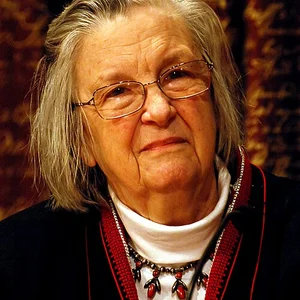

Elinor Ostrom (1933-2012) was an American economist and political scientist. The first woman to receive the Nobel Prize in Economics, in 2009, she showed how communities can sustainably manage shared resources (the “commons”) without resorting to either the state or the private market.
Elinor Ostrom(1933 — 2012)
Elinor Ostrom
États-Unis
6 min read
Frequently asked questions
Key Facts
- Born on August 7, 1933 in Los Angeles, died on June 12, 2012 in Bloomington, Indiana
- Publishes her major work Governing the Commons in 1990
- Receives the Nobel Prize in Economics in 2009, the first woman to be awarded this distinction
- Demonstrates that local communities can sustainably manage common resources through self-organization
- Co-founds with her husband Vincent Ostrom the “Bloomington School” of institutional analysis
Works & Achievements
Her most famous book, which demonstrates that communities can sustainably manage shared resources. It founded an entire field of research on the commons.
An interdisciplinary research center in Bloomington, co-founded with Vincent Ostrom, which became an international hub for the study of institutions and governance.
A set of rules drawn from her fieldwork, explaining the conditions under which a shared resource can be sustainably managed by its users.
A work presenting her analytical framework (the “IAD framework”) for understanding the diversity of human rules and institutions.
The first woman to receive this distinction, for her analysis of economic governance, particularly of the commons.
She developed the idea of “polycentric” governance: multiple decision-making centers at different levels, rather than a single authority, to manage complex problems such as climate change.
Anecdotes
In 2009, Elinor Ostrom became the first (and for a long time the only) woman to receive the Nobel Prize in Economics, even though she held a doctorate not in economics but in political science. The news surprised her so much that she first thought it was a prank phone call.
As a teenager, she was advised against taking algebra classes because she was a girl. She would later recount that, having stuttered as a child, she joined her high school debate team to overcome her difficulties — a training in argumentation that would serve her throughout her career.
To prove her thesis, she didn't rely on theoretical models alone: she traveled the world to observe firsthand Turkish fishermen, irrigation systems in Nepal, and Swiss mountain pastures managed in common for centuries without collapsing.
Turned down by several universities for a doctorate in economics, she turned to political science at UCLA. With her husband Vincent Ostrom, she founded a now-famous research center in Bloomington, the “Workshop in Political Theory and Policy Analysis.”
Time magazine ranked her among the 100 most influential people in the world in 2012, the very year of her death. She continued to teach and write until her final months, despite having cancer.
Primary Sources
Neither the state nor the market has consistently succeeded in enabling individuals to sustain a productive and lasting use of natural resource systems over the long term.
Resource users frequently build their own rules and institutions to manage their shared resources, contradicting the idea that the tragedy of the commons would be inevitable.
Hardin claimed that free access to the commons leads to ruin for all; Ostrom showed through field research that this verdict was not a universal law.
The prize is awarded to Elinor Ostrom for her analysis of economic governance, and especially of the commons.
Key Places
City where Elinor Ostrom was born in 1933 and grew up during the Great Depression.
University where she earned her bachelor's degree and then her doctorate in political science, after being steered away from economics.
University where she taught and, together with her husband, founded the famous Workshop in Political Theory and Policy Analysis.
City where she received the Nobel Prize in Economics in December 2009.
Iconic fieldwork site where she observed irrigation systems managed in common by farmers for generations.
Typical Objects

Notebook in which she recorded her direct observations of fisheries, forests, and irrigation systems managed in common across the world. A symbol of her empirical method, grounded in observing reality rather than relying on theory alone.

Medal awarded by the Royal Swedish Academy of Sciences in 2009. It marks the international recognition of her work on the governance of the commons.

Networks of canals collectively managed by farmers, such as in Nepal, which she studied in detail. A concrete example of a commons sustainably administered by its very own users.

A synthesis of the rules she identified for a community to sustainably manage a shared resource (clear boundaries, graduated sanctions, conflict resolution…). A theoretical tool that became a worldwide reference.

The everyday working tools of a prolific researcher who published hundreds of articles and several books. They accompanied her generation's transition into the computer age.
School Curriculum
Vocabulary & Tags
Key Vocabulary
Tags
Daily Life
Morning
An indefatigable academic, Elinor Ostrom started early, reading articles and preparing her lectures and seminars. Mornings were often devoted to research and writing in her office at the Workshop in Bloomington.
Afternoon
Her afternoons combined meetings with doctoral students and colleagues, the supervision of research, and debates within her interdisciplinary workshop. She placed great importance on collective work and on discussing matters with students as equals.
Evening
In the evening, she continued her reading and scholarly correspondence, often sharing her thinking with her husband Vincent, himself a political scientist. Evenings extended a constant intellectual dialogue between the couple.
Food
Like an American middle-class academic of her time, her diet was ordinary and unremarkable. During her fieldwork, she shared the meals of the communities she studied, from Nepal to Turkey.
Clothing
She wore the plain, practical outfits of a university professor of the second half of the 20th century. Her appearance was understated, in keeping with the North American academic world.
Housing
She lived in Bloomington, Indiana, near the university where she spent most of her career. Her home and her workplace formed a single intellectual environment shared with her husband.
Historical Timeline
Period Vocabulary
Liens externes & ressources
Références
Œuvres
Governing the Commons: The Evolution of Institutions for Collective Action
1990
Fondation du Workshop in Political Theory and Policy Analysis
1973
Les « huit principes de conception » des communs
1990
Understanding Institutional Diversity
2005
Prix Nobel d'économie
2009
Governing the Commons (théorie de la gouvernance polycentrique)
années 1990-2000