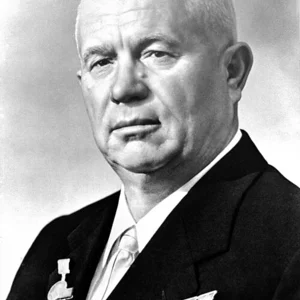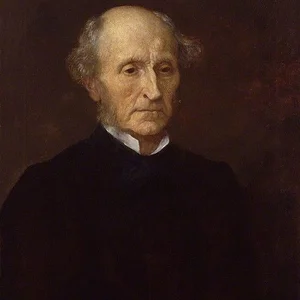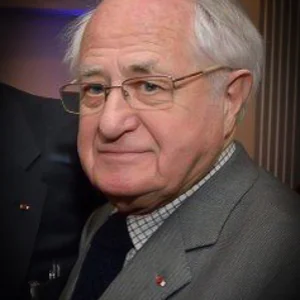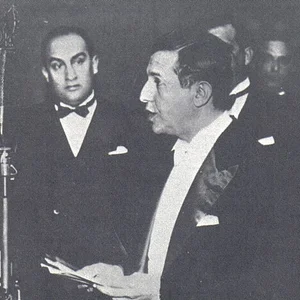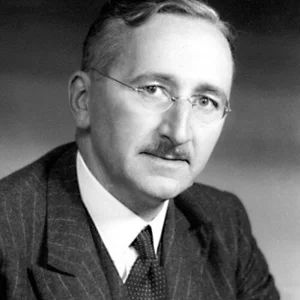

Austrian economist and philosopher, a major figure of classical liberalism and the Austrian school of economics. Winner of the Nobel Prize in Economics in 1974, he championed the spontaneous order of the market and criticized central planning.
Friedrich Hayek(1899 — 1992)
Friedrich Hayek
Autriche, Royaume-Uni
6 min read
Frequently asked questions
Key Facts
- Born in 1899 in Vienna, died in 1992 in Freiburg im Breisgau
- Published 'The Road to Serfdom' in 1944, a critique of state planning
- Founder of the Mont Pelerin Society in 1947, a network of liberal intellectuals
- Nobel Prize in Economics in 1974 (shared with Gunnar Myrdal)
- Published 'The Constitution of Liberty' in 1960
Works & Achievements
A work on the Austrian theory of business cycles that made his name and brought him to the London School of Economics.
His most famous book, in which he warns that central planning leads to the loss of freedoms. A worldwide best-seller.
A landmark essay showing that knowledge is dispersed among all individuals and that the market coordinates better than central planning.
A grand synthesis of his political philosophy on individual liberty and the rule of law.
A trilogy on spontaneous order and the legal foundations of a free society.
An international network of liberal thinkers he created to defend the ideas of freedom during the Cold War.
An award he received for his work on money, business cycles, and the analysis of institutions.
Anecdotes
In 1944, Hayek published *The Road to Serfdom*, a book that became an unexpected best-seller. The American magazine Reader's Digest published a condensed version, which made it known to millions of readers and earned him a triumphant tour of the United States.
As a young man, Hayek fought on the Italian front during the First World War as an artillery officer in the Austro-Hungarian army. There he caught malaria and came close to death, an experience that, upon his return, drove him to study economics to understand how to prevent such catastrophes.
In 1947, Hayek gathered around forty liberal thinkers at a Swiss hotel near Mont Pèlerin to defend the ideas of liberty against triumphant socialism. This “Mont Pèlerin Society” still exists today.
For decades, Hayek carried on a passionate intellectual debate with the British economist John Maynard Keynes, his great rival. The two men championed opposing visions of the role of the state, yet they respected each other and maintained cordial relations.
In 1974, when his ideas had fallen out of fashion, Hayek received the Nobel Prize in Economics. This award abruptly revived his career and influence, at the very moment when leaders like Margaret Thatcher and Ronald Reagan were preparing to draw on his theories.
Primary Sources
Economic control in the hands of others is not merely control of a sector of human life which can be separated from the rest; it is the control of the means for all our ends.
The economic problem of society is not merely a problem of how to allocate given resources: it is a problem of the utilization of knowledge not given to anyone in its totality.
If man is not to do more harm than good in his efforts to improve the social order, he will have to learn that in this, as in all fields where essential complexity prevails, he cannot acquire the full knowledge which would make mastery of the events possible.
Liberty is not merely one particular value but the source and condition of most moral values.
Key Places
Hayek's birthplace and the cradle of the Austrian School of economics, where he studied law and political science.
Hayek taught here from 1931 and held his famous debates with Keynes on economic cycles and the role of the state.
He worked here from 1950 as part of the Committee on Social Thought, in an intellectual environment favorable to economic liberalism.
Site of the first meeting in 1947 of the liberal society he founded, near Montreux on the shore of Lake Geneva.
The city where Hayek taught in the later part of his career and where he died in 1992.
Typical Objects

Hayek, like many intellectuals of his time, was often photographed pipe in hand, deep in thought. The pipe was an attribute of the calm, methodical thinker.

An indispensable tool for writing his books and his countless articles before the computer age. Hayek produced a considerable body of work over the decades.

A medal and diploma awarded in 1974 by the Royal Swedish Academy of Sciences. This distinction revived his worldwide recognition.

Hayek accumulated notes and index cards to organize his vast erudition, which spanned economics, law, psychology, and political philosophy.

His most famous work, which became a symbol of the defense of liberty against totalitarian regimes. Distributed in millions of copies.
School Curriculum
Vocabulary & Tags
Key Vocabulary
Tags
Daily Life
Morning
Hayek rose early and devoted his mornings, his most productive hours, to writing and research in his study. Methodical, he advanced slowly but surely on his manuscripts.
Afternoon
The afternoon was often dedicated to teaching, to seminars with his students, and to intellectual discussions. He also enjoyed walking and hiking in the mountains, which renewed his energy.
Evening
In the evening, he read widely across varied fields — law, psychology, the history of ideas — and kept up an extensive correspondence with other scholars around the world.
Food
Born into the Viennese bourgeoisie, Hayek enjoyed Central European cuisine and the cafés of Vienna, those hubs of intellectual debate. His diet was that of an academic of his time, with no particular excess.
Clothing
He wore the understated suit and tie of the twentieth-century European academic: a tweed jacket, a shirt, and sometimes a bow tie — the image of the distinguished professor.
Housing
Over the course of his career, he lived in academics' apartments and houses in Vienna, London, Chicago, and then Freiburg, near the great universities where he taught.
Historical Timeline
Period Vocabulary
Liens externes & ressources
Références
Œuvres
Prix et production (Prices and Production)
1931
La Route de la servitude (The Road to Serfdom)
1944
L'utilisation de la connaissance dans la société
1945
La Constitution de la liberté (The Constitution of Liberty)
1960
Droit, législation et liberté (Law, Legislation and Liberty)
1973-1979
Fondation de la Société du Mont-Pèlerin
1947
Prix Nobel d'économie
1974