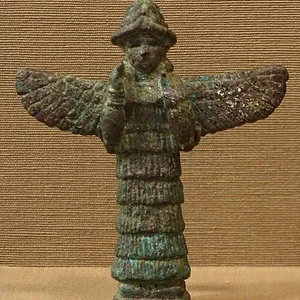

The lamassu is a protective deity of ancient Mesopotamia, depicted as a winged spirit with the body of a bull (or lion), the wings of an eagle and a bearded human head. Standing guard at the gates of Assyrian palaces and cities, these monumental figures warded off the forces of evil.
Lamassu
Lammasu
6 min read
Frequently asked questions
Key Facts
- Protective spirit of Mesopotamian mythology combining a human head, the body of a bull or lion, and the wings of an eagle
- Colossal statues erected at the gates of Assyrian palaces, notably under Sargon II at Dur-Sharrukin (Khorsabad), around 710 BC
- Often sculpted with five legs so it appears to stand still when seen from the front and to be walking when seen from the side
- Major examples preserved at the Louvre, the British Museum, and the Oriental Institute Museum in Chicago
- A monumental lamassu from Nimrud was destroyed by ISIS in 2015, a symbol of the ravaging of Mesopotamian heritage
Works & Achievements
Colossal lamassu guarding the gates of the new Assyrian capital. Now iconic, they are today housed in the Louvre.
Among the oldest known great guardians, divided between the British Museum and the Metropolitan Museum in New York.
Monumental guardians of a palace the king wanted to be the greatest of all, adorned with inscriptions boasting of his building works.
Guardians of one of the city's gates, which stayed in place until their destruction in 2015. A symbol of the protection of the city walls.
An Achaemenid Persian revival of the Assyrian motif, evidence of the lamassu's spread beyond Mesopotamia.
Anecdotes
Seen from the front, the lamassu seem motionless, firmly planted; but seen from the side, they look as if they are walking. The secret? The Assyrian sculptors gave them five legs! That way the statue appears complete and alive from every angle.
The largest lamassu stand more than four metres tall and weigh up to thirty tonnes, carved from a single block of stone. To move them, hundreds of men dragged them on enormous sledges — a scene the Assyrians themselves carved on the walls of their palaces.
In 1843, the French consul **Paul-Émile Botta** unearthed at **Khorsabad** immense winged bulls with human heads. A few years later, two of them crossed the Mediterranean to **Paris**: you can still admire them at the Louvre Museum, in the great Khorsabad courtyard.
Between the legs of the lamassu, the scribes carved long cuneiform inscriptions recounting the king's victories. This text served both as a royal signature and as magical protection: the written word reinforced the creature's guard.
In 2015, the group **Islamic State** destroyed several lamassu in the **Mosul** region, including the one from the Nergal Gate at **Nineveh**, nearly 2,700 years old. Today, casts, photographs and digital reconstructions strive to preserve their memory.
Primary Sources
My god has forsaken me and vanished, my goddess has abandoned me and keeps her distance. The good spirit (shedu) who walked at my side has gone away, my protectress (lamassu) has taken flight.
Protective bulls of stone, guardians watching over the steps of the king, I had them set up to the right and left of its gates.
At its gates, I had great winged bulls and protective spirits of white limestone fashioned and set up, so that they might drive back the wicked and guard the steps of whoever passes through them.
May the good shedu and the good lamassu stand day and night at the palace gate, and may they never depart from it.
Key Places
Capital founded by Sargon II in the 8th century BC. Its gates were guarded by the most famous lamassu, now housed in the Louvre.
Great Assyrian capital on the Tigris, adorned with the palace of Sennacherib. Its Nergal Gate bore monumental winged bulls.
Ancient capital of King Ashurnasirpal II. Its palace held some of the first great lamassu unearthed by archaeologists.
Persian royal city where the Achaemenid kings revived the motif of the human-headed winged bull, a direct heir to the Assyrian lamassu.
In Paris, the Khorsabad Court displays the winged bulls of Sargon II. It is one of the places where you can see authentic lamassu.
Holds several lamassu from Nimrud and Nineveh, brought back in the 19th century by Austen Henry Layard.
Typical Objects

Headdress topped with several pairs of horns worn by the lamassu. In Mesopotamia, this headgear was a sign reserved for gods and divine beings.

Monumental block of gypsum or alabaster into which the lamassu is carved, part statue and part bas-relief. Set against the wall, it framed the entrance to palaces.

Long text engraved between the lamassu's legs, recounting the exploits and titles of the king. It served as a signature and reinforced protection through the written word.

Small engraved stone cylinder that was rolled over fresh clay to leave an impression. Many depict protective winged spirits like the lamassu.

Small terracotta statuette in the image of a guardian spirit, buried in a brick box beneath the floor of doorways and rooms. It protected the house from demons.

Great wings of a bird of prey grafted onto the body of the bull or lion. They connect the lamassu to the sky and symbolize its supernatural power.
School Curriculum
Vocabulary & Tags
Key Vocabulary
Tags
Daily Life
Morning
At dawn, the first ray of sunlight lights up the alabaster face of the lamassu standing at the palace gate. Motionless since nightfall, it welcomes visitors and weighs their intentions before they cross the threshold.
Afternoon
Under the scorching Mesopotamian sun, the guardian stays frozen in place, yet its five legs create the illusion that it is striding forward. Dignitaries, ambassadors, and scribes pass between its legs, reading the inscriptions carved into the stone.
Evening
At dusk comes the hour of demons: the lamassu stands guard against malevolent spirits like Lamashtu, who was believed to prowl in the shadows. The glow of torches sets shadows dancing across its outspread wings.
Food
A divine spirit, the lamassu does not eat human food. It “feeds” on the offerings placed at its feet: incense, libations of beer or wine, and perfumes burned to win its favor.
Clothing
It wears the horned tiara of the gods and a long beard carefully curled and braided. Its body of a bull or a lion is covered in finely carved fur, and powerful eagle wings complete its silhouette.
Housing
Its home is the threshold: the gates of palaces and the ramparts of cities like Dur-Sharrukin, Nineveh, or Nimrud. Carved from alabaster or gypsum, half-statue and half-relief, it is one with the wall it protects.
Historical Timeline
Period Vocabulary
Liens externes & ressources
Références
Œuvres
Taureaux ailés du palais de Sargon II à Dur-Sharrukin
vers 713 av. J.-C.
Lamassu du palais d'Assurnasirpal II à Nimroud
vers 870 av. J.-C.
Taureaux ailés du palais « sans rival » de Sennacherib à Ninive
vers 690 av. J.-C.
Lamassu de la porte de Nergal à Ninive
VIIe siècle av. J.-C.
Taureaux ailés de la Porte de toutes les nations à Persépolis
vers 475 av. J.-C.