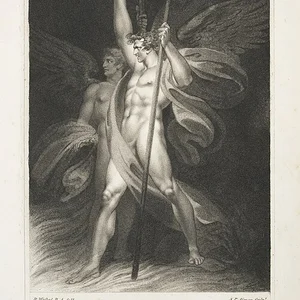

Mammon is a demonic figure from the New Testament, a personification of material wealth and greed. Taken up in medieval literature and by Milton in Paradise Lost, he embodies the temptation of earthly riches over spiritual values.
Mammon
Mammon
8 min read
Frequently asked questions
Famous Quotes
« No one can serve two masters: God and Mammon. (Matthew 6:24)»
Key Facts
- Mentioned in the Gospel of Matthew (6:24) and Luke (16:13) as a symbol of corrupting wealth
- Adopted in medieval literature as one of the demons of the seven deadly sins
- Appears in John Milton's Paradise Lost (1667) as the fallen angel most attached to material possessions
- His name is of Aramaic origin and means 'wealth' or 'profit'
Works & Achievements
The two New Testament passages that introduce Mammon as an antagonistic figure to God are the founding source of the entire subsequent tradition surrounding this character.
A long allegorical poem in Middle English depicting the struggle between spiritual values and the temptation of wealth, in which Mammon embodies the corruption of medieval institutions.
A demonology treatise that officially ranks Mammon among the seven princes of Hell, assigning him dominion over the sin of greed within the demonic hierarchy.
A satirical comedy in which the character Sir Epicure Mammon embodies the greed and gullibility of the newly wealthy, popularizing Mammon as a comic and moral archetype in Jacobean theatre.
An epic poem in blank verse in which Mammon appears among the great fallen angels; Milton portrays him as the spiritual architect of infernal materialism, ever gazing downward toward the earth even in Paradise.
A critical essay on the Industrial Revolution in which Carlyle coins the phrase 'Gospel of Mammonism' to denounce the worship of profit as the religion of modern capitalist society.
Anecdotes
The word 'Mammon' comes from the Aramaic 'mamona', a common term in the language of Jesus used to refer to goods, wealth, or property. When Jesus declares in the Gospel of Matthew 'You cannot serve God and Mammon', he personifies material wealth by giving it the name of a rival deity, transforming an everyday word into a formidable spiritual figure.
During the Middle Ages, Christian theologians developed an elaborate hierarchy of demons corresponding to the seven deadly sins. Peter Binsfeld, auxiliary bishop of Trier, published an official classification in 1589 in which Mammon appears as a prince of Hell governing avarice, alongside Lucifer for pride and Beelzebub for gluttony. This list had a lasting influence on European demonic iconography.
In John Milton's 'Paradise Lost' (1667), Mammon is described as the last of the fallen angels to have left Heaven, because even before his fall he 'never looked up, but always walked with downward eyes, admiring the riches of Heaven's pavement'. Milton makes him the first to mine the minerals of Hell in order to build Pandemonium, Satan's capital.
The medieval poet William Langland, in 'Piers Plowman' (c. 1370), portrays Lady Mede — the personification of corrupt reward and greed — who is closely associated with Mammon. This allegorical poem in Middle English, read throughout England, helped cement Mammon in the popular imagination as a symbol of the corruption of feudal society by money.
Theologians such as Thomas Aquinas in the 13th century drew on the figure of Mammon to develop their doctrine of 'disordered love' (amor inordinatus): loving material goods more than God was considered a form of idolatry. This thinking directly influenced the rules of the mendicant orders — the Franciscans and Dominicans — who took vows of absolute poverty in reaction to Mammon.
Primary Sources
No one can serve two masters. Either he will hate the one and love the other, or he will be devoted to the one and despise the other. You cannot serve both God and Mammon.
No servant can serve two masters; for either he will hate the one and love the other, or he will be devoted to the one and despise the other. You cannot serve both God and Mammon.
Mammon, the least erected Spirit that fell / From heav'n, for ev'n in heav'n his looks and thoughts / Were always downward bent, admiring more / The riches of Heav'ns pavement, trod'n Gold, / Then aught divine or holy else enjoy'd in vision beatific.
Mammon is the prince of Hell associated with the sin of greed, one of the seven chief demons corresponding to the seven deadly sins according to demonological classification.
Lady Mede, daughter of False, seeks to corrupt the institutions of the kingdom through her wealth, embodying the seductive power of Mammon over medieval society.
Key Places
The place where Jesus delivered his foundational teachings opposing God and Mammon, in the context of the Temple economy marked by money changers whom Jesus drove out.
Center of the Catholic Church and the birthplace of Augustinian and Scholastic theology, which established Mammon as the central figure in the condemnation of greed.
The episcopal city where Peter Binsfeld published his 1589 demonological classification, naming Mammon as the prince of the sin of avarice, in the context of the witchcraft trials.
The city where Milton wrote 'Paradise Lost' and Ben Jonson created 'The Alchemist': Mammon became a symbol of English literary criticism of the rising culture of mercantile greed.
The heart of medieval Scholasticism at the University of Paris, where Thomas Aquinas and his contemporaries developed the moral philosophy condemning the disordered love of wealth.
Typical Objects

The most common iconographic attribute of Mammon in medieval and Renaissance art, symbolizing the sterile accumulation of wealth and the refusal to share with the poor.

An instrument associated with commercial deceit and greed, the rigged scales evoke the usurious practices condemned by the Church and personified by Mammon.

A recurring figure in allegorical depictions of avarice, the locked chest symbolizes hoarding and the refusal to put one's wealth at the service of the common good.

Directly inspired by Milton, who describes Mammon leading the demons to extract gold from the bowels of Hell in order to build Pandemonium, Satan's capital.

A symbol of usurious loans and financial obligations that bind men to material wealth — practices that the medieval Church equated with the service of Mammon.

Mammon is sometimes depicted crowned in medieval demonology as the 'king of avarice', wearing a crown devoid of spiritual luster, purely material — a parody of the divine crown.
School Curriculum
Vocabulary & Tags
Key Vocabulary
Tags
Daily Life
Morning
In the medieval imagination, Mammon is conceived as an eternally vigilant entity that 'watches over' his treasures from the break of dawn. Theologians describe the miser — his earthly servant — rising before daylight to check his strongboxes, count his coins, and review his ledgers of debts, incapable of the spiritual serenity that morning prayer provides.
Afternoon
The disciple of Mammon's afternoon is devoted to transactions, negotiations, and usurious contracts. In medieval allegorical literature, he spends his hours weighing gold, haggling at fairs, and weaving webs of debt that ensnare the poor — activities that Franciscan preachers condemned from their pulpits.
Evening
In the evening, according to medieval moralists, the miser finds no rest: he is consumed by fear of theft and obsession with loss. Milton describes Mammon himself as incapable of enjoying heavenly beauty, his eyes perpetually cast downward toward the ground. His servant's nights are haunted by nightmares of poverty, a gilded prison of his own making.
Food
Medieval iconography of avarice associates Mammon with meager, miserly fare: the miser eats little not out of spiritual asceticism but out of refusal to spend, hoarding even at his own table. Moral fables depict him eating alone, on stale bread and water, while his strongboxes overflow with gold — the very antithesis of Christian charity.
Clothing
In allegorical depictions, Mammon and his servants wear paradoxical garments: rich in appearance but worn and torn, for the miser refuses to replace his clothes. The demons of avarice are often shown in grotesque rags covered with sewn-on coins, blending physical wretchedness with the absurd accumulation of wealth.
Housing
Mammon's dwelling, as Milton describes it, is Pandemonium — an underground palace of obsidian columns and vaults of raw gold, built by demon-miners. On Earth, his servant lives in a manor cluttered with locked strongboxes, stacked ledgers, and rooms kept dark for fear of thieves: a space rich in wealth but devoid of beauty or human warmth.
Historical Timeline
Period Vocabulary
Visual Style
Un style sombre inspiré des enluminures médiévales et de la peinture flamande grotesque — Bosch et Bruegel — avec des ors ternis, des rouges profonds et une atmosphère souterraine pesante et claustrophobique.
Sound Ambience
Une atmosphère souterraine et étouffante mêlant le cliquetis de l'or, le grincement des serrures et le brouhaha lointain des marchés médiévaux, évoquant la séduction froide et pesante des richesses matérielles.
Liens externes & ressources
Références
Œuvres
Évangiles de Matthieu et Luc (Nouveau Testament)
vers 80-90 apr. J.-C.
Piers Plowman — William Langland
vers 1370-1386
Tractatus de confessionibus maleficorum et sagarum — Pierre Binsfeld
1589
L'Alchimiste (The Alchemist) — Ben Jonson
1612
Paradise Lost — John Milton
1667
Past and Present — Thomas Carlyle
1843