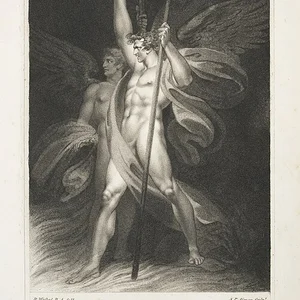

Metatron is the highest of the angels in certain Jewish mystical traditions. Celestial scribe and chancellor of Heaven, he is said to be the angelic incarnation of the patriarch Enoch. He appears notably in Merkabah literature and in the Hebrew Book (3 Enoch).
Metatron
Metatron
10 min read
Frequently asked questions
Key Facts
- Metatron appears in Merkabah literature (1st–6th century CE)
- The Hebrew Book (3 Enoch) describes him as the 'Prince of the Presence,' seated beside God
- Identified with the biblical patriarch Enoch, transformed into an angel after his ascension to Heaven (Genesis 5:24)
- He holds the role of celestial scribe, recording human deeds in the Book of Life
- His name remains etymologically obscure; several theories exist: from the Greek 'metathronos' (near the throne) or the Latin 'metator'
Works & Achievements
A major work of Jewish mystical literature entirely devoted to Metatron, recounting his ascension from the patriarch Enoch and his enthronement as supreme prince of the heavens. It is the primary and most developed source on this figure.
A pseudepigraphical work attributed to Enoch, the literary ancestor of Metatron, describing this patriarch's heavenly journeys and cosmic revelations. It forms the narrative foundation upon which the angelic figure of Metatron would later be built.
A major mystical text of the Hekhalot corpus describing the mystic's ascent through the seven heavenly palaces under the guidance of Metatron. It provides a detailed account of the angelic hierarchy and the protocol for accessing the divine presence.
A complementary mystical text of the Hekhalot corpus, mentioning Metatron as mediator between the mystic and the divine realm. It develops the ecstatic techniques and heavenly visions characteristic of Merkabah mysticism.
A controversial mystical text describing the cosmic dimensions of the divine figure and its heavenly representatives, including Metatron. It illustrates the tendency of early Jewish mysticism to conceive of celestial beings with proportions beyond human comprehension.
A work of Jewish magic and mysticism that incorporates Metatron into a network of guardian angels and divine mediators. Though composed relatively late, it draws on angelic traditions inherited from late antiquity.
Anecdotes
According to the Book of the Hebrews (3 Enoch), Metatron is none other than the patriarch Enoch, of whom it is said in Genesis (5:24) that he 'walked with God, and then he was no more, for God took him.' This transformation of a man into a supreme angel is unique in Jewish tradition: Enoch was said to have been taken up to heaven alive and transformed into a being of fire of cosmic proportions.
In the Babylonian Talmud (tractate Hagigah 15a), a famous episode recounts that a sage named Elisha ben Abuyah (nicknamed 'Acher,' meaning 'the Other') saw Metatron seated in God's presence. Scandalized that a celestial being should be seated — a privilege reserved for God alone — he concluded that there were 'two powers in heaven.' This incident illustrates the theological danger that the figure of Metatron posed to strict monotheism.
Metatron is called 'the Lesser YHWH' (Ha-Shem Ha-Katan) in certain mystical texts, granting him a near-divine authority. According to 3 Enoch, he bears seventy different names, each corresponding to a particular celestial attribute or function, highlighting the richness and complexity of this figure in Jewish mystical thought.
As the heavenly scribe, Metatron is said to record in celestial registers all the actions of human beings as well as divine decrees. He also presides over a heavenly school where the souls of deceased children study the Torah. This vision of an angelic divine secretary reflects the importance placed on writing and the transmission of knowledge in rabbinic Jewish culture.
During his transformation from Enoch, Metatron is said to have acquired 36 pairs of wings and a throne set at the entrance to the seventh heaven. He served as a celestial guide to the mystic Rabbi Ishmael on his journey through the 'heavenly palaces' (Hekhalot), revealing to him the secrets of divine cosmology. This initiatory narrative is one of the most elaborate in all of ancient Jewish mystical literature.
Primary Sources
Rabbi Ishmael said: Metatron, Prince of the Divine Presence, told me: 'Before the world was created, the Holy One, Blessed be He, chose me to be the servant of His Throne of Glory.' [...] He called my name: Metatron, the Lesser YHWH.
Acher looked and saw Metatron, who had been granted permission to sit and record the merits of Israel. He said: 'We have been taught that on high there is no sitting, no standing [...] perhaps there are two powers in heaven?'
Metatron, the Prince of the Presence, bears witness before the Divine Presence. His is the voice that proclaims the heavenly decrees and seals the fates of men.
Enoch lived sixty-five years, and begot Methuselah. After he begot Methuselah, Enoch walked with God three hundred years [...] Enoch walked with God; then he was no more, for God took him.
And it came to pass after this that the Spirit carried him away — Enoch — from among those who dwelt on dry ground, and lifted him up to the heaven of heavens [...] and he saw there other luminous beings who could not be distinguished.
Key Places
Metatron's primary dwelling in Jewish mystical cosmology, the seventh heaven is the realm closest to the Divine Presence. It is here that Metatron fulfills his role as chancellor, scribe, and Prince of the Divine Face.
These two great Babylonian rabbinic academies (3rd–11th centuries) were the primary centers for the development and transmission of the Talmudic and mystical texts containing the main references to Metatron. The Babylonian Talmud, produced within their sphere of influence, is the most important rabbinic source on this figure.
Following the destruction of the Temple in 70 CE, Jerusalem remained a major symbolic reference point for rabbinic Judaism. It was in this context of mourning and religious reorganization that Hekhalot mysticism and the figure of Metatron emerged as a spiritual response to the loss of the sanctuary.
The heartland of rabbinic Judaism after 70 CE, the Galilee and especially Tiberias were home to the academies that compiled the Jerusalem Talmud. The earliest developments of Merkabah mysticism found fertile ground here.
The preeminent site of divine revelation in the Hebrew tradition, Sinai serves as a symbolic reference for the Hekhalot mystics who sought to replicate the experience of Moses — direct access to the Divine Presence — in their heavenly journeys guided by Metatron.
Typical Objects

As the supreme scribe of Heaven, Metatron is constantly depicted holding a divine calamus with which he records the deeds of men and the decrees of God in the celestial registers. This instrument symbolizes the power of the divine Word conveyed through writing.

Metatron holds and consults the cosmic books or registers in which human destinies and the secrets of creation are recorded. These celestial tablets echo the Mesopotamian tradition of the 'tablets of destiny' and underscore his role as guardian of divine memory.

The Holy Blessed One is said to have placed upon Metatron's head a crown bearing the same letters engraved on the divine throne. This crown symbolizes the authority delegated by God to his heavenly chancellor.

Upon his transformation from Enoch, Metatron receives a robe of glory woven from divine light. This celestial garment sets him apart from other angels and manifests his exceptional status within the angelic hierarchy.

Metatron possesses a throne placed at the entrance to the seventh heaven, a unique privilege granted to no other angelic being. This detail, a source of theological controversy in the Talmud, illustrates the exceptional and sometimes ambiguous nature of his position between creature and divinity.

Metatron is presented as the heavenly herald who proclaims divine decrees throughout the heavens. His resounding voice is the instrument through which God's will is transmitted to all the celestial hosts.

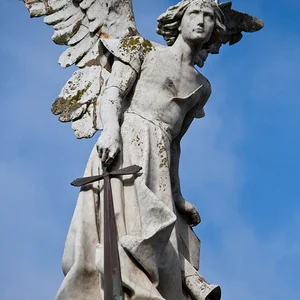
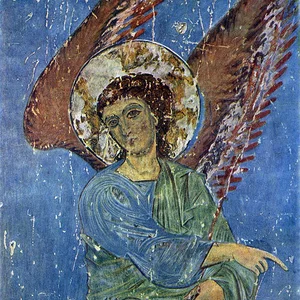
After his transformation, Metatron is said to have acquired 72 wings according to 3 Enoch, composed of fire and light. This extraordinary physical detail signifies his ability to traverse instantaneously every dimension of the divine cosmos.
School Curriculum
Vocabulary & Tags
Key Vocabulary
Tags
Daily Life
Morning
At the 'celestial dawn,' Metatron takes his place on his throne at the entrance to the seventh heaven to preside over the heavenly academy where the souls of deceased children study the Torah. He summons the scribe angels and assigns the tasks of the cosmic day, opening the registers in which humanity's deeds will be recorded.
Afternoon
At the heart of the celestial day, Metatron stands before the Throne of Glory to convey divine decrees to the angelic hosts. He arbitrates the pleas of souls, records prayers ascending from the earth, and oversees the proper unfolding of cosmic order — ensuring the stars hold their course and the laws of nature are upheld.
Evening
At celestial dusk, Metatron seals the day's registers and presents an account of human deeds before the Divine Presence. He leads the angelic choirs that intone the Kedushah ('Holy, holy, holy is the Lord') at the precise moment evening falls upon the earth, maintaining the continuity of the cosmic liturgical office.
Food
As an angelic being of fire and light, Metatron does not eat as humans do. His very substance is made of divine glory — he 'sustains' himself through the unceasing contemplation of God's Presence and the breath of holiness that continually emanates from the heavenly Throne.
Clothing
Metatron is clothed in a robe of glory ('Levush HaKavod') woven from divine light, akin to the one Enoch wore before his transformation. Upon his head rests a crown bearing the letters of the divine Name. His physical appearance is defined by the 36 pairs of fiery wings that envelop him like a living mantle.
Housing
Metatron dwells in the seventh and highest heaven ('Aravot'), at the immediate threshold of the Throne of Glory. His 'palace' is a hall of sapphire fire and blazing crystal, its gates guarded by angels of flame, from which he can survey at a glance all six lower heavens and the whole of creation.
Historical Timeline
Period Vocabulary
Visual Style
Style des manuscrits enluminés de l'Antiquité tardive, avec influences byzantines et sassanides : figure angélique colossale de feu et de lumière dorée sur fond d'indigo profond, palais célestes concentriques de saphir et de flammes, lettres hébraïques en or.
Sound Ambience
Ambiance des palais célestes de la mystique juive ancienne : choeurs angéliques chantant le Qedushah, fracas cosmique du Char divin (Merkabah) et grattement du calame divin sur les registres célestes.
Liens externes & ressources
Références
Œuvres
3 Hénoch (Sefer Hekhalot — Livre des Palais célestes)
Ve-VIe siècle de l'ère commune
1 Hénoch (Livre d'Hénoch éthiopien)
IIIe-IIe siècle avant l'ère commune
Livre des Palais (Hekhalot Rabbati)
IVe-VIe siècle de l'ère commune
Hekhalot Zoutarti (Petits Palais)
Ve-VIe siècle de l'ère commune
Shiur Qomah (Mesure de la Stature divine)
IIe-IVe siècle de l'ère commune
Sefer Raziel HaMalakh (Livre de l'Ange Raziel)
Compilation médiévale (XIIIe siècle), traditions plus anciennes