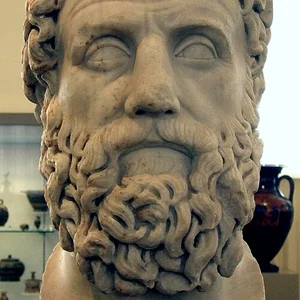

Archilochus was an archaic Greek poet of the 7th century BC, native to the island of Paros. A mercenary soldier and poet, he is regarded as the inventor of iambic poetry and one of the first to express a personal and satirical voice in Greek literature.
Archilochus(687 av. J.-C. — 644 av. J.-C.)
Archilochus
7 min read
Frequently asked questions
Famous Quotes
« The fox knows many things, but the hedgehog knows one big thing.»
« Some Saian struts about with my shield, a flawless weapon that I had to leave behind against my will beside a bush; but I saved my life. What do I care about that shield? Let it go! I'll buy another one that will be no worse.»
Key Facts
- Born around 680 BC on the island of Paros, the son of a nobleman and a slave according to tradition
- Regarded as the founder of Greek iambic poetry (7th century BC)
- Led the life of a mercenary soldier, notably during the colonization of Thasos
- Used animal fables in his verse (the fox and the eagle) before Aesop
- Died around 645 BC, killed in battle according to tradition
Works & Achievements
Biting satirical poems that gave their name to the iambic verse. In them Archilochus attacks his enemies, notably **Lycambes**, with a savagery that became legendary.
A short poem in which the poet admits to throwing away his shield in order to survive. It overturns the heroic ideal inherited from **Homer** by choosing life over glory.
More solemn poems on war, mourning and fate, among the oldest preserved in Greek. In them Archilochus blends personal experience with moral reflection.
A poem taking up an animal fable to denounce betrayal, an ancestor of the genre that **Aesop** would later make his own. Its form, alternating long and short lines, is called an *epode*.
Lines evoking a solar eclipse at high noon to declare that anything is now possible. This astronomical marker helps historians date the poet's life.
A victory song celebrating the hero **Heracles**, long sung at the Olympic Games according to the ancients. It attests to the religious and public role of Archilochus's poetry.
Anecdotes
Archilochus wrote a famous poem in which he admits to abandoning his shield in a bush to flee a battle against the Thracians. Far from being ashamed of it, he declares that he can always buy himself another one, but that his life is irreplaceable. This scandalous frankness breaks with the heroic ideal of Homer, for whom throwing away one's weapon was the height of dishonor.
According to the legend reported by the Ancients, Archilochus was to marry Neobule, but her father Lycambes broke the marriage promise. The poet took revenge with iambic verses so fierce and biting that, it is said, Lycambes and his daughters died of shame, even going so far as to hang themselves. The story is no doubt exaggerated, but it shows the fear that Archilochus's satire inspired.
Archilochus led a double life as a mercenary soldier and a poet, which he sums up in a famous line: he says he is both a servant of Ares, the god of war, and a connoisseur of the lovely gift of the Muses. In his day, combining the profession of arms with the art of poetry in this way was a novelty that left a strong impression.
It is said that Archilochus was killed in battle by a man from Naxos nicknamed Calondas, or “the Crow.” When this warrior came to consult the oracle of Delphi, the Pythia is said to have driven him away, calling him the murderer of a servant of the Muses, showing the almost sacred respect that poets inspired.
The inhabitants of his native island, Paros, eventually came to venerate him with a true cult after his death. Several centuries later, a monument was erected in his honor, the Archilocheion, on which were engraved inscriptions recounting his life and his work, proof that he had become a local glory.
Primary Sources
Some Saian struts about with my shield, that flawless weapon which I had to leave, against my will, beside a bush. But I saved my life: what do I care about that shield? To hell with it — I'll buy another just as good.
I am the servant of lord Enyalios, god of war, and I also know the lovely gift of the Muses.
I have no liking for a tall general who struts with legs apart, proud of his curls and clean-shaven. Give me instead a short man, bandy-legged, but firm on his feet and full of heart.
Nothing now is beyond expectation, nothing too strange to swear to, nothing astonishing, since Zeus, father of the Olympians, made night out of midday by hiding the light of the radiant sun.
Key Places
Island of the Cyclades, in the Aegean Sea, where Archilochus was born. Famous for its white marble, highly prized throughout Antiquity.
Island in the northern Aegean colonized by the Parians, where Archilochus settled and fought. He describes it as a land rich in timber but far from welcoming.
Region of the mainland facing Thasos, home to warlike tribes against whom Archilochus fought as a mercenary. It was there that he is said to have abandoned his shield.
Great sanctuary of Apollo where people consulted the oracle of the Pythia. Tradition holds that the oracle honored the memory of Archilochus there as a servant of the Muses.
Monument raised in honor of Archilochus on his native island, several centuries after his death. Inscriptions there recounted his life and preserved his verses.
Typical Objects

Large round shield of wood and bronze carried by the Greek soldier. Archilochus made his own famous by recounting that he had abandoned it to flee a battle.

Long iron-tipped spear, the main weapon of the archaic Greek warrior. Archilochus says he earns his bread and his wine thanks to his spear.

Plucked string instrument on which the poet accompanied the singing of his verses. Greek poetry was first sung rather than read.

A type of rhythmic verse that Archilochus is said to have invented, particularly suited to satire and mockery. The word gave rise to “iambic.”

The medium on which poems were copied to preserve and circulate them. It is thanks to these copies that fragments of Archilochus have come down to us.

Ceramic vessel used at banquets where poems were recited. Archilochus invites his companions to drink while keeping watch on the deck of a ship.
School Curriculum
Vocabulary & Tags
Key Vocabulary
Daily Life
Morning
At the military camp, Archilochus rises at dawn and checks his soldier's gear: spear, shield and leather cuirass. Mornings might be spent on training, fatigue duties, or marching toward a new position facing the Thracian tribes.
Afternoon
When he is not in battle, the poet composes his verses in his head, setting them to a rhythm, for writing does not yet come easily. On the island of Paros or Thasos, he might also oversee the work in the fields or the trade in the harbor.
Evening
Evening brought the time of the banquet, the symposion, where wine cut with water was drunk while listening to poetry. There Archilochus would recite his iambics accompanied by the lyre, making his audience laugh or tremble with his mockery.
Food
People ate barley bread, olives, goat cheese, figs and fish, which was plentiful on the islands. Wine, always mixed with water, accompanied meals; Archilochus even says he drinks leaning on his spear while on guard duty.
Clothing
The Greeks of this era wore the chiton, a wool or linen tunic gathered at the waist, and a cloak, the himation, thrown over the shoulder. In battle, the soldier added a bronze helmet, a cuirass and greaves.
Housing
Archaic Greek houses were modest, made of sun-dried mud bricks on a stone foundation, with a roof of tiles or reeds. On campaign, the soldier slept under a tent or beneath the open sky, near the ships drawn up on the beach.
Historical Timeline
Period Vocabulary
Liens externes & ressources
Références
Œuvres
Les Iambes
VIIe siècle av. J.-C.
Le poème du bouclier (fr. 5)
VIIe siècle av. J.-C.
Élégies
VIIe siècle av. J.-C.
L'épode de la fable (Renard et Aigle)
VIIe siècle av. J.-C.
Fragment de l'éclipse (fr. 122)
vers 648 av. J.-C.
Hymne à Héraclès
VIIe siècle av. J.-C.