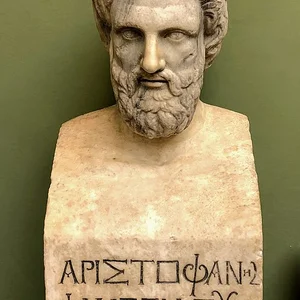

Aristophanes is the foremost representative of ancient Greek comedy, author of around forty plays, eleven of which have survived. His works blend political satire, social criticism, and poetic fantasy. He humorously staged the conflicts of his time, most notably the Peloponnesian War.
Aristophanes(444 av. J.-C. — 384 av. J.-C.)
Aristophanes
Athènes
10 min read
Frequently asked questions
Famous Quotes
« Often the truest words are spoken in jest.»
« Old age is a second childhood.»
Key Facts
- Born around 444 BC in Athens
- Wrote approximately 40 plays, 11 of which have been preserved
- The Clouds (423 BC) ridicules Socrates and the Sophists
- Lysistrata (411 BC) depicts women refusing to support the Peloponnesian War
- Died around 384 BC, a contemporary of Socrates and Plato
Works & Achievements
His earliest surviving comedy, which won first prize at the Lenaia. An Athenian farmer negotiates a private peace with Sparta, reflecting the popular longing for peace against the war party.
A savage satire of the demagogue Cleon, portrayed as a sausage seller. The play won first prize and stands as the most direct political attack Aristophanes ever wrote.
A comedy ridiculing Socrates and the Sophists, accused of corrupting the youth through their relativistic teachings. Though it placed only third, it is one of Aristophanes' best-known and most debated works.
A satire of the Athenian legal system and the obsession of older citizens with jury service, easily manipulated by demagogues. The play depicts a generational conflict between an obsessive juror father and his reform-minded son.
Performed just days before the signing of the Peace of Nicias, the comedy follows a farmer who flies on a giant dung beetle to free the goddess Peace from the grip of war. It expresses the popular relief at the end of hostilities.
A pacifist masterpiece in which the women of both sides go on a sex strike to force their husbands to make peace. A work of exceptional boldness, performed in the midst of renewed fighting after the Sicilian disaster.
Considered the most poetic of Aristophanes' comedies, two Athenians convince the birds to found an ideal city between earth and the gods. The play is a whimsical utopia as much as a satire of Athenian imperialism.
A comedy in which Dionysus descends to the Underworld to bring back Euripides, but ends up choosing Aeschylus after a literary debate. The play is a valuable document on ancient literary criticism and proved so popular it was performed again.
Anecdotes
Aristophanes dared to openly mock Cleon, the most powerful Athenian demagogue of his time, in his comedy The Knights (424 BC). Cleon was so feared that no one was willing to make the mask depicting him for the play — Aristophanes had to make up his own face to play the role himself.
In his play Lysistrata (411 BC), Aristophanes imagines that the women of Athens and Sparta refuse all intimate relations with their husbands until the Peloponnesian War is brought to an end. This bold fantasy, performed in the midst of the conflict, is considered one of the earliest pacifist texts in literary history.
Aristophanes was clearly fascinated by his contemporary Socrates, whom he caricatures in The Clouds (423 BC) as a charlatan floating in the air, teaching his students to reason in twisted ways. Plato reports that Socrates himself attended the performance, standing in the theater so the audience could compare the original to the caricature.
In The Frogs (405 BC), Aristophanes stages the god Dionysus descending to the Underworld to bring back the poet Euripides. The play includes a genuine literary debate between Aeschylus and Euripides, judged on the quality of their verses using a set of scales — a unique way of conducting literary criticism through comedy.
Aristophanes is one of the rare ancient authors whose work has survived in significant quantity: eleven complete comedies out of the roughly forty he is believed to have written. This exceptional preservation is explained by the use of his plays in Greek and Byzantine grammatical instruction for centuries.
Primary Sources
Socrates: 'I walk on air and contemplate the sun.' Strepsiades: 'And from your basket, you look down on the gods?' Socrates: 'I could never discover celestial phenomena if I did not suspend my thinking in the heights.'
Lysistrata: 'We must abstain from everything — listen to me — from all intercourse with our husbands. Why are you looking at me like that? Where are you going? You're frowning and shaking your heads? What does this change of color mean? Why these tears? Will you agree or not?'
Aeschylus: 'Tell me, what quality do you esteem most in a poet?' Euripides: 'Skill and wisdom, and that we make men better citizens in their cities.' Aeschylus: 'If you have not achieved that, but instead turned honest men into villains, what punishment do you deserve?'
Trygaeus: 'O dearest Peace, O sweetest of all divinities, how dear your face is to me! How sweet it is, how it breathes a fragrant scent! A scent that goes straight to my heart — a scent of freedom, of festivals, of theater, of weddings!'
Chorus: 'Come, old people, crowned with violets — for you well deserve to be — listen to the finest of men and the one most devoted to your interests. He declares he has something useful for the city at heart.'
Key Places
The venue where all of Aristophanes' comedies were first performed, built into the southern slope of the Acropolis and capable of holding up to 17,000 spectators. This is where Athenian democracy gathered not only to laugh, but to reflect on the poet's political critiques.
The central public square of the city, where merchants, philosophers, politicians, and citizens mingled — the beating heart of Athenian democratic life that Aristophanes so often staged. It was here that Socrates taught while strolling about, making him a favorite target of comic satire.
The sacred hill towering over the city, crowned by the Parthenon built under Pericles — a symbol of Athenian power and glory that Aristophanes both celebrated and criticized through its leaders. It appears in Lysistrata as the site occupied by the women during their protest.
An island close to Athens where Aristophanes reportedly owned land, according to ancient sources. This rural property reflects the poet's deep attachment to peasant life and the simplicity of the countryside, far from the political scheming of the city.
Athens' great rival city and chief enemy during the Peloponnesian War, frequently invoked in Aristophanes' comedies as a foil — or occasionally as a model of simple living. In Lysistrata, Spartan women join forces with the Athenians to bring about peace.
The meeting place of the Athenian popular Assembly (Ekklesia), where citizens voted on laws and military decisions. Aristophanes set several political scenes here, using this setting — instantly familiar to his audience — to sharpen his satirical edge.
Typical Objects

An iconic prop of ancient Greek theatre, the comic mask with its exaggerated features (gaping mouth, grotesque grimace) allowed actors to embody caricatured stock types. Aristophanes used it masterfully to mock politicians and philosophers.

A common writing surface in ancient Greece, on which the poet would compose and revise his texts using a stylus. Aristophanes would draft his dialogues in complex metres, often several months before a performance.

The material on which Aristophanes' plays were copied and circulated throughout the literate Greek world. His comedies survived thanks to successive copies of these scrolls kept in libraries, most notably the Library of Alexandria.

A shallow, two-handled vessel used for drinking wine at symposia — those festive philosophical banquets where culture and politics mingled freely. Wine and feasting appear throughout Aristophanes' comedies as symbols of peace and happiness.

Elaborate outfits worn by the twenty-four chorus members who performed the collective roles in the plays. Aristophanes often named his plays after whimsical chorus identities — wasps, birds, frogs, clouds — requiring spectacular and inventive costumes.

A double-reed wind instrument used to accompany choruses in Greek theatre. The choral music marked the lyrical passages of Aristophanes' comedies, which were often the most poetic and politically charged sections of his work.

A leather prop worn by comic actors, forming part of the traditional costume of Old Comedy. Aristophanes uses it as a recurring visual comic device, particularly in his plays dealing with war and sexuality.
School Curriculum
Vocabulary & Tags
Key Vocabulary
Daily Life
Morning
Aristophanes rose at dawn with the Mediterranean sun, like most Athenians. He likely devoted his mornings to poetic composition on wax tablets, a task requiring concentration and silence. As a citizen, he may also have taken part in gymnasium exercises or discussions at the Agora before the heat of the day set in.
Afternoon
In the afternoons, he probably frequented the typical gathering places of Athenian male society: the Agora to observe the human types he would later caricature, the workshops of craftsmen, or the public baths. He also worked with his actors and the choregos (the wealthy patron who financed the production) on rehearsals — an intensive process lasting several weeks.
Evening
Athenian evenings were often given over to symposia — banquets among men of good company where wine mixed with water was drunk, poems were recited, and politics and philosophy were debated. It was in these cultivated circles that Aristophanes mingled with the intellectuals and politicians he would satirize on stage the following day.
Food
Like most Greeks of the classical period, Aristophanes' diet consisted mainly of barley or wheat bread, olives and olive oil, vegetables (broad beans, lentils, onions), cheese, and dried fish. Meat was reserved for religious sacrifices and major festive occasions. Wine, always diluted with water, was the everyday drink of adults.
Clothing
Aristophanes wore the chiton, a linen or wool tunic fastened at the shoulders, and the himation, a large rectangular cloak draped over it. As a prosperous citizen, his garments were likely of good quality and possibly dyed. Leather sandals completed the outfit, though bare feet were common in private spaces.
Housing
Aristophanes most likely lived in a traditional Athenian house (oikos) organized around an inner courtyard, with separate rooms for men (andron) and women (gynaeceum). The walls were of whitewashed mud brick, and the floors of packed earth or simple mosaic. He may also have owned a rural estate in Attica, in keeping with his deep attachment to peasant values.
Historical Timeline
Period Vocabulary
Visual Style
Esthétique de la céramique à figures rouges athénienne : tons chauds de terre cuite et d'ocre sur fond noir, avec masques comiques exagérés, drapés fluides et décor architectural des temples classiques.
Sound Ambience
L'atmosphère sonore du théâtre de Dionysos : foule enthousiaste, flûte aulos scandant les chœurs et éclats de rire traversant l'air chaud de l'Attique sous ciel bleu.
Liens externes & ressources
Références
Œuvres
Les Acharniens (Acharneis)
425 av. J.-C.
Les Cavaliers (Hippeis)
424 av. J.-C.
Les Nuées (Nephelai)
423 av. J.-C.
Les Guêpes (Sphèkes)
422 av. J.-C.
La Paix (Eirene)
421 av. J.-C.
Lysistrata
411 av. J.-C.
Les Oiseaux (Ornithes)
414 av. J.-C.