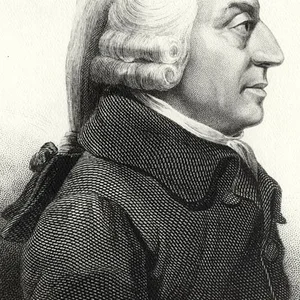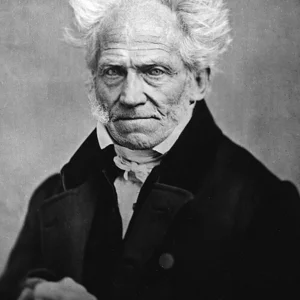

A 19th-century German philosopher, Schopenhauer is the great thinker of pessimism and the will. His masterwork, The World as Will and Representation (1818), profoundly influenced Nietzsche, Freud, and Wagner.
Arthur Schopenhauer(1788 — 1860)
Arthur Schopenhauer
royaume de Prusse
8 min read
Frequently asked questions
Famous Quotes
« Life swings like a pendulum back and forth between pain and boredom.»
« Talent hits a target no one else can hit; genius hits a target no one else can see.»
« Compassion is the basis of all morality.»
Key Facts
- 1788: born in Danzig (present-day Gdańsk, Poland)
- 1813: defends his doctoral thesis On the Fourfold Root of the Principle of Sufficient Reason
- 1818: publishes his masterwork The World as Will and Representation
- 1820: rivalry with Hegel at the University of Berlin, where he deliberately schedules his lectures at the same time
- 1860: dies in Frankfurt, belatedly recognized as a great philosopher
Works & Achievements
Schopenhauer's doctoral dissertation, laying the epistemological foundations of his philosophy. He analyzes the four forms through which the principle of causality governs our knowledge of the world.
Schopenhauer's absolute masterpiece, in which he develops his vision of the world as a dual reality: representation (what we perceive) and blind Will (the dark force animating all things). The founding work of Western philosophical pessimism.
An essay in which Schopenhauer confronts his metaphysics of the Will with the natural science discoveries of his time, seeking empirical confirmation for his philosophical system.
A collection bringing together his two essays on the freedom of the will and the basis of morality. Schopenhauer argues that compassion — not Kantian reason — is the only authentic foundation of ethics.
A collection of accessible essays on varied subjects (practical wisdom, psychology, literature, philosophy). This late work finally brought Schopenhauer the international fame he had fruitlessly awaited for forty years.
Anecdotes
Schopenhauer was known for his misanthropic personality and his passionate love of animals, particularly poodles. He owned several of these dogs in succession, naming them all 'Atma' — a Sanskrit term for the universal soul — reflecting his Buddhist-influenced philosophy on the unity of all life.
For decades, Schopenhauer was ignored by the general public and academia alike. He had made the ill-advised decision to schedule his lectures in Berlin at the same time as Hegel, the star philosopher of the era — with disastrous results: his lecture halls sat empty while Hegel's overflowed. Fame only came to him late in life, in the 1850s.
In 1851, Schopenhauer published Parerga and Paralipomena, a collection of accessible and incisive essays. This book, which he considered a minor work, paradoxically became the success that finally brought him celebrity at over sixty years of age. He felt both relieved and bitter about it, painfully aware of the years lost to obscurity.
Schopenhauer harbored a deep and lasting hatred for Hegel, whom he called a 'charlatan' and an 'impostor.' This philosophical rivalry was no mere posturing: for Schopenhauer, Hegelian idealism represented precisely the kind of hollow, pretentious speculation he had spent his entire career fighting against.
By the end of his life, Schopenhauer had become so famous that visitors came from around the world to see him in Frankfurt. Every day he lunched at the same table in the same restaurant, read the English Times — which he loved — and walked his poodle through the streets of the city. This unchanging routine stood in curious contrast to the turbulence of his philosophy.
Primary Sources
The world is my representation: this is a truth valid for every living and thinking being... A man does not know a sun, does not know an earth; he only knows an eye that sees a sun, a hand that touches an earth.
The will to live is the foundation of our being; it is what drives us, agitates us, makes us suffer. All suffering arises from an unsatisfied desire, and every satisfied desire immediately gives rise to a new boredom.
The health of the soul, inner peace — that priceless good we sometimes call happiness — depends far more on what we are than on what we have or how we appear in the eyes of others.
Nothing is without a sufficient reason for being. This principle is the foundation of all science and all knowledge. Without it, no demonstration, no explanation could ever be successfully carried out.
It is to your teachings, to your work on the theory of colors, that I owe my understanding that philosophical truth cannot do without the observation of the sensible world, and that metaphysics must be rooted in nature.
Key Places
Schopenhauer's birthplace, then a cosmopolitan Hanseatic port city. Being born into this European merchant milieu gave him a lifelong taste for travel and foreign languages.
His mother Johanna Schopenhauer ran a celebrated literary salon there, where the young Arthur met Goethe. Their intellectual relationship was fruitful, though marked by deep tension with his mother, with whom he was seriously estranged.
Schopenhauer taught there as a Privatdozent from 1820, deliberately scheduling his lectures at the same times as Hegel. The failure of this direct confrontation led him to abandon an academic career for good.
The city where Schopenhauer settled in 1831 and lived until his death in 1860. He led a solitary and regimented life there, lunching every day at the same restaurant and walking his poodle through the streets of the old town.
Schopenhauer traveled extensively in Italy between 1818 and 1819 following the publication of his major work. These Mediterranean stays enriched his aesthetic thinking on beauty as a temporary escape from the Will.
Typical Objects

Schopenhauer considered this collection of Indian philosophical texts the greatest consolation of his life. He kept a copy on his bedside table and saw in it a confirmation of his own metaphysics of the Will.

Schopenhauer always kept a poodle, which he named 'Atma' — the Sanskrit word for the universal soul. This animal was his daily companion, a symbol of his conviction that compassion toward all living beings is the foundation of morality.

A great lover of music and opera, Schopenhauer was a regular at the concert halls and theaters of Frankfurt. For him, music was the supreme art form — a direct expression of the universal Will, beyond all representation.

Schopenhauer read The Times of London every day, a reflection of his cosmopolitan outlook and his excellent command of English, a language he had learned during his travels and continued to use throughout his life.

Schopenhauer collected Buddhist statuettes and representations. He admired Buddhism for its emphasis on universal suffering and detachment — a philosophy he considered the closest to his own worldview.

From an early age, Schopenhauer methodically recorded his reflections in personal notebooks. A large portion of his Parerga and Paralipomena grew out of these notes, accumulated over decades of productive solitude.
School Curriculum
Vocabulary & Tags
Key Vocabulary
Daily Life
Morning
Schopenhauer rose early and devoted his mornings to philosophical work with rigorous discipline. He would write and think for several hours in his Frankfurt apartment, surrounded by his books and his Buddhist figurines. His working mornings were jealously guarded against any interruption.
Afternoon
Every day at the same time, Schopenhauer went for lunch at the Englischer Hof restaurant in Frankfurt, where he always occupied the same table. His afternoons were devoted to long walks through the city with his poodle Atma — walks he considered essential to physical health and mental clarity.
Evening
Schopenhauer's evenings were often spent at concerts and the theatre, which he attended regularly. He also read extensively at night, particularly works of science and literature in several languages — he was fluent in German, French, English, and Italian. He went to bed early, following a meticulous daily routine.
Food
Schopenhauer was a food lover of fixed habits who lunched at a restaurant every day, enjoying well-prepared, traditional cooking. He drank wine in moderation, was fond of coffee, and placed great importance on the pleasures of the table as a compensation for life's inevitable suffering. He had little patience for excessive dietary asceticism, preferring a reasoned temperance.
Clothing
Schopenhauer dressed with the understated elegance of a German bourgeois gentleman of the mid-19th century: a dark coat, carefully knotted cravat, and a wool waistcoat. Nothing ostentatious, but meticulous attention to his appearance — a reflection of a certain aristocratic stoicism in the way he moved through the social world.
Housing
In Frankfurt, Schopenhauer occupied a comfortable but unpretentious bourgeois apartment, adorned with his collection of Buddhist figurines and a portrait of Kant hung on the wall. His library was the heart of his living space. He lived alone — never married, and known for his difficult relationships with women — in the company of his faithful poodle.
Historical Timeline
Period Vocabulary
Visual Style
L'univers visuel de Schopenhauer s'inscrit dans l'esthétique Biedermeier et romantique allemande : intérieurs bourgeois sombres et studieux, atmosphère de clair-obscur mélancolique rappelant les paysages existentiels de Caspar David Friedrich.
Sound Ambience
L'univers sonore de Schopenhauer mêle le silence studieux d'un appartement de philosophe solitaire à Francfort aux sons feutrés de la ville bourgeoise du XIXe siècle, ponctué par la musique qu'il vénérait par-dessus tout.
Liens externes & ressources
Références
Œuvres
De la quadruple racine du principe de raison suffisante
1813
Le Monde comme volonté et comme représentation
1818
Sur la volonté dans la nature
1836
Les Deux Problèmes fondamentaux de l'éthique
1841
Parerga et Paralipomena
1851