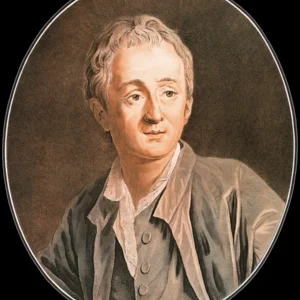

French philosopher, writer, and encyclopedist (1713–1784), a leading figure of the Enlightenment. Co-editor of the Encyclopédie with d'Alembert, he embodies the critical spirit and pursuit of rational knowledge that defined the 18th century. Author of philosophical novels such as Jacques the Fatalist, he helped transform European intellectual thought.
Denis Diderot(1713 — 1784)
Denis Diderot
royaume de France
6 min read
Frequently asked questions
Famous Quotes
« Enthusiasm is the true soul of genius.»
« Those who have no enemies have no character.»
« Nature has made neither masters nor slaves; I neither want to give nor to receive laws.»
Key Facts
- 1747: Publication of Letter on the Blind, his first major philosophical work blending sensualist reflection and critique
- 1751–1772: Co-direction of the Encyclopédie with d'Alembert, a monumental 28-volume project gathering the knowledge of the Enlightenment
- 1762: Publication of Rameau's Nephew, a satirical dialogue novel criticizing social mores
- 1796: Posthumous publication of Jacques the Fatalist and His Master, a philosophical novel exploring freedom and determinism
- 1784: Death in Paris after a life devoted to combating obscurantism through reason and knowledge
Works & Achievements
A monumental work in 28 volumes co-edited with d'Alembert, aiming to gather all human knowledge. It is considered the very symbol of the Enlightenment spirit.
A bold philosophical essay that questions the relationship between sensory perception and knowledge, and challenges the existence of God.
A satirical and philosophical dialogue between a philosopher and a cynical bohemian, exploring morality, genius, and society. Published posthumously.
An innovative philosophical novel that blends embedded narratives with reflections on free will and determinism, in an avant-garde narrative style.
A play that established the genre of bourgeois drama, halfway between tragedy and comedy, depicting characters from everyday life.
A philosophical dialogue in which Diderot develops a materialist and transformist vision of living beings, anticipating certain ideas of modern biology.
A philosophical dialogue that contrasts the natural customs of Tahitians with European morality, questioning colonialism and social conventions.
Anecdotes
Diderot was imprisoned in the dungeon of Vincennes in 1749 for his Letter on the Blind, deemed subversive by the authorities. It was during this detention that his friend Jean-Jacques Rousseau visited him and had, on the way, the illumination that gave birth to the Discourse on the Sciences and the Arts.
When Diderot needed money for his daughter's dowry, Empress Catherine II of Russia bought his entire library while allowing him to remain its keeper in Paris, and additionally paid him an annual librarian's salary. This generous gesture made Diderot one of the few philosophers to benefit from such an original form of patronage.
Diderot spent more than twenty years directing the Encyclopédie, from 1751 to 1772. He personally wrote several thousand articles, sometimes on highly technical subjects such as the manufacture of silk stockings or cutlery, having visited craftsmen's workshops to observe their work with his own eyes.
In 1773, Diderot made the long journey to Saint Petersburg to meet Catherine II. During their daily conversations, he had a habit of slapping the empress's thigh to emphasize his arguments, which greatly amused the sovereign, who later recounted that her thighs were covered in bruises.
Diderot wrote Rameau's Nephew, one of his masterpieces, without ever publishing it during his lifetime. The text only became known to the public in 1805, through a German translation made by Goethe from a manuscript copy, even before the French original was recovered.
Primary Sources
The goal of an Encyclopédie is to gather the knowledge scattered across the surface of the earth, to set forth its general system to the men among whom we live, and to transmit it to those who will come after us.
If you want me to believe in God, you must make me touch him.
All beings circulate within one another, and consequently all species... everything is in perpetual flux... Every animal is more or less human; every mineral is more or less a plant; every plant is more or less an animal.
It is impossible for me to live happily or peacefully when I am far from you. I need to tell you this, and I will tell you so endlessly.
Key Places
Diderot's birthplace in Haute-Marne, where he grew up in his family's cutlery workshop home. He retained a deep attachment to the town throughout his life.
Famous literary café in the Latin Quarter where Diderot met with philosophers and encyclopedists to debate new ideas.
Diderot's place of detention in 1749, where he spent three months imprisoned for writings deemed contrary to religion.
Diderot's Parisian address for much of his active life, where he worked on writing the Encyclopédie.
Catherine II's residence where Diderot stayed from 1773 to 1774 and held daily conversations with the empress.
Liens externes & ressources
Références
Œuvres
Encyclopédie ou Dictionnaire raisonné des sciences, des arts et des métiers
1751-1772
Lettre sur les aveugles à l'usage de ceux qui voient
1749
Le Neveu de Rameau
rédigé vers 1761-1774
Jacques le Fataliste et son maître
rédigé vers 1765-1780
Le Fils naturel
1757
Le Rêve de d'Alembert
1769
Supplément au Voyage de Bougainville
1772
Rechercher
See also
Related Characters
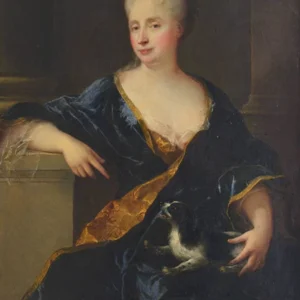
Anne Thérèse de Marguenat de Courcelles, marquise de Lambert
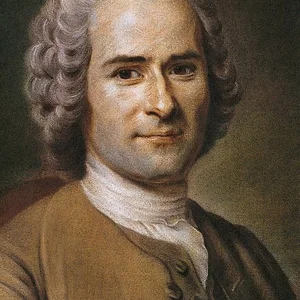
Jean-Jacques Rousseau
1712 — 1778
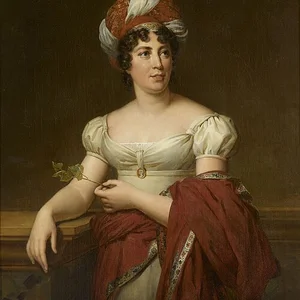
Madame de Staël
1766 — 1817
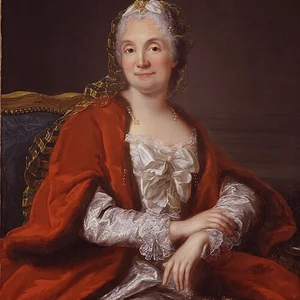
Madame Geoffrin
1699 — 1777
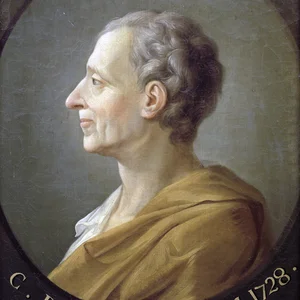
Montesquieu
1689 — 1755
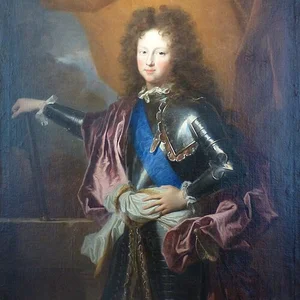
Philippe II d'Orléans