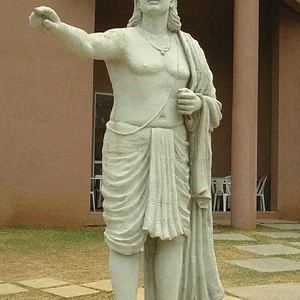

Āryabhata was an Indian mathematician and astronomer born in 476, the first of the great scholars of India's classical age. Author of the Āryabhaṭīya, he set down major advances in arithmetic, algebra, and astronomy.
Aryabhata(476 — 550)
Āryabhata
6 min read
Frequently asked questions
Key Facts
- Born in 476, in India during the classical age (Gupta Empire)
- Wrote the Āryabhaṭīya in 499, at the age of 23
- Gave a remarkable approximation of the number π (3.1416)
- Described methods for calculating square and cube roots
- Put forward the idea of the Earth's rotation on its axis to explain the apparent motion of the stars
Works & Achievements
Major treatise in Sanskrit verse covering arithmetic, algebra, trigonometry and astronomy; a cornerstone of classical Indian mathematics.
Calculation of a remarkably precise value of π, described as “approximate”, which reveals great mathematical sophistication.
One of the earliest trigonometric tables in history, the origin of the word “sine” by way of Arabic and then Latin.
The claim that the Earth spins on its axis, explaining the apparent motion of the stars — a remarkably bold idea for its time.
Demonstration that eclipses result from the shadows of the Earth and the Moon, rejecting mythological explanations.
An algorithm for solving indeterminate equations (Diophantine analysis), used in astronomy for calculating periods.
A poetic notation allowing very large astronomical numbers to be encoded in a memorable form.
Anecdotes
In his Āryabhaṭīya, Āryabhata calculates the value of π with remarkable precision: 3.1416. He even specifies that this number is “approximate” (āsanna), which suggests he may have had an intuition that π cannot be written exactly — an idea that mathematicians would not prove until the 18th century.
Āryabhata claims that the Earth spins on its own axis and that it is this rotation which gives the illusion of a sky turning above our heads. He compares this to a traveler on a boat who sees the trees on the riverbank “go by” when in fact it is he and his vessel that are moving. This bold idea ran counter to the beliefs of his time.
To write very large numbers in his verses, Āryabhata invents a system in which syllables represent digits, allowing him to encode enormous astronomical values in a few words that are easy to memorize. Scholars thus used poetry as a way to remember complex calculations.
Āryabhata offers a scientific explanation of eclipses: the Moon darkens because it enters the Earth's shadow, and the Sun is hidden by the Moon. He thereby rejects the popular belief that a demon named Rāhu “swallowed” the celestial bodies during eclipses.
He completes his treatise at just 23 years old, as he himself indicates in the text by specifying his age. This astonishing youthfulness shows just how thoroughly he had already mastered the mathematics and astronomy of his era.
Primary Sources
Add 4 to 100, multiply by 8, then add 62,000: the result is approximately the circumference of a circle of diameter 20,000. (i.e. π ≈ 3.1416)
Just as a man in a moving boat sees the stationary objects move backwards, so the fixed stars appear to an observer at Laṅkā to move westward.
The Moon eclipses the Sun, and the great shadow of the Earth eclipses the Moon.
When sixty times sixty years and three quarters of a yuga had elapsed, twenty-three years had passed since my birth.
Key Places
Great city of Magadha where Āryabhata lived, studied and composed the Āryabhaṭīya; a major intellectual center of the Gupta Empire.
Historical region where he was probably born and which formed the heart of the Gupta Empire.
Famous center of learning in Magadha; some historians believe that Āryabhata headed a scholarly institution there.
A major astronomical center of ancient India, located on the Indian reference meridian, whose observations were in dialogue with Āryabhata's work.
Typical Objects

A vertical rod planted in the ground whose shadow, measured throughout the day, makes it possible to determine the time, the latitude and the Sun's positions. Āryabhata describes its use in his calculations.

A water clock used to measure regular intervals of time during astronomical observations. A pierced bowl slowly sank into the water.

A writing medium made from dried palm leaves engraved with a stylus, onto which scholarly treatises such as the Āryabhaṭīya were copied.

A metal point used to incise characters into palm leaves, which were then blackened with soot to make them legible.

A model made of interlocking rings representing the celestial sphere and the paths of the heavenly bodies, used to teach and to calculate in astronomy.

A list of trigonometric values calculated by Āryabhata, one of the earliest tables of sines in history, indispensable for astronomical calculations.
School Curriculum
Vocabulary & Tags
Key Vocabulary
Daily Life
Morning
At daybreak, Āryabhata records the last positions of the celestial bodies observed during the night and performs his ritual ablutions and prayers. The morning is devoted to teaching his students and reading ancient treatises on palm leaves.
Afternoon
The afternoon is spent on calculations: he lays out the numbers, builds his tables of sines, and checks his approximations using the gnomon whose shadow he measures. He also discusses the positions of the Sun and the planets with other scholars.
Evening
As night falls, the most important work begins: observing the sky. Equipped with simple instruments and a water clock to measure time, he records the positions of the stars and planets to test his calculations against reality.
Food
His diet, in keeping with the customs of a scholar of Gupta India, rests mainly on rice, pulses (lentils, peas), vegetables, fruit, and dairy products such as curds and clarified butter (ghee). Spices flavor the dishes, and the diet is largely vegetarian.
Clothing
He wears light cotton garments suited to the hot climate: a dhotī, a piece of cloth draped around the waist, and a length of fabric covering the upper body. Scholars and Brahmins were distinguished by the plainness of their attire.
Housing
He probably lives in a simple dwelling near a center of learning in Kusumapura, made of brick or of wood and cob, with a courtyard. The home would have offered an open space allowing observation of the night sky.
Historical Timeline
Period Vocabulary
Liens externes & ressources
Références
Œuvres
Āryabhaṭīya
vers 499
Approximation de π (3,1416)
vers 499
Table des sinus (valeurs de jyā)
vers 499
Théorie de la rotation de la Terre
vers 499
Explication scientifique des éclipses
vers 499
Méthode de résolution d'équations (kuṭṭaka)
vers 499
Système de numération par syllabes
vers 499