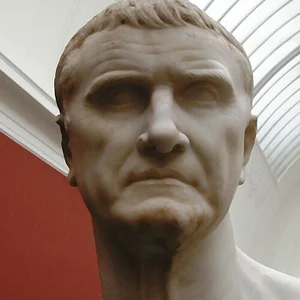

A Roman politician and general of the 1st century BC, Crassus was the wealthiest man in Rome. He formed the First Triumvirate with Caesar and Pompey in 60 BC. He died in the disastrous Battle of Carrhae against the Parthians.
Crassus(114 av. J.-C. — 52 av. J.-C.)
Crassus
Rome antique
7 min read
Frequently asked questions
Key Facts
- c. 115 BC: born into a Roman patrician family
- 73–71 BC: crushes the Spartacus revolt with his private army
- 60 BC: forms the First Triumvirate with Julius Caesar and Pompey
- 55 BC: appointed consul then governor of Syria
- 53 BC: dies at the Battle of Carrhae, a major defeat against the Parthians
Works & Achievements
Crassus took command of the Servile War and encircled Spartacus's army in Lucania using a strategic 55 km trench. His victory ended the largest slave rebellion in Roman history.
Held alongside Pompey, this consulship saw the restoration of the powers of the tribunate that Sulla had abolished. It strengthened Crassus's image as a statesman capable of balancing his private interests with the public good.
A secret political alliance formed with Caesar and Pompey to control the institutions of the Roman Republic. This pact inaugurated an era of personal domination that led inexorably to the end of the Republic.
A secret meeting of the triumvirs in Etruria that renewed their pact and distributed the imperial provinces. Crassus secured Syria, a springboard for his Parthian ambitions and his hopes for military glory.
A military expedition against the Parthian kingdom, undertaken to rival Caesar and Pompey in glory. It ended in the disaster at Carrhae, the capture of the legionary standards, and the death of Crassus.
Anecdotes
Crassus owned a private fire brigade of 500 slave firefighters. But whenever a fire broke out in Rome, he would only send his men in after negotiating the purchase of the burning building at a rock-bottom price. Through this cynical scheme, he eventually came to own a large portion of Rome's real estate.
To crush the Spartacus revolt in 71 BC, Crassus had 6,000 captured slaves crucified along the entire length of the Via Appia, from Capua to Rome — one body every thirty meters over nearly 200 kilometers. This gruesome spectacle was intended to deter any future slave rebellion.
Envious of the military glory of Pompey and Caesar, Crassus was desperate to win a great victory against the Parthians. At the Battle of Carrhae in 53 BC, his army was annihilated by the Parthian cavalry and their fearsome archers. Crassus was killed during the negotiations that followed, a victim of his own ambition.
According to the legend reported by Cassius Dio, the Parthians supposedly poured molten gold down the throat of Crassus's corpse, mocking his insatiable thirst for wealth. While the anecdote is probably apocryphal, it perfectly illustrates the reputation for greed that followed him throughout his life.
Crassus was famous for his lavish banquets to which he invited thousands of Romans. On one occasion he distributed three months' worth of grain to every plebeian family and offered public feasts in his own honor. These calculated acts of generosity were far from selfless: they guaranteed him an enormous base of political clients.
Primary Sources
Crassus kept a large number of slave architects and builders, so that at Rome he would buy up houses that were on fire and those adjoining burning buildings, because their owners, in their alarm, let them go at low prices.
Crassus had the prisoners of Spartacus crucified along the Appian Way, from Capua to Rome, to the number of six thousand.
Surena, after cutting off the head and right hand of Crassus, sent them to Hyrodes. It is said that the Parthians poured molten gold into his mouth, mocking his love of riches.
Crassus is immensely wealthy and equally ambitious; he seeks by every means to match the glory of Pompey and to extend his influence over the eastern provinces.
Key Places
The political and judicial heart of Rome, where Crassus served as consul and censor. It was here that he forged his alliances, argued his cases, and consolidated his grip on the Senate.
The great Roman road along which Crassus had 6,000 enslaved survivors of Spartacus's revolt crucified in 71 BC. This brutal act left an indelible mark on Roman collective memory.
A city in Upper Mesopotamia (in present-day southeastern Turkey) where Crassus suffered his fatal defeat against the Parthians in 53 BC. The Battle of Carrhae remains one of Rome's worst military disasters.
The Italian city where Spartacus's revolt began in a gladiatorial school. Crassus massed his legions here before encircling and crushing the rebels on the plains of Lucania.
Capital of the Roman province of Syria and Crassus's rear base as he prepared for the Parthian war. He gathered his legions and financial resources here for the expedition that would cost him his life.
Typical Objects

Wooden tablets coated with wax, used to record contracts, accounts, and messages. Crassus used them daily to manage his countless real estate and financial transactions.

Small pouch worn at the belt, holding silver coins and denarii. For Crassus, a symbol of his legendary wealth and an instrument of his constant financial speculation.

White toga bordered with purple, reserved for high-ranking Roman magistrates. Crassus wore it during his consulships, publicly displaying his political power no less than his economic influence.

Bronze breastplate molded in the shape of a muscular torso, worn by Roman generals. Crassus donned it during his disastrous Parthian campaign in 53 BC.

Bundles of rods bound around an axe, carried by the lictors who escorted magistrates. A symbol of consular imperium, they accompanied Crassus on all his official appearances.

Document notarizing the transfer of a piece of real estate, drawn up on papyrus or wooden tablets. Crassus accumulated hundreds of them, buying up Roman buildings gutted by fire.
School Curriculum
Vocabulary & Tags
Key Vocabulary
Daily Life
Morning
Crassus rose at dawn and received his clients (clientela) in the atrium of his Palatine domus, granting favors, legal advice, and loans in exchange for political support. He then reviewed, alongside his stewards, the accounts of his properties, mining operations, and outstanding loans.
Afternoon
The middle of the day was devoted to public affairs: the Forum, the Senate, the courts. There, Crassus met with Caesar and Pompey, negotiated alliances, argued cases, or oversaw the auctioning of properties acquired after fires. Plutarch notes that he was never idle.
Evening
In the evenings, Crassus hosted or attended banquets (convivia) at his villa, welcoming senators, knights, and men of letters. These lavish dinners, accompanied by Campanian wines, served as opportunities to strengthen his network of influence while conspicuously displaying his generosity.
Food
Crassus's table reflected his rank: saltwater fish, Italian oysters, stuffed poultry, fine breads, pickled vegetables, fresh fruit, and honey cakes. All washed down with Greek or Italian wines diluted with water, following Roman custom. The public banquets he hosted could draw thousands of guests.
Clothing
In public life, Crassus wore the white purple-bordered toga praetexta during his consular duties, over a fine linen tunic belted at the waist. On military campaign, he donned the bronze breastplate (lorica musculata) and the commander's red cloak (paludamentum).
Housing
Crassus lived in a patrician domus on the Palatine Hill, richly decorated with marble, frescoes, and mosaics, complete with an interior garden and pool. He also owned holiday villae in Campania and vast agricultural estates. Plutarch reports that he nonetheless criticized the excessive luxury of his contemporary Lucullus.
Historical Timeline
Period Vocabulary
Visual Style
Esthétique de la Rome républicaine tardive : marbre blanc et mosaïques dorées côtoient les paysages désertiques de Syrie, avec la toge pourpre des grands patriciens et l'éclat brutal des armures légionnaires.
Sound Ambience
Une Rome républicaine tardive bruyante et fiévreuse : les cris du forum, les transactions financières au comptoir, le fracas militaire des légions et les incendies nocturnes qui enrichissent Crassus.
Liens externes & ressources
Références
Œuvres
Répression de la révolte de Spartacus
73-71 av. J.-C.
Premier consulat (avec Pompée)
70 av. J.-C.
Premier triumvirat
60 av. J.-C.
Conférence de Lucques
56 av. J.-C.
Campagne de Parthie
55-53 av. J.-C.
See also
Related Characters
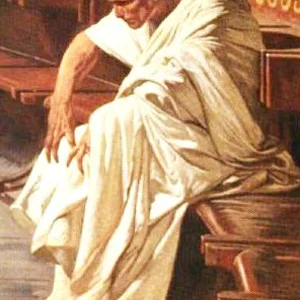
Catiline
107 av. J.-C. — 61 av. J.-C.
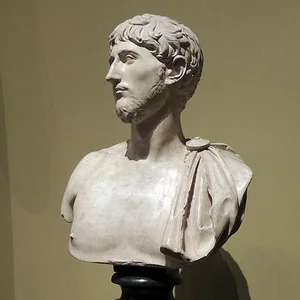
Lepidus
89 av. J.-C. — 12 av. J.-C.
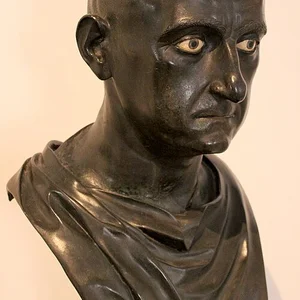
Scipio Africanus
234 av. J.-C. — 182 av. J.-C.
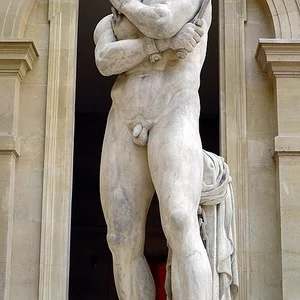
Spartacus
102 av. J.-C. — 70 av. J.-C.
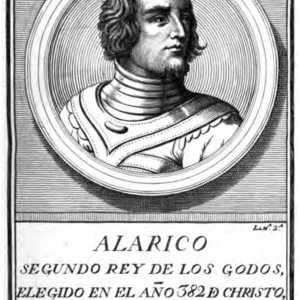
Alaric I
370 — 410
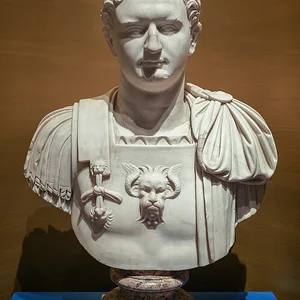
Domitian
51 — 96