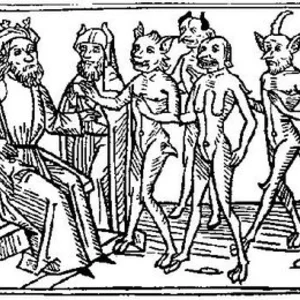

Belial is a demonic figure from ancient Hebrew and Jewish traditions, whose name means 'worthless' or 'wickedness'. He appears in the Dead Sea Scrolls as a prince of darkness opposed to the Archangel Michael. He is considered one of the four crowned princes of Hell in medieval demonology.
Belial
Belial
9 min read
Frequently asked questions
Key Facts
- The term 'Belial' appears as early as the 9th century BCE in the Hebrew Bible to denote moral depravity.
- In the Dead Sea Scrolls (2nd–1st century BCE), Belial is personified as the leader of the forces of evil, opposing the Archangel Michael.
- The 'Community Rule' (1QS) of the Qumran Essenes presents Belial as the chief of the 'sons of darkness'.
- In the 'War of the Sons of Light Against the Sons of Darkness', Belial commands the demonic armies in a final cosmic conflict.
- In the Middle Ages, Christian demonology incorporated him among the four crowned princes of Hell, associated with anarchy and lies.
Works & Achievements
A text from the Qumran community describing the final eschatological war between the Sons of Light and the Sons of Darkness, led by Belial. It is the most detailed document on Belial's military and cosmic role.
An Essene text describing Belial's corrupting influence throughout the history of Israel through three moral snares. This document is essential for understanding how Belial was woven into a theological reading of Jewish history.
A retelling of Genesis and Exodus in which Belial (under the name Mastema) acts as an adversary of God and the patriarchs. This text reveals the emergence of a structured good-versus-evil dualism in Jewish thought.
A collection of fictional testaments from the sons of Jacob in which Belial is presented as the instigator of all human wrongdoing. This text shows how Belial became a theological explanation for moral evil.
A collection of Judeo-Hellenistic prophecies in which Belial appears as a false messiah who will come to lead humanity astray before the end of times. This text illustrates the spread of the figure of Belial throughout the Mediterranean world.
Paul of Tarsus's mention opposing Christ and Belial, permanently establishing the figure within Christian theology. It is the only occurrence of the name in the canonical New Testament.
Anecdotes
In the War Scroll discovered at Qumran, Belial is presented as the supreme commander of the army of darkness, opposed to the archangel Michael who leads the Sons of Light. This text, written around 150 BCE, describes a final eschatological war between good and evil, in which Belial will be definitively defeated.
The Hebrew name 'Belial' (בְּלִיַּעַל) is a combination of the words 'beli' (without) and 'ya'al' (worth or use), literally meaning 'worthless' or 'the useless one'. In the Hebrew Bible, the expression 'sons of Belial' refers to immoral or corrupt individuals, long before the term came to designate a full-fledged demonic entity.
The apostle Paul mentions Belial in his second letter to the Corinthians (6:15), asking: 'What accord has Christ with Belial?' This is one of the rare uses of the name in the New Testament, reflecting the enduring presence of this figure in the Judeo-Christian imagination of the 1st century.
In the Damascus Document, another text from the Qumran community, Belial is described as having 'cast three nets' to ensnare Israel: fornication, wealth, and defilement of the Temple. This text reveals how the Essene community viewed Belial as responsible for the moral and religious corruption of their time.
In the medieval period, demonology treatises such as the Liber Officiorum Spirituum assign Belial the rank of king of hell and credit him with 80 legions of demons. He is described as having been created immediately after Lucifer, granting him a particularly high status in the infernal hierarchy imagined by medieval theologians.
Primary Sources
For this is the day appointed by God for the war of annihilation against all the sons of darkness. Belial and all the spirits of his lot are ready for the day of destruction.
Throughout all these years, Belial shall be unleashed against Israel, as God has spoken through the prophet Isaiah son of Amoz: Terror, pit, and snare are upon you, O inhabitant of the earth.
And Prince Mastema said to the Lord: Lord Creator, leave some of them before me, and let them listen to my voice and do according to all that I shall tell them; for if none are left, I shall not be able to exercise the power of my will among the sons of men.
And now, fear the Lord, my children, and beware of Satan and his spirits. Draw near to God and to the angel who intercedes for you, for he is the mediator between God and men.
What accord has Christ with Belial? Or what portion does a believer share with an unbeliever?
Key Places
Site of the Essene community where the principal texts about Belial were written, including the War Scroll and the Damascus Document. The surrounding caves preserved these manuscripts for two millennia.
The discovery site of the 972 Dead Sea Scrolls, found between 1947 and 1956, which revealed to the modern world the significance of Belial in ancient Jewish theology. The remote desert setting reinforced the sense of a universal spiritual struggle.
Religious center of Second Temple Judaism that Belial is accused of having defiled according to the Damascus Document. The holy city represents the central stake in the cosmic conflict between Belial and the divine forces.
A vast arid expanse perceived in Hebrew traditions as a place inhabited by evil spirits. In the Hebrew Bible, the desert is associated with primordial chaos and the forces that Belial embodies.
Typical Objects

The physical medium of the Qumran texts in which Belial is described. The Essenes meticulously copied sacred writings onto scrolls made of goat or sheepskin, preserving descriptions of Belial for future generations.

In the War Scroll, silver trumpets are used to coordinate battles against the armies of Belial. Inscriptions on these trumpets bore formulas such as 'Called of God' for the Sons of Light.

A universal symbol of light set against the darkness of Belial in the Essene tradition. Lamps burned continuously in the Qumran scribal centers, representing constant vigilance against the forces of evil.

A small leather case containing scriptural passages, worn as protection against the malevolent influences attributed to Belial and his spirits. This practice is well attested in Second Temple Judaism.

In Qumran theology, every human being belongs either to the 'lot of Belial' or the 'lot of God.' In concrete terms, this word referred to small objects drawn by lot to designate one's destiny, symbolizing each person's spiritual allegiance.

The tools of the Essene scribe who copied texts describing Belial in the Qumran scriptorium. A bronze inkwell was found at the site, bearing witness to the painstaking work of these copyists.
School Curriculum
Vocabulary & Tags
Key Vocabulary
Tags
Daily Life
Morning
According to the Qumran texts, at the break of day the spirits subject to Belial resume their work of seduction and leading men astray. The Essene community began its morning prayers precisely to counter this influence, reciting blessings to place themselves under divine protection against the 'lot of Belial'.
Afternoon
In Essene cosmology, the middle of the day is the time when Belial sets his three fundamental traps described in the Damascus Document: fornication, love of wealth, and profanation of worship. Members of the Qumran community devoted these hours to studying sacred texts in order to resist these temptations.
Evening
Night is Belial's domain par excellence in the ancient texts. The War Scroll describes how the armies of darkness grow in power as day gives way to dusk. The Essenes intensified their ritual practices at twilight, lighting lamps as symbols of divine light persisting against the darkness of Belial.
Food
As a spiritual entity, Belial has no diet of his own in the ancient texts. However, in the Qumran tradition, the Essenes' communal ritual meals were explicitly designed as an act of belonging to the 'lot of God' rather than the 'lot of Belial', giving these shared meals a dimension of spiritual resistance.
Clothing
In the rare late medieval depictions inspired by ancient texts, Belial is portrayed clothed in darkness, sometimes wearing dark armor symbolizing his warlike nature as described in the War Scroll. The Qumran texts offer no physical description, emphasizing instead his purely spiritual and invisible nature.
Housing
According to the Qumran texts, Belial does not dwell in a fixed place but reigns over the 'realm of darkness', a cosmic space opposed to the 'realm of light' governed by God. Some texts associate his presence with desert places, spaces of death, and the underworld — in contrast to the Temple in Jerusalem, the dwelling place of the divine presence.
Historical Timeline
Period Vocabulary
Visual Style
Style apocalyptique proche des enluminures de manuscrits anciens, jouant sur un clair-obscur dramatique opposant les ténèbres absolues de Bélial à la lumière fragile des Fils de Lumière, sur fond de texture parchemin et d'écriture hébraïque ancienne.
Sound Ambience
Ambiance du désert de Judée nocturne, mêlant le vent sur les rochers, les incantations des scribes de Qumrân et le son du shofar sonnant comme un avertissement contre les forces des ténèbres.
Liens externes & ressources
Références
Œuvres
Rouleau de la Guerre (1QM)
vers 150-100 av. J.-C.
Document de Damas (CD)
vers 100 av. J.-C.
Livre des Jubilés
vers 160-150 av. J.-C.
Testament des Douze Patriarches
IIe siècle av. J.-C.
Oracles sibyllins (extraits)
IIe siècle av. J.-C. — Ier siècle ap. J.-C.
Deuxième épître aux Corinthiens (6,15)
vers 55 ap. J.-C.