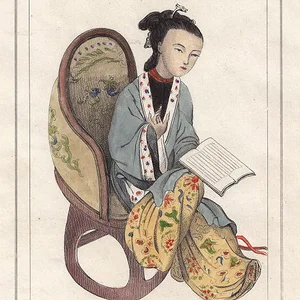

Ban Zhao (45–116) was China's first great female scholar, a historian and philosopher under the Eastern Han dynasty. She completed the works of her brother Ban Gu, most notably the Book of Han. Her treatise Lessons for Women (Nüjie) profoundly shaped Confucian thought on the role of women.
Ban Zhao(45 — 116)
Ban Zhao
Han orientaux
7 min read
Frequently asked questions
Key Facts
- Born around 45 CE into a family of scholars: her father Ban Biao and her brother Ban Gu were both renowned historians.
- Around 92 CE, she was summoned to the imperial court to complete the Book of Han (Hanshu), left unfinished by her brother Ban Gu, who had died in prison.
- Wrote Lessons for Women (Nüjie) around 100 CE, the first Chinese treatise on female education grounded in Confucian values.
- Became tutor to Empress Deng and the ladies of the court, gaining considerable political influence.
- Died around 116 CE, leaving behind a body of work that would be studied in China for more than fifteen centuries.
Works & Achievements
A treatise in seven chapters on Confucian feminine virtues: humility, deference, diligence, and respect for parents-in-law. A foundational text of female didactic literature in China, studied for over a thousand years.
Ban Zhao completed the eight chronological tables and the Treatise on Astronomy of the Hanshu, China's first dynastic history. This collective work, begun by her father and brother, remains a major historical reference.
A prose poem (fu) describing a journey and expressing the melancholy of family separation. It reveals the poetic and personal dimension of Ban Zhao, beyond her role as a historian.
A collection of lyrical compositions, partly lost, mentioned in dynastic sources. These texts attest to Ban Zhao's mastery of all literary genres of her era.
Anecdotes
When her brother Ban Gu died in prison in 92 AD without having completed the Book of Han (Hanshu), Emperor He called upon Ban Zhao to finish this monumental work. She completed the chronological tables and astronomical treatises, becoming the first official female historian in China.
Empress Deng Sui, regent of the empire, held Ban Zhao in such high regard that she summoned her to the palace to teach the ladies of the court. Ban Zhao taught calligraphy, astronomy, mathematics, and history — disciplines that were at the time reserved for men.
Ban Zhao wrote her celebrated Lessons for Women (Nüjie) not as a universal treatise, but to educate her own daughters before their marriages. In it she was both demanding and clear-eyed, insisting on women's education as a prerequisite for their dignity within Confucian society.
Born into an exceptional family of scholars, Ban Zhao had a historian father (Ban Biao) and two distinguished brothers: Ban Gu, the great historian, and Ban Chao, the legendary general who extended Chinese influence as far as Central Asia. She alone embodied the union of letters and history within the Han dynasty.
Toward the end of her life, when she was elderly and her son was stationed far away, Ban Zhao composed a poignant elegy expressing family separation and the melancholy of passing time. This poem, preserved in the Hou Hanshu, reveals a personal and sensitive voice behind the official scholarship.
Primary Sources
Humility means being respectful and reserved, putting others first and keeping oneself in the background, doing what one must even when one feels incapable, and enduring insult without complaint.
Ban Zhao completed the eight tables and the Treatise on Astronomy, sections that her brother Ban Gu had been unable to finish before his death.
Lady Cao was deeply learned; the empress dowager summoned her to the palace and sought her advice on matters of state. The ladies of the court called her 'Great Mistress'.
I journey eastward, far from my loved ones; my heart aches with the separation. The plains stretch as far as the eye can see, the wind blows over the yellowed grasses.
Key Places
Ban Zhao's hometown, in present-day northwestern China, and the cradle of the Ban family. It was here that her father Ban Biao and her brothers grew up in a family culture oriented toward letters and history.
The political and intellectual heart of China in the 1st and 2nd centuries, Luoyang was home to the imperial court, the archives, and the royal library where Ban Zhao worked throughout her adult life.
The place where the archives and official texts of the Han dynasty were kept. It was in this building in Luoyang that Ban Zhao consulted sources and wrote the missing sections of the Hanshu.
Residence of the Eastern Han court, where Ban Zhao taught the palace ladies under the patronage of Empress Deng Sui. She enjoyed a prestige there unmatched by any other woman of her era.
Typical Objects

The primary tool of the Chinese scholar, the brush was used both for calligraphy and the composition of historical texts. Ban Zhao mastered this instrument with a skill widely recognized at court.

Writing materials of the Han period, silk scrolls (bóshu) coexisted with lacquered bamboo tablets. It was on these supports that Ban Zhao composed and consulted the imperial archives.

A fine stone slab on which the ink stick was ground with a few drops of water. A central object on the historian's desk, it symbolized intellectual work and rigor of thought.

An astronomical instrument composed of metal rings representing the celestial circles. Ban Zhao was versed in astronomy and contributed to the astronomical treatise of the Hanshu, which involved the use of such instruments.

Ladies of high birth wore silk robes in colors codified according to their rank. As an imperial preceptress, Ban Zhao wore court attire that reflected her exceptional status.

A small block of jade or bronze engraved with the characters of her name, used to authenticate official documents and correspondence. Such a seal conferred authority and legitimacy upon Ban Zhao's writings.
School Curriculum
Vocabulary & Tags
Key Vocabulary
Daily Life
Morning
Ban Zhao rose before dawn to practice calligraphy, a moment of meditation and daily discipline required of Confucian scholars. She would then consult the archival scrolls brought by scribes from the imperial library before the court's activities began.
Afternoon
Afternoons were dedicated to teaching the palace ladies: history, rites, astronomy, and literary composition. She also oversaw the work of scribes tasked with copying the sections of the Hanshu she had written or revised.
Evening
In the evenings, by the light of oil lamps, Ban Zhao wrote her own texts — poems, treatises — and reviewed historiographical sources. She sometimes received learned visitors who came to discuss points of doctrine or the interpretation of classical texts.
Food
The diet of a court lady under the Han included millet, rice, stir-fried vegetables, bean soups, and grilled or boiled meats at official banquets. Tea was not yet widespread; herbal infusions and warm broths were consumed instead.
Clothing
Ban Zhao wore layered robes (pao and shan) in dark-colored silk — black, burgundy, deep green — trimmed with embroidery befitting her rank as imperial preceptress. Jade pendants and lacquered hairpins adorned her pinned-up hair, symbols of her social distinction.
Housing
She resided in a district of the capital Luoyang reserved for scholars and officials, in a dwelling with curved rooftops, inner courtyards, and shaded galleries. Her apartments included a study furnished with a low table, rolls of texts, and lacquered wooden shelves.
Historical Timeline
Period Vocabulary
Visual Style
Esthétique des fresques et laques de la dynastie Han : figures élancées en robes de soie bordeaux et or, architecture aux colonnes laquées rouges, éclairage ambré, motifs de dragons et de nuages en encre noire.
Sound Ambience
Ambiance feutrée d'une bibliothèque impériale des Han : froissement de soie, grattement du pinceau sur les rouleaux, carillons lointains et clepsydre rythmant les heures d'étude.
Liens externes & ressources
Références
Œuvres
Nüjie (Admonitions pour les femmes / Leçons pour les femmes)
vers 106 apr. J.-C.
Hanshu (Livre des Han) — parties achevées
vers 92-111 apr. J.-C.
Dong Zheng Fu (Fu du voyage vers l'Est)
vers 110 apr. J.-C.
Dazhan Fu (Fu de la grande sauterelle) et autres poèmes
Ier-IIe siècle apr. J.-C.
See also
Related Characters
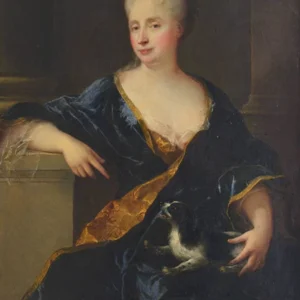
Anne Thérèse de Marguenat de Courcelles, marquise de Lambert
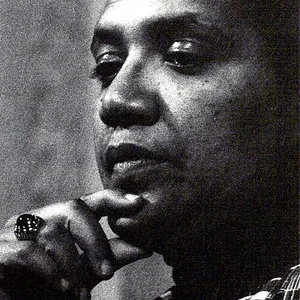
Audre Lorde
1934 — 1992
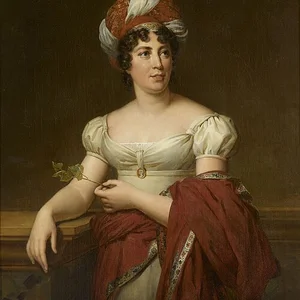
Madame de Staël
1766 — 1817
Simone de Beauvoir
1908 — 1986
Hypatia of Alexandria
vers 355/370 — 415
Sappho
650 av. J.-C. — 569 av. J.-C.