Character Catalog

Historical Library

CollectionGalaxy
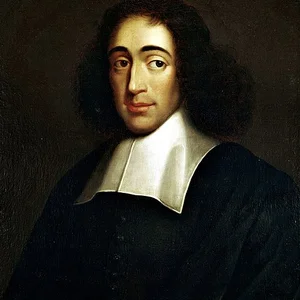
Portrait de Baruch Spinoza

Baruch Spinoza

Baruch Spinoza

1632 — 1677

Provinces-Unies

PhilosophyPhilosopheEarly Modern17th century (1632–1677)

A 17th-century Dutch philosopher, Spinoza developed an original metaphysical system built on the concept of a single substance (God or Nature). His major work, the Ethics, offers a new conception of freedom and the relationship between mind and body.

Émotions disponibles (6)

N

Neutre

par défaut

I

Inspiré

P

Pensif

S

Surpris

T

Triste

F

Fier

Famous Quotes

« He who has a true idea knows at the same time that he has a true idea, and cannot doubt the truth of the thing. »
« Blessedness is not the reward of virtue, but virtue itself. »
« Human bondage consists in the weakness by which men are incapable of moderating and restraining their affects. »

Key Facts

  • 1656: excommunication by the Portuguese Jewish community of Amsterdam for his heterodox ideas
  • 1665–1675: composition of the Ethics, his major work structured as geometric demonstrations
  • 1670: publication of the Theological-Political Treatise, a defense of freedom of thought
  • 1677: posthumous publication of the Ethics and the Political Treatise, cementing his influence
  • Development of the concept of Deus sive Natura (God, that is to say, Nature), challenging traditional theology

Works & Achievements

Ethics (Ethica ordine geometrico demonstrata) (1677 (posthumous))

Spinoza's absolute masterpiece, written according to the geometric method. In it he develops his metaphysics of the single substance, his theory of affects, and his conception of freedom as the comprehension of necessity.

Theological-Political Treatise (Tractatus Theologico-Politicus) (1670)

Published anonymously, this founding work of modern biblical exegesis defends the freedom to philosophize and the separation between theology and philosophy. It was immediately banned.

Treatise on the Emendation of the Intellect (Tractatus de Intellectus Emendatione) (c. 1661 (posthumous 1677))

An unfinished work in which Spinoza sets out his philosophical method and searches for the highest good capable of providing continuous and supreme joy.

The Principles of Cartesian Philosophy (Renati Des Cartes Principiorum Philosophiae) (1663)

The only work published under his own name during his lifetime, it expounds Cartesian philosophy in geometric form, accompanied by the Metaphysical Thoughts.

Political Treatise (Tractatus Politicus) (1677 (posthumous, unfinished))

Spinoza's last work, left unfinished, in which he analyses the different forms of government (monarchy, aristocracy, democracy) while seeking the conditions for political stability.

Short Treatise on God, Man, and His Well-Being (Korte Verhandeling) (c. 1660)

The first draft of Spinoza's thought, rediscovered in the 19th century. Already present are the seeds of his philosophy of the single substance and of blessedness.

Correspondence (Epistolae) (1661-1676 (posthumous 1677))

A collection of 88 letters exchanged with scholars, philosophers, and theologians from across Europe, invaluable for understanding the development of his thought and his intellectual debates.

Anecdotes

In 1656, at only 23 years old, Spinoza was struck by a herem (excommunication) from the Portuguese Jewish community of Amsterdam. The text of the ban was exceptionally violent, cursing him "by day and by night, lying down and rising up". He never sought to have this sentence lifted.

Spinoza earned his living by grinding optical lenses, a precision trade highly sought after at the time. This manual activity, which he practiced daily, allowed him to live modestly while remaining independent. Tragic irony: the glass dust inhaled over many years most likely contributed to the tuberculosis that carried him off at 44.

In 1673, the Elector Palatine Karl Ludwig offered him a chair in philosophy at the University of Heidelberg, with a promise of "the most extensive freedom to philosophize". Spinoza politely declined, fearing that academic obligations would limit his freedom of thought.

After the assassination of the De Witt brothers in 1672 by an Orangist mob in The Hague, Spinoza, deeply shaken, reportedly wanted to post a placard bearing the inscription "Ultimi barbarorum" (the last of the barbarians). His landlord allegedly locked him inside to spare him a similar fate.

Spinoza lived so frugally that his friends worried about him. At his death in February 1677, the inventory of his belongings revealed an extremely modest wardrobe and a library of around 160 works. His material estate barely covered the cost of his funeral.

Primary Sources

Ethics (Ethica ordine geometrico demonstrata) (1677 (posthumous publication))
By God I mean an absolutely infinite being, that is, a substance consisting of infinite attributes, each of which expresses an eternal and infinite essence.
Theological-Political Treatise (Tractatus Theologico-Politicus) (1670)
The end of the State is not to transform men from rational beings into beasts or automata, but on the contrary to bring it about that their minds and bodies perform their functions safely, and that they themselves make use of free reason.
Letter to Albert Burgh (Letter 76) (1675)
I do not claim to have found the best philosophy, but I know that I understand the true one. If you ask me how I know this, I will answer: in the same way that you know that the three angles of a triangle are equal to two right angles.
Text of the herem pronounced by the Jewish community of Amsterdam (27 July 1656)
By the judgment of the angels and the sentence of the saints, we excommunicate, expel, curse and damn Baruch de Spinoza, with the consent of the entire holy community, in the presence of the holy books.
Treatise on the Emendation of the Intellect (Tractatus de Intellectus Emendatione) (c. 1661 (posthumous publication 1677))
After experience had taught me that all the things which regularly occur in ordinary life are vain and futile, I resolved to inquire whether there existed a true good capable of communicating itself.

Key Places

Amsterdam, Dutch Republic

Spinoza's birthplace, a center of world trade and the Sephardic Jewish community. He grew up there, received his religious education, and was excommunicated in 1656.

Rijnsburg, near Leiden

Village where Spinoza settled around 1660–1663 to live in tranquility. His house is today a museum (Spinozahuis) dedicated to his memory.

Voorburg, near The Hague

Spinoza lived here from 1663 to 1670, lodging with the painter Daniel Tydeman. It is here that he wrote much of the Ethics and the Theologico-Political Treatise.

The Hague (Den Haag), Dutch Republic

Spinoza's last residence, from 1670 until his death in 1677. The political capital of the Dutch Republic, he lodged on the Paviljoensgracht. He is buried in the Nieuwe Kerk.

Portuguese Synagogue of Amsterdam (Esnoga)

Place of worship of the Sephardic Jewish community where Spinoza received his education. The current building, inaugurated in 1675, bears witness to the prosperity of that community.

Typical Objects

Lens-grinding lathe

Spinoza's primary trade tool, used to shape optical lenses for spectacles and microscopes. This highly precise craft work was his source of income.

Optical lenses

The finished products of Spinoza's work, these lenses were in high demand during a period of considerable advances in optics. Huygens himself acknowledged the quality of his lenses.

Quill pen and inkwell

Writing instruments with which Spinoza composed his treatises and his extensive philosophical correspondence with scholars across Europe.

Manuscript of the Ethics

His major work written more geometrico (in the manner of geometers), with definitions, axioms, and propositions. Spinoza kept it unpublished during the final years of his life.

Clay pipe

A very common everyday object in the 17th-century Dutch Republic. Spinoza was known to smoke tobacco while watching spiders fight, which he found amusing.

Hebrew Bible

A text Spinoza studied in depth from his youth at the synagogue, which he later subjected to rigorous critical analysis in the Theologico-Political Treatise.

School Curriculum

LycéePhilosophie
LycéePhilosophie — La liberté : déterminisme et responsabilité chez Spinoza
LycéePhilosophie — La substance unique et le problème du rapport âme-corps
LycéePhilosophie — La critique de la transcendance divine : panthéisme vs théisme
LycéePhilosophie — L'Éthique comme science des affections et de la puissance d'agir
LycéePhilosophie — Liberté et connaissance : les trois genres de connaissance
LycéePhilosophie — Spinoza et les Lumières : influence sur la pensée moderne

Vocabulary & Tags

Key Vocabulary

Substance: the single fundamental principle from which everything follows; in Spinoza, God or NaturePantheism: the doctrine that God is identical with natureConatus: the striving of each thing to persevere in its own beingDeterminism: the doctrine that all events are necessarily connected by causesAffects: modifications of the body and its relations to other bodiesPower of acting: the capacity of a being to act and transform the worldEternity: a perspective of knowledge that transcends linear timeImmanence: the presence of God within nature, as opposed to transcendence

Tags

Baruch Spinozarevolution-scientifiqueRévolution scientifiqueSubstance : principe fondamental unique dont tout découle ; chez Spinoza, Dieu ou la NaturePanthéisme : doctrine selon laquelle Dieu est identique à la natureConatus : effort de chaque chose à persévérer dans son êtreDéterminisme : doctrine selon laquelle tous les événements sont nécessairement liés par des causesAffections : modifications du corps et ses rapports à d'autres corpsPuissance d'agir : capacité d'un être à agir et de transformer le mondeÉternité : perspective de la connaissance qui dépasse le temps linéaireImmanence : présence de Dieu dans la nature, non transcendanceXVIIe siècle (1632-1677)

Daily Life

Morning

Spinoza rose early and devoted his mornings to philosophical reflection and writing. He worked in his modest room, drafting his treatises or correspondence with European scholars. He would eat a frugal meal, sometimes nothing more than milk soup and oat porridge.

Afternoon

The afternoon was generally devoted to grinding optical lenses, his artisanal trade that ensured him modest financial independence. He sometimes received visits from friends and disciples with whom he discussed philosophy, science, and politics. He occasionally amused himself by watching spider fights.

Evening

In the evening, Spinoza smoked his pipe and conversed with his landlord or visitors. He continued his reading, particularly works on philosophy, mathematics, and optics. He went to bed relatively early, leading a regulated and sober life, frequenting neither taverns nor worldly entertainments.

Food

Spinoza led a life of great dietary frugality. He often made do with milk soup seasoned with butter, or porridge, and a light beer. His friends worried about this austerity, but he believed that simple food was sufficient to maintain bodily health and clarity of mind.

Clothing

Spinoza dressed simply, without any concern for fashion, but in a proper manner. He wore the typical clothes of a modest Dutch burgher of the 17th century: a white shirt, dark doublet, coat, and broad-brimmed hat. The post-mortem inventory mentions a very limited wardrobe.

Housing

Spinoza always lived as a lodger in other people's homes, never owning a house of his own. In The Hague, he rented a room in the house of the painter Hendrick van der Spyck on the Paviljoensgracht. His living space served simultaneously as bedroom, writing study, and lens-grinding workshop.

Historical Timeline

1632Naissance de Spinoza à Amsterdam dans une famille de marchands juifs portugais ayant fui l'Inquisition ibérique.
1637Descartes publie le Discours de la méthode aux Pays-Bas, où il s'est installé pour bénéficier d'une relative liberté intellectuelle.
1648Traités de Westphalie mettant fin à la guerre de Trente Ans ; les Provinces-Unies voient leur indépendance officiellement reconnue par l'Espagne.
1651Thomas Hobbes publie le Léviathan, ouvrage fondateur de la philosophie politique moderne.
1656Spinoza est excommunié (herem) de la communauté juive portugaise d'Amsterdam à l'âge de 23 ans.
1660Spinoza quitte Amsterdam pour Rijnsburg, près de Leyde, où il commence à rédiger ses premières œuvres philosophiques.
1663Publication des Principes de la philosophie de Descartes, seul ouvrage publié sous son nom de son vivant.
1665Début de la deuxième guerre anglo-néerlandaise ; grande épidémie de peste à Londres.
1670Publication anonyme du Traité théologico-politique, immédiatement condamné et interdit par les autorités religieuses.
1672Année désastreuse (Rampjaar) pour les Provinces-Unies : invasion française de Louis XIV, assassinat des frères De Witt à La Haye.
1673Spinoza décline la chaire de philosophie offerte par l'université de Heidelberg pour préserver sa liberté de pensée.
1675Spinoza achève l'Éthique mais renonce à la publier face aux menaces de poursuites pour athéisme.
1677Mort de Spinoza à La Haye le 21 février ; ses amis publient ses œuvres posthumes (Opera Posthuma) la même année.

Period Vocabulary

Herem — Excommunication in the Jewish tradition, involving total banishment from the community. Spinoza's herem in 1656 was particularly severe and definitive.
More geometrico — A method of exposition 'in the manner of geometers', proceeding through definitions, axioms, propositions, and demonstrations. This is the method Spinoza adopted in the Ethics.
Substance — A central concept in Spinoza referring to that which exists in itself and is conceived through itself. According to him, there exists only one substance, which he calls God or Nature.
Conatus — The striving by which each thing perseveres in its being. For Spinoza, the conatus is the very essence of every living being — the fundamental power to exist and to act.
Deus sive Natura — A Latin phrase meaning 'God, that is to say, Nature'. Spinoza's famous expression identifying God with the totality of nature and its laws.
United Provinces — A republic formed by the seven northern provinces of the Netherlands, independent from Spain. In the 17th century, they constituted a major commercial and cultural power.
Affects — In Spinoza, affects (affectus) denote modifications of the body and mind — joy, sadness, desire — that increase or diminish our power to act.
Attribute — That which the intellect perceives of substance as constituting its essence. Spinoza recognizes two attributes accessible to humans: Thought and Extension.
Marranos — Jews from the Iberian Peninsula forced to convert to Christianity under the Inquisition, while secretly practicing Judaism. Spinoza's family belonged to this community.
Libertin — In the 17th century, a term designating a freethinker who breaks free from religious dogma. Spinoza was often called a libertin, or even an atheist, by his contemporaries.

Gallery


Portrait of Benedictus de Spinoza (1632-1677)label QS:Lfr,"Portrait de Benedictus de Spinoza (1632-1677)"label QS:Len,"Portrait of Benedictus de Spinoza (1632-1677)"label QS:Lsl,"Portret Benedikta Sp

Portrait of Benedictus de Spinoza (1632-1677)label QS:Lfr,"Portrait de Benedictus de Spinoza (1632-1677)"label QS:Len,"Portrait of Benedictus de Spinoza (1632-1677)"label QS:Lsl,"Portret Benedikta Sp


John Milton title QS:P1476,en:"John Milton "label QS:Len,"John Milton "label QS:Lbn,"জন মিল্টন"

John Milton title QS:P1476,en:"John Milton "label QS:Len,"John Milton "label QS:Lbn,"জন মিল্টন"


Benedictus de Spinozalabel QS:Lde,"Benedictus de Spinoza"label QS:Lpt,"Benedictus de Spinoza"label QS:Len,"Benedictus de Spinoza"label QS:Lfr,"Benedictus de Spinoza"label QS:Lnl,"Benedictus de Spinoz

Benedictus de Spinozalabel QS:Lde,"Benedictus de Spinoza"label QS:Lpt,"Benedictus de Spinoza"label QS:Len,"Benedictus de Spinoza"label QS:Lfr,"Benedictus de Spinoza"label QS:Lnl,"Benedictus de Spinoz

Portret van Baruch Spinoza Benoit Spinosa (titel op object), RP-P-1959-138

Portret van Baruch Spinoza Benoit Spinosa (titel op object), RP-P-1959-138


Portrait of Benedictus de Spinoza (1632-1677)label QS:Lfr,"Portrait de Benedictus de Spinoza (1632-1677)"label QS:Len,"Portrait of Benedictus de Spinoza (1632-1677)"label QS:Lsl,"Portret Benedikta Sp

Portrait of Benedictus de Spinoza (1632-1677)label QS:Lfr,"Portrait de Benedictus de Spinoza (1632-1677)"label QS:Len,"Portrait of Benedictus de Spinoza (1632-1677)"label QS:Lsl,"Portret Benedikta Sp

Amsterdam - Zwanenburgwal - Amstel - View West on Statue of Benedictus de Spinoza 2008 by Nicolas Dings

Amsterdam - Zwanenburgwal - Amstel - View West on Statue of Benedictus de Spinoza 2008 by Nicolas Dings

Walking man in front of the bronze Spinoza sculpture, Waterlooplein; free photo Amsterdam city, 12-10-2021

Walking man in front of the bronze Spinoza sculpture, Waterlooplein; free photo Amsterdam city, 12-10-2021

Spinoza monument in bronze sculpture, at Waterlooplein square; free photo Amsterdam, Fons Heijnsbroek, 12-10-2021

Spinoza monument in bronze sculpture, at Waterlooplein square; free photo Amsterdam, Fons Heijnsbroek, 12-10-2021

2024 tourist people, sitting by the bronze statue sculpture of Spinoza at the square Waterlooplein, Amsterdam city

2024 tourist people, sitting by the bronze statue sculpture of Spinoza at the square Waterlooplein, Amsterdam city


Dissolving views in the history of Judaism

Dissolving views in the history of Judaism

Visual Style

Style inspiré des maîtres hollandais du Siècle d'or, avec un clair-obscur chaleureux à la Vermeer et Rembrandt, centré sur l'intimité d'un intérieur modeste de philosophe-artisan.

#2C1810
#8B6914
#C4956A
#1B3A5C
#D4C5A9
AI Prompt
Dutch Golden Age interior painting style inspired by Vermeer and Rembrandt. Warm chiaroscuro lighting with a single source of natural light entering through a tall leaded glass window on the left, casting geometric patterns across a modest wood-paneled study. Rich amber and deep brown tones with occasional deep blue accents. A solitary philosopher at work, surrounded by books, manuscripts, and optical instruments. Dust motes floating in the beam of light. Muted earth tones with the luminous quality characteristic of 17th-century Dutch masters. Oil painting texture with visible brushstrokes, intimate domestic scale.

Sound Ambience

Atmosphère feutrée d'un intérieur hollandais du XVIIe siècle, entre le bruit régulier du polissage de lentilles et les sons lointains de la vie des canaux d'Amsterdam — cloches, bateaux et conversations.

AI Prompt
A quiet 17th-century Dutch interior: the steady rhythmic grinding of glass lenses on a polishing wheel, fine glass dust settling softly. Through leaded windows, the muffled sounds of Amsterdam canal life — distant church bells tolling the hours, the creak of merchant ships' rigging, water lapping against brick quays, horse hooves on cobblestones. Occasionally, the scratch of a quill pen on paper, the rustle of manuscript pages turning. A clock ticks steadily on the mantelpiece. Outside, seagulls cry and Dutch conversations drift up from the street below. The gentle whistle of wind through narrow alleyways between tall canal houses.

Portrait Source

Wikimedia Commons — domaine public — anonymous — 1665

Aller plus loin

Ĺ’uvres

Traité théologico-politique (Tractatus Theologico-Politicus)

1670

Traité de la réforme de l'entendement (Tractatus de Intellectus Emendatione)

vers 1661 (posthume 1677)

Les Principes de la philosophie de Descartes (Renati Des Cartes Principiorum Philosophiae)

1663

Traité politique (Tractatus Politicus)

1677 (posthume, inachevé)

Court traité de Dieu, de l'homme et de la santé de son âme (Korte Verhandeling)

vers 1660