 flip
flipThe hyssop and oil bread of the banquet
The hyssop and oil bread of the banquet
Why this dish? On feast days, the Rule of the Congregation (1QSa) describes the priest blessing the bread and the must first before the multitude eats. This bread perfumed with hyssop, a plant of purification, embodies the pure meal opposed to the domain of Belial.
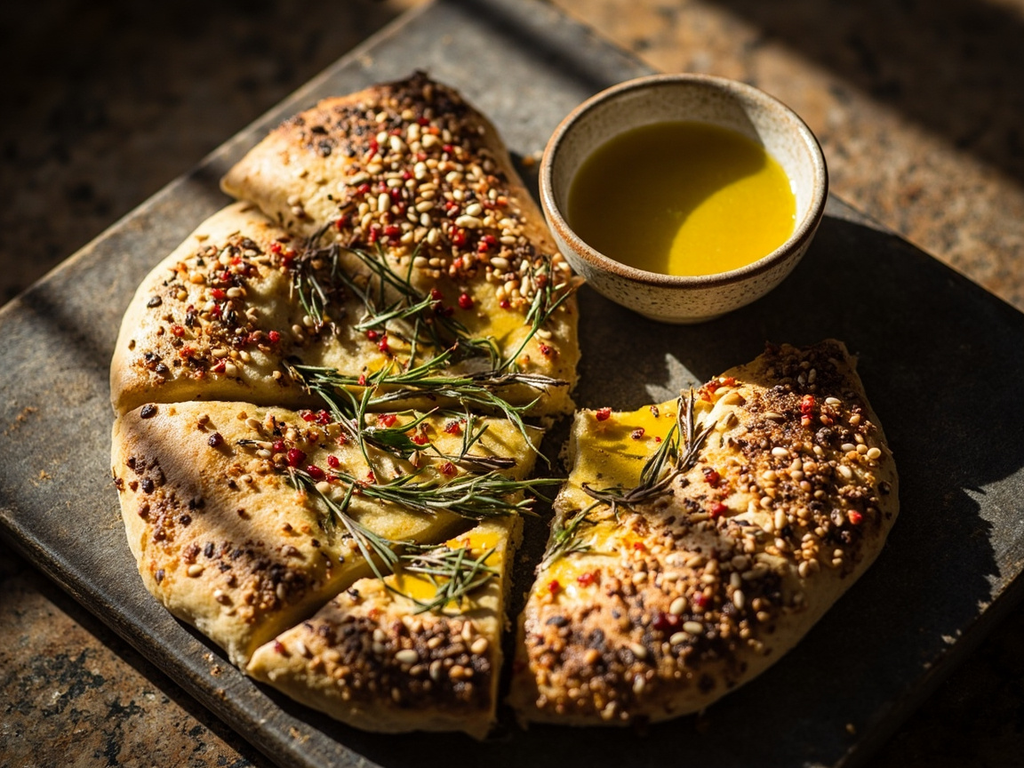
A leavened flatbread, golden, brushed with olive oil and sprinkled with a mix of hyssop, sumac, and sesame—the ancestor of za'atar. Crispy at the edges, soft in the center, fragrant and slightly astringent.
Banquet day! They break the bread as if they were breaking my empire. The priest stretches out his hand before all, he blesses, he perfumes the cake with hyssop—that plant with which they sprinkle themselves to think themselves cleansed of me. Let me tell you their secret, you: knead the flour and leaven, roll the dough thin, rub it with olive oil until it shines, then powder it with hyssop, sour sumac, and toasted sesame. Bake it on the hot stone. They eat it thinking they are beyond my reach—let them savor their short victory.
- •Wheat flour (or spelt) — according to the household (bread base)
- •Natural leaven — a piece of yesterday's dough (leavening and acidity)
- •Warm water — as needed (hydration)
- •Salt — a pinch (taste, covenant)
- •Dried hyssop (ezov) — generously (signature herb, purification)
- •Sumac — a spoonful (sour note and purple color)
- •Sesame seeds — a handful (crunch and roundness)
- •Olive oil — for brushing and drizzling (richness, binder for aromatics)
The hyssop and oil bread of the banquet
A leavened flatbread, golden, brushed with olive oil and sprinkled with a mix of hyssop, sumac, and sesame—the ancestor of za'atar. Crispy at the edges, soft in the center, fragrant and slightly astringent.
Why this dish? On feast days, the Rule of the Congregation (1QSa) describes the priest blessing the bread and the must first before the multitude eats. This bread perfumed with hyssop, a plant of purification, embodies the pure meal opposed to the domain of Belial.
Banquet day! They break the bread as if they were breaking my empire. The priest stretches out his hand before all, he blesses, he perfumes the cake with hyssop—that plant with which they sprinkle themselves to think themselves cleansed of me. Let me tell you their secret, you: knead the flour and leaven, roll the dough thin, rub it with olive oil until it shines, then powder it with hyssop, sour sumac, and toasted sesame. Bake it on the hot stone. They eat it thinking they are beyond my reach—let them savor their short victory.
Ingredients (period version)
- Wheat flour (or spelt) — according to the household (bread base)
- Natural leaven — a piece of yesterday's dough (leavening and acidity)
- Warm water — as needed (hydration)
- Salt — a pinch (taste, covenant)
- Dried hyssop (ezov) — generously (signature herb, purification)
- Sumac — a spoonful (sour note and purple color)
- Sesame seeds — a handful (crunch and roundness)
- Olive oil — for brushing and drizzling (richness, binder for aromatics)
Ingredients
- Wheat flour T80 (or half spelt) — 400 g (base)
- Active sourdough starter — 100 g (or 1 packet dry yeast) (leavening)
- Warm water — 240 ml (hydration)
- Salt — 1 tsp (taste)
- Dried oregano or hyssop za'atar — 2 tbsp (signature herb (if fresh hyssop unavailable))
- Sumac — 1 tbsp (acidity)
- Sesame seeds — 2 tbsp (crunch)
- Extra virgin olive oil — 5 tbsp (for brushing and drizzling)
Method
- Mix flour, starter, water, and salt. Knead 8 to 10 minutes until a supple dough forms.
- Cover and let rise 2 to 3 hours (or until doubled in volume).
- Preheat oven to maximum with a baking stone or sheet inside.
- Divide dough, roll into thin flatbreads, place on hot sheet.
- Bake 6 to 8 minutes until puffed and golden.
- Remove, brush with olive oil, sprinkle with hyssop-sumac-sesame mix. Serve warm.
How it was made : Bread was baked against the walls of a clay oven (tabun) or on a hot stone. Hyssop, mentioned in the Bible for purification rites, grew wild on the hills; mixed with oil, it prefigures the Levantine za'atar still alive today.
The contemporary twist : Cut the bread into diamonds and serve on a sharing board with a small bowl of olive oil for dipping—a 'covenant bread' to break together.
Sources : Rule of the Congregation (1QSa), Dead Sea Scrolls · Hebrew Bible, references to hyssop (Exodus 12, Psalm 51)
Belial · Charactorium