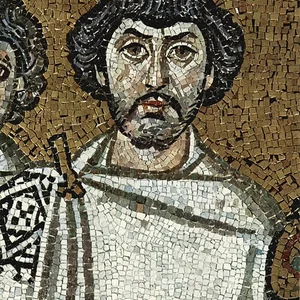

Belisarius was the greatest general of the Byzantine emperor Justinian I in the 6th century. The architect of the wars to reconquer the West, he took Africa back from the Vandals and Italy from the Ostrogoths, helping to advance the dream of restoring the Roman Empire.
Belisarius(505 — 565)
Belisarius
Empire byzantin
5 min read
Frequently asked questions
Key Facts
- Around 530: wins the Battle of Dara against the Sasanian Persians
- 533-534: reconquers North Africa by crushing the Vandal kingdom (Battle of Tricamarum)
- 535-540: leads the Gothic War in Italy and retakes Rome and Ravenna from the Ostrogoths
- 532: helps suppress the Nika riot in Constantinople
- 559: repels an incursion of Kutrigur Huns threatening Constantinople
Works & Achievements
Belisarius's first great victory, breaking the Sassanid Persian offensive in Mesopotamia through a clever defensive formation.
A decisive intervention in the Hippodrome of Constantinople that saved the throne of Justinian I.
A lightning campaign annihilating the Vandal kingdom and restoring imperial authority over North Africa.
The beginning of the reconquest of Italy, with the entry into Rome after it was abandoned by the Ostrogoths.
A victorious resistance against the Ostrogothic army of Vitiges for over a year, a model of the art of defensive siege warfare.
The seizure of the Ostrogothic capital and its treasury, the high point of the Italian reconquest.
His final military feat: Belisarius, already advanced in age, repelled an incursion threatening the capital with greatly reduced forces.
Anecdotes
In 532, during the Nika riots that nearly toppled Justinian, Belisarius and the general Mundus led their troops into the Hippodrome of Constantinople, where the rioters had acclaimed a new emperor. The slaughter is said to have left tens of thousands dead and saved Justinian's throne.
In 533, Belisarius landed in Africa with a relatively modest army and crushed the Vandal kingdom within a few months. He captured King Gelimer and brought him back to Constantinople, where he celebrated a triumph — the first granted to a non-emperor in centuries.
During the defense of Rome against the Ostrogoths in 537-538, Belisarius held the besieged city for more than a year with a reduced garrison, mounting bold sorties and clever stratagems to wear down a far larger Gothic army.
According to the historian Procopius, who accompanied him on his campaigns, Belisarius's wife, Antonina, played a major political role and sometimes joined him in the field, notably managing the army's supplies.
A late legend, with no historical basis, claims that Belisarius was blinded on Justinian's orders and ended his life as a beggar. In reality, after a brief fall from favor in 562, he was rehabilitated and died in 565, shortly before the emperor himself.
Primary Sources
Belisarius, having taken Carthage, forbade his soldiers any act of violence and saw to it that the inhabitants were treated with gentleness, as subjects of the Empire who had been recovered.
During the siege of Rome, Belisarius never ceased to sally forth with a few horsemen to harass the enemy, so that the Goths had no rest by day or by night.
Antonina, the wife of Belisarius, held great sway over him and followed him on his campaigns, directing affairs as she pleased.
Key Places
Region traditionally attributed as Belisarius's birthplace, on the borders of Thrace and Illyria, a land that supplied many soldiers to the Empire.
Capital of the Byzantine Empire where Belisarius served Justinian, celebrated his triumph, and ended his life.
Capital of the Vandal kingdom in North Africa, captured by Belisarius in 533 during the reconquest.
City retaken from the Ostrogoths in 536 and defended by Belisarius during a long siege in 537-538.
Capital of the Ostrogothic kingdom, captured by Belisarius in 540, marking the height of the reconquest of Italy.
Byzantine fortress near the Persian frontier where Belisarius won his first great victory against the Sasanians in 530.
Typical Objects

A long, straight, double-edged sword carried by Byzantine cavalrymen, better suited to mounted combat than the classic Roman gladius.

The weapon of choice of the Byzantine cavalrymen, the bucellarii, who could shoot while on the move. Belisarius built his tactics around these mounted archers.

A cuirass made of small metal plates laced together, protecting the Byzantine cataphracts while still allowing great mobility.

A long lance wielded by Byzantine heavy cavalrymen during charges against enemy infantry.

A shield carried by Byzantine infantry and cavalry, often decorated with patterns identifying the unit.

A Byzantine military ensign bearing the monogram of Christ, rallying the troops and symbolizing the emperor's authority.
School Curriculum
Vocabulary & Tags
Key Vocabulary
Tags
Daily Life
Morning
On campaign, Belisarius rose before dawn to inspect the camp, check the sentries, and hold council with his officers. In Constantinople, his morning was devoted to audiences and to the administrative affairs of his command.
Afternoon
The afternoon was spent training the troops, organizing supplies, and planning the army's movements. Scouts reported their intelligence on enemy positions.
Evening
In the evening, the general sometimes shared the table of his officers and of his personal guard, the *bucellarii*, whose pay he provided himself. There they discussed strategy and listened to news from Constantinople.
Food
On campaign, the diet relied on ration bread (dried biscuit), dried vegetables, wine cut with water, and meat when supplies allowed. At court, meals were more refined, combining fish, fruit, and spices from the East.
Clothing
In battle, Belisarius wore lamellar armor, a cloak (the *chlamys*) fastened at the shoulder, and cavalryman's boots. In the city, he donned silk tunics and embroidered cloaks befitting his high rank.
Housing
In Constantinople, Belisarius owned a vast aristocratic residence worthy of a high dignitary. On campaign, he lived in the commander's tent, at the center of a fortified camp laid out according to Roman military rules.
Historical Timeline
Period Vocabulary
Liens externes & ressources
Références
Œuvres
Victoire de Dara
530
Répression de la sédition Nika
532
Reconquête de l'Afrique vandale
533-534
Prise de la Sicile et de Rome
535-536
Défense de Rome assiégée
537-538
Prise de Ravenne
540
Défense de Constantinople contre les Koutrigours
559