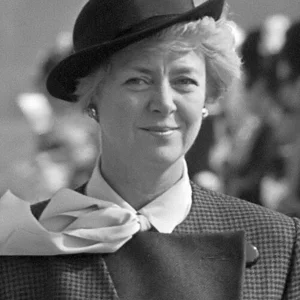

Vigdís Finnbogadóttir was elected President of Iceland in 1980, becoming the first woman in the world to be democratically elected head of state. Re-elected four times, she served until 1996 and became a global figure in feminism and cultural diplomacy.
Vigdís Finnbogadóttir(1930 — ?)
Vigdís Finnbogadóttir
Islande
6 min read
Frequently asked questions
Famous Quotes
« Language is the key to all culture.»
Key Facts
- Born on April 15, 1930, in Reykjavik, Iceland
- Elected President of Iceland in 1980, the first woman ever democratically elected as head of state
- Re-elected three times, she led Iceland for 16 years until 1996
- Former theater director and French teacher before entering politics
- Appointed UNESCO Goodwill Ambassador for Languages in 1998
Works & Achievements
Vigdís Finnbogadóttir becomes the first woman elected head of state by direct popular vote in Iceland. This election marks a major milestone for the representation of women in the highest executive offices.
She is re-elected to a second term as President of Iceland, confirming her popular support and strengthening her legitimacy on the Icelandic political stage.
Vigdís Finnbogadóttir wins three further re-elections, serving four consecutive presidential terms until 1996, making her one of the longest-serving elected female heads of state.
Throughout her presidency, she actively works to promote equal rights for women and gender parity in Iceland, using her position to raise awareness of these important social issues.
She represents Iceland on the international stage and contributes to enhancing its diplomatic standing, particularly within international organizations such as the United Nations.
Anecdotes
In 1980, Vigdís Finnbogadóttir became the world's first woman to be democratically elected as head of state. She won the Icelandic presidential election with 33.6% of the vote against three male candidates — and she hadn't even sought the candidacy herself. It was a group of feminists and citizens who convinced her to run.
A single mother who had adopted a baby girl on her own in 1972, Vigdís made her personal situation a symbol of modernity and independence. At the time, it was rare and bold for an unmarried woman to adopt a child in Iceland — yet it did nothing to stop her from earning the trust of an entire nation.
A passionate lover of theatre and the French language, Vigdís had studied theatre in Paris and directed the Reykjavík City Theatre before entering politics. She remains the only theatre director ever to have risen to the presidency of a country.
Throughout her sixteen-year tenure (1980–1996), Vigdís consistently refused to sign legislation that would have criminalized abortion — including in the middle of Christmas night 1985. This courageous act sparked a fierce national debate and stood as a powerful statement of her commitment to women's rights.
A lifelong champion of languages, Vigdís was appointed UNESCO Goodwill Ambassador for Languages in 1998 and founded the Vigdís International Centre for Multilingualism and Intercultural Understanding in Reykjavík. She often reminds the world that Icelandic — the language of a small people numbering just a few hundred thousand — deserves just as much respect as any of the world's major languages.
Primary Sources
As the first woman elected to the presidency of a nation, I feel the responsibility to represent not only Icelandic women, but all citizens of our Republic.
The education of women is the key to sustainable development. Iceland has understood that without gender equality, no nation can truly progress.
The protection of our natural resources and respect for ecological balance must guide our policies for future generations.
For sixteen years, I have had the honor of serving the Republic of Iceland with dedication. It is with gratitude that I bring my presidential term to a close.
Key Places
Birthplace of Vigdís Finnbogadóttir in 1930. She spent much of her life in the Icelandic capital, where she carried out her political duties.
Official residence of the President of Iceland. Vigdís Finnbogadóttir lived here as President of Iceland from 1988 to 1996.
The institution where Vigdís Finnbogadóttir pursued her studies and developed her academic career before entering politics.
Iceland's central political institution, where Vigdís Finnbogadóttir had significant interactions as the country's democratically elected President.
Vigdís Finnbogadóttir studied in France and maintained strong cultural and diplomatic ties with the country throughout her career.
Typical Objects

Official symbol of Icelandic executive power. Vigdís Finnbogadóttir wore it throughout her four consecutive presidential terms from 1980 to 1996, making her the world's first democratically elected female president.

The national emblem featuring its blue, white, and red Nordic cross. It represents the independent Iceland of which Vigdís was head of state for sixteen years — a pivotal period in modern Icelandic history.

Documents written by hand or typed out containing the president's addresses. Vigdís Finnbogadóttir spoke in Icelandic and several foreign languages, using the power of words to champion democracy.

Formal clothing worn at state ceremonies. As the first elected female president, her dress was symbolic of the social transformations taking place in 20th-century Northern Europe.

A typical working tool of the 20th century, used to draft official texts and speeches. It represents the daily reality of government offices in the pre-digital era.

A cartographic document of the country situated in the North Atlantic. It symbolizes the territory Vigdís governed and Iceland's geostrategic importance during the Cold War.

Honorary distinctions presented at diplomatic ceremonies. Vigdís both received and awarded them as representative of the Republic of Iceland and its international relations.

A major communications medium through which Vigdís could address the Icelandic people during national broadcasts. It symbolizes the modern role of the presidency in the mass media society of the late 20th century.
School Curriculum
Vocabulary & Tags
Key Vocabulary
Tags
Daily Life
Morning
Vigdís Finnbogadóttir starts her day in Iceland with a breakfast of Icelandic dark bread, butter, and coffee. Before her political career, she worked as a teacher of history and French, so her mornings were regularly spent preparing for classes or handling administrative duties.
Afternoon
After World War II and throughout her academic career, she devoted her afternoons to teaching, historical research, or professional meetings. As an active figure in the Icelandic feminist movement, she also took part in public debates and political party gatherings.
Evening
Evenings are spent reading, engaging with Icelandic cultural life, or fulfilling political commitments. She moves in Reykjavik's intellectual circles and attends civic events, as a public figure deeply involved in her community.
Food
The typical Icelandic diet of her era includes fresh or dried fish, lamb, dark bread, dairy products, and seasonal vegetables. Local produce and preserved foods dominate the island's cuisine.
Clothing
Vigdís wears elegant yet understated clothing, typical of female politicians and intellectuals of the 20th century: tailored suits, classic dresses, and heavy coats suited to Iceland's Arctic climate. Her appearance is polished and formal, reflecting her professional standing.
Housing
She lives in Reykjavik in a modern house or urban apartment, at the political and cultural heart of Iceland. Her home reflects the urban lifestyle of mid-20th-century Icelandic intellectuals, with the comforts of a Nordic capital.
Historical Timeline
Period Vocabulary
Visual Style
Un style visuel nordique épuré et moderniste, évoquant l'Islande du 20e siècle, qui mêle élégance diplomatique et féminisme politique. L'illustration privilégie les lignes épurées, une palette minimaliste avec des teintes froides et chaudes, et une atmosphère intellectuelle et inspirante.
Sound Ambience
Une ambiance nordique et politique évoquant un bureau islandais du XXe siècle, mêlant les bruits de la diplomatie, les vents côtiers d'Islande et l'atmosphère intellectuelle de Reykjavik.
Liens externes & ressources
Références
Œuvres
Élection à la présidence de l'Islande
1980
Réélection présidentielle
1984
Trois réélections successives
1988-1996
Promotrice de l'égalité des genres
1980-1996
Diplomatie internationale et représentation islandaise
1980-1996