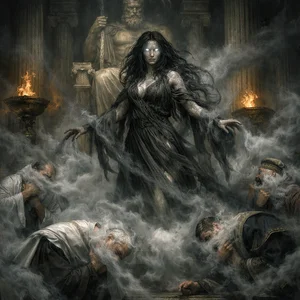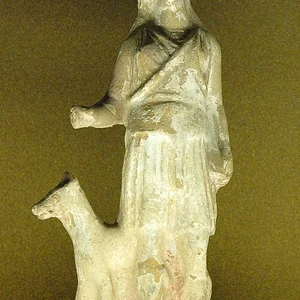

Bendis is a Thracian goddess of the moon, the hunt, and the wild, often identified with the Greek Artemis. Her cult, introduced in Athens in the 5th century BC, was celebrated there with a public festival, the Bendideia.
Bendis
Bendis
6 min read
Frequently asked questions
Key Facts
- Chief goddess of the Thracian pantheon, associated with the moon and the hunt
- Cult officially introduced in Athens around 429 BC, notably at the Piraeus
- The Bendideia festival celebrated with a procession and a torch race on horseback
- Mentioned by Plato at the opening of The Republic, whose action takes place during this festival at the Piraeus
- Identified by the Greeks with Artemis and sometimes with Hecate or Persephone
Works & Achievements
Athenian public festival established in honour of Bendis, famous for its procession and its nocturnal torch-lit horse race.
Establishment of an official place of worship for a foreign deity, an exceptional event in Athenian religion.
Series of marble plaques depicting the goddess and her devotees, major iconographic sources on her cult.
The opening of the dialogue sets the scene during the Bendideia, immortalising the festival in philosophical literature.
Religious brotherhood, attested by inscriptions, charged with organising the goddess's cult and festivals at Piraeus.
Identification of Bendis with the Greek goddess of the hunt, an example of interpretatio graeca that eased the integration of her cult.
Anecdotes
Bendis was a goddess from Thrace, a region north of Greece. When Thracian merchants and immigrants settled in Piraeus, the port of Athens, they brought her cult with them. Around 429 BC, the city of Athens officially recognized this foreign cult, which was quite rare for a non-Greek deity.
The philosopher Plato opens his famous dialogue *The Republic* by mentioning the festival of Bendis. Socrates recounts going down to Piraeus to attend this very first celebration and to admire the procession of the Thracians: it is one of the few direct accounts of this goddess.
The Bendideia, a festival in honor of Bendis, featured a nighttime torch race on horseback. The riders passed flaming torches to one another in the middle of the race, an unusual and impressive spectacle for the Athenians.
The Greeks were in the habit of identifying foreign gods with their own deities. Since Bendis was associated with hunting, the moon, and wild animals, they linked her to Artemis, the Greek goddess of the hunt and sister of Apollo.
Bendis was often depicted wearing a Phrygian cap, hunter's boots, and a long Thracian cloak, holding two spears or a spear and a cup. This “barbarian” attire set her clearly apart from the classical Greek goddesses on votive reliefs.
Primary Sources
Yesterday I went down to the Piraeus with Glaucon, the son of Ariston, to offer my prayers to the goddess and also to see how they would celebrate the festival, which was being held for the first time.
The procession of the local people seemed to me beautiful, but that of the Thracians was no less so. (...) Do you not know that there will be a torch-race on horseback this evening in honour of the goddess?
The women of Thrace and Paeonia, when they sacrifice to Artemis the Queen, never perform their rites without using wheat straw.
Bendis is counted among the Thracian deities honoured with rites comparable to those of the Cabeiri and to the orgiastic festivals of the Great Mother.
Key Places
Port of Athens where the Thracian community settled and where the sanctuary of Bendis was established; site of the first Bendideia.
The homeland of Bendis, north of the Aegean Sea, where she was worshipped as a moon goddess and huntress before her cult arrived in Greece.
The Greek city that officially recognized the foreign cult of Bendis in the 5th century BC, a rare case of a barbarian deity being adopted.
Temple dedicated to Bendis in Piraeus, managed by an association of Thracian and Athenian worshippers (the orgeones), the center of her cult.
Hill in Piraeus associated with the cult of Artemis Munichia, with whom Bendis was identified due to their shared attributes.
Typical Objects

Soft cap with a forward-folded peak, typical of the Thracian peoples, which identifies Bendis in depictions and signals her 'barbarian' origin in the eyes of the Greeks.

Bendis is frequently depicted holding two spears or javelins, attributes of the huntress goddess and mistress of wild beasts.

Torch carried during the nighttime horseback race held in honor of Bendis, passed from rider to rider throughout the festival.

Long, full and colorful cloak worn by the Thracians, draped over Bendis's shoulder in votive reliefs.

High leather boots suited to hunting and rough terrain, worn by Bendis as goddess of wild nature.

Carved marble plaque offered by the faithful, depicting Bendis receiving the homage of a procession of devotees at Piraeus.

Symbolic attribute linking Bendis to the moon, consistent with her assimilation to Artemis and her character as a nocturnal deity.
School Curriculum
Vocabulary & Tags
Key Vocabulary
Daily Life
Morning
As goddess of the hunt and the wild, Bendis belongs to the world of the Thracian forests and mountains rather than to domestic life. In the morning, her Thracian faithful would go to the sanctuary at Piraeus to leave offerings and address their prayers.
Afternoon
In the afternoon, the members of the cult association (the orgeones) managed the sanctuary, welcomed new devotees and prepared the sacrifices. The goddess herself was imagined roaming the woods in the company of wild beasts.
Evening
The rites of Bendis took on a particularly nocturnal dimension, in keeping with her lunar nature. During the Bendideia, the evening culminated in the famous torch-lit horse race that lit up Piraeus.
Food
The offerings made to Bendis included sacrificed animals, grain and libations. The Thracians, a people renowned for their herds, probably dedicated domestic animals to her during the festivals.
Clothing
Bendis is depicted in Thracian costume: a pointed Phrygian cap, a long cloak (zeira) draped over the shoulder, a short tunic and high hunting boots — an outfit that sets her apart from the Greek goddesses.
Housing
Bendis's 'home' was her sanctuary at Piraeus, the Bendideion, but her true domain was the wild: the forests, mountains and nighttime clearings of Thrace.
Historical Timeline
Period Vocabulary
Liens externes & ressources
Références
Œuvres
Les Bendideia
vers 413 av. J.-C.
Sanctuaire de Bendis au Pirée
Ve siècle av. J.-C.
Reliefs votifs de Bendis
IVe siècle av. J.-C.
Mention dans La République de Platon
vers 380 av. J.-C.
Association des orgéons de Bendis
IVe-IIIe siècle av. J.-C.
Assimilation à Artémis
Ve siècle av. J.-C.