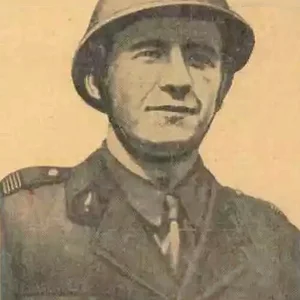

A French communist militant and resistance fighter, he became famous for shooting German officer candidate Alfons Moser at a Paris Métro station on 21 August 1941, the first armed attack against the Nazi occupiers in Paris. He went on to fight with the FTP and later commanded a Free French brigade, dying in combat in Alsace in December 1944.
Pierre Georges (Colonel Fabien)
Pierre Georges, known as Colonel Fabien
8 min read
Frequently asked questions
Key Facts
- Born on 21 January 1919 in Jarry (Guadeloupe), son of a communist militant railway worker
- 21 August 1941: shot German officer candidate Alfons Moser on the platform of Barbès-Rochechouart Métro station — the first armed attack against the occupiers in Paris
- Became one of the leading commanders of the Francs-Tireurs et Partisans (FTP) in the Île-de-France region
- Took part in the Liberation of Paris in August 1944, commanding the Fabien Brigade
- Died on 27 December 1944, killed by a landmine in Alsace during the Liberation battles
Works & Achievements
The first act of armed resistance against the Nazi occupier in Paris: by shooting Aspirant Alfons Moser in the metro, Pierre Georges opened a new phase of the liberation struggle and proved that urban armed resistance was possible despite the enemy's omnipresence.
Pierre Georges took part in the clandestine structuring of the Francs-Tireurs et Partisans, recruiting and training fighters despite the Gestapo's repression and the surveillance of the collaborating French police.
Colonel Fabien and his FTP fighters took part in the street battles during the Paris uprising of August 1944, contributing to the liberation of the capital alongside General Leclerc's 2nd Armored Division.
Integrated into the regular French army after the Liberation of Paris, he commanded this unit in the fighting in Alsace, leading former Maquis fighters and resistance members in conventional positional warfare until his death in combat.
Anecdotes
On August 21, 1941, at the age of 22, Pierre Georges waits on the platform of the Barbès-Rochechouart metro station. When German officer cadet Alfons Moser steps off the train, he shoots him in the back of the head and disappears into the crowd. It is the first armed attack against the Nazi occupier in Paris, an act that opens a new phase of the urban Resistance.
Before the French Resistance, Pierre Georges had already taken up arms as early as 1936 in the Spanish Civil War, fighting alongside the International Brigades. A young working-class teenager, he had joined these antifascist volunteers from around the world who came to defend the Spanish Republic against Franco, Mussolini, and Hitler.
In retaliation for the Barbès attack, the Germans immediately shot three French hostages, then demanded the execution of nearly a hundred more. This policy of collective terror aimed to isolate the Resistance fighters, but often inspired more people to join the underground.
A simple working-class Communist activist, Pierre Georges quickly rose through the ranks of the armed Resistance. Under the alias 'Colonel Fabien', he commanded the 151st Brigade in 1944, a unit integrated into the regular French army that took part in the liberation of Alsace.
Pierre Georges died on December 27, 1944, killed by a land mine in Alsace, at just 25 years old, with final victory almost within reach. His name was given to a square in the 19th arrondissement of Paris, where the PCF headquarters designed by Oscar Niemeyer keeps his memory alive.
Primary Sources
On 21 August 1941, Aspirant Alfons Moser of the Kriegsmarine was shot dead on the platform of the Barbès-Rochechouart metro station by an unidentified individual who fled the scene. Reprisal measures were immediately ordered against the French civilian population.
French patriots have struck at the Nazi enemy in the heart of Paris. Every French man and woman must understand that armed struggle is the only answer to barbaric occupation. The Francs-Tireurs et Partisans call on the people to join the active resistance against the invader.
French patriots have shown that the Nazi occupier is not invincible on our soil. The action of 21 August opens a new phase in the struggle for national liberation. Armed resistance is organizing and spreading across the entire country.
The 151st Brigade, placed under the command of Colonel Fabien, took part in the liberation operations in Alsace from November 1944 onwards, distinguishing itself in several engagements against entrenched German positions in the Rhine plain.
Pierre Georges, known as Colonel Fabien, officer of the French Forces of the Interior, distinguished himself by exceptional courage in the struggle against the Nazi occupier, from the first armed attack in Paris in August 1941 until his heroic death in combat in Alsace on 27 December 1944.
Key Places
It was on this platform of the Paris Métro that Pierre Georges shot German naval officer Alfons Moser on August 21, 1941, carrying out the first armed attack against the Nazi occupiers in Paris. This site symbolizes the Resistance's shift toward urban armed struggle.
A working-class neighborhood where Pierre Georges grew up and became active in the French Communist Party. The square that now bears his name is home to the PCF headquarters designed by architect Oscar Niemeyer, which has become a place of remembrance for the French communist resistance.
Pierre Georges fought alongside the International Brigades during the Spanish Civil War between 1936 and 1939, gaining military training and first-hand experience of armed combat against fascism — experience that would permanently shape his commitment to the Resistance.
It was near this Alsatian village that Pierre Georges died on December 27, 1944, killed by a mine explosion while commanding the 151st Brigade during the final weeks of the liberation of Alsace.
Pierre Georges was buried in Ivry-sur-Seine, a working-class suburb of Paris nicknamed "the red city" for its deep communist roots. His grave has become a place of pilgrimage for those who carry on the legacy of the communist resistance.
Typical Objects

The weapon used in the Barbès attack on August 21, 1941. FTP resistance fighters obtained handguns through the black market, seized from the enemy, or supplied by Allied networks — easily concealed under a coat during clandestine movements.

Essential to every resistance fighter, fake identity cards and false passes allowed operatives to move freely under fictitious identities. Pierre Georges used several successive pseudonyms, including 'Fredo' and 'Colonel Fabien', to evade checks by the Gestapo and the French police.

The FTP distributed secretly printed leaflets to inform the population, call for sabotage, and recruit fighters. Merely possessing or distributing these flyers exposed anyone involved to arrest, deportation, or even death.

Pierre Georges wore this uniform during the Spanish Civil War (1936–1939). This early combat experience made him one of the rare French resistance fighters who had already faced a fascist regime in armed conflict before the Occupation.

Under the Occupation, every French person had to present a food ration book to obtain bread, meat, and fats. Clandestine resistance fighters, forced to live under false names, depended on the solidarity of fellow militants to eat without revealing their true identity.

After the Liberation of Paris, Colonel Fabien donned the uniform of the French Forces of the Interior, now integrated into the regular army. He commanded the 151st Brigade during the fighting in Alsace, recognized as a full officer of the Liberation Army.
School Curriculum
Vocabulary & Tags
Key Vocabulary
Tags
Daily Life
Morning
Living underground, Pierre Georges regularly changed his lodgings to evade the Gestapo and the French police. Each morning began with checking the agreed signals with his network and inspecting forged papers, following strict codes established among resistance members.
Afternoon
Afternoons were devoted to armed resistance activities: discreet travel by metro or bicycle to meet comrades, collecting weapons or leaflets, and preparing operations. He changed his appearance and used fictitious identities to get through checkpoints.
Evening
Clandestine meetings were often held in the evenings in militants' apartments, back rooms of shops, or cellars. Pierre Georges planned operations with his comrades, fully aware that a tip-off or a surveillance tail could lead to arrest, torture, and deportation.
Food
Like all French people living under the Occupation, Pierre Georges endured the strict food rationing imposed by the occupiers. Living under false identities, he depended on the solidarity of militant networks to feed himself without using his real ration cards.
Clothing
Pierre Georges wore ordinary, inconspicuous working-class clothing to avoid drawing attention during his clandestine movements. Blending into the crowd was a matter of survival. From the summer of 1944, he wore the military uniform of the FFI and later of the regular French army.
Housing
Life underground meant constantly changing lodgings, staying in turn with militant families or Communist sympathizers. He could never settle anywhere permanently, living with the ever-present fear of a nighttime raid and cut off from his own family to keep them out of danger.
Historical Timeline
Period Vocabulary
Liens externes & ressources
Références
Œuvres
Attentat de Barbès-Rochechouart
21 août 1941
Organisation et commandement des groupes FTP en région parisienne
1942-1944
Participation à l'insurrection de Paris
Août 1944
Commandement de la 151e Brigade (Brigade Fabien)
Automne-hiver 1944