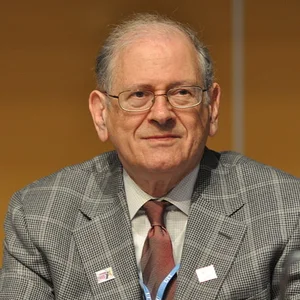

American computer scientist who co-invented the TCP/IP protocol with Vint Cerf, the technical foundation of the Internet. His work made universal communication between computers possible on a global scale.
Bob Kahn(1938 — ?)
Robert E. Kahn
États-Unis
8 min read
Frequently asked questions
Key Facts
- 1938: born in Brooklyn, New York
- 1972: demonstrates ARPANET at the first International Conference on Computer Communications
- 1974: co-publishes with Vint Cerf the landmark paper describing the TCP/IP protocol
- 1986: founds the Corporation for National Research Initiatives (CNRI)
- 2004: receives the Turing Award with Vint Cerf for the design of TCP/IP
Works & Achievements
Landmark paper co-written with Vint Cerf in IEEE Transactions on Communications, describing the TCP/IP protocol for the first time. This 19-page document is considered the technical birth certificate of the Internet.
Kahn organized and oversaw the first public demonstration of the ARPANET network at the international ICCC conference in Washington, connecting 40 computers of different types in real time. The event convinced the global scientific community of the viability of packet-switched networks.
Under Kahn's leadership at DARPA's IPTO office, the entire ARPANET switched over to TCP/IP on January 1, 1983. This migration, planned over several years, is regarded as the official birth of the Internet.
Developed within CNRI, the DOI (Digital Object Identifier) system assigns a stable, universal identifier to each digital resource. Today, more than 250 million scientific articles, books, and research datasets carry a DOI.
Kahn made a decisive contribution to the U.S. report on the National Information Infrastructure, which would shape the Clinton administration's Internet policy and drive the worldwide popularization of the Internet throughout the 1990s.
Anecdotes
In October 1972, Robert Kahn organized in Washington the first public demonstration of ARPANET, the precursor network to the Internet. Forty computers from different universities and research centers were connected live before an audience of specialists. It was the first time that the broader scientific community became aware that a nationwide computer network was technically possible.
In 1973, Kahn reached out to a young researcher at Stanford, Vint Cerf, to solve a fundamental problem: how to enable communication between very different computer networks? Together, they worked for several months and in 1974 published the foundational paper describing TCP/IP, the protocol that would become the backbone of the Internet. Kahn had conceived the central idea; Cerf had formalized it mathematically.
On January 1, 1983, ARPANET permanently switched to the TCP/IP protocol — a date that computer scientists sometimes call the 'real' birthday of the Internet. Kahn had lobbied for years within DARPA to establish this open standard, against advocates of proprietary protocols championed by major companies such as IBM.
In 2004, Robert Kahn and Vint Cerf jointly received the Turing Award, considered the 'Nobel Prize of computing.' The jury praised their invention of TCP/IP as one of the most important technological contributions in human history. Kahn stated at the time that their original goal was not to create the Internet, but simply to get machines to talk to one another.
After leaving DARPA, Kahn founded the CNRI (Corporation for National Research Initiatives) in 1986, a nonprofit organization. There he developed the DOI (Digital Object Identifier) system — those permanent digital identifiers that today allow millions of scientific articles on the Internet to be cited and retrieved — a lesser-known contribution, but equally essential to the ecosystem of digital knowledge.
Primary Sources
A technique called internetworking is proposed in which various packet networks are interconnected via a common protocol. The protocol provides a universal addressing scheme and a reliable transmission mechanism independent of the underlying networks.
The demonstration showed that geographically distributed computers of different types could communicate reliably over a shared packet-switched network. Forty nodes were operational and accessible to conference participants.
Federal funding at the critical early stages was essential. No private company would have invested in an open, non-proprietary protocol whose benefits would accrue to everyone rather than to any single firm.
The internet is not a thing, a place, or a treasure chest. It is an activity that occurs between computers. TCP/IP was designed so that no single entity could own or control the network.
Key Places
Birthplace of Robert Kahn, on December 23, 1938. He grew up in an intellectually stimulating environment that steered him toward engineering studies.
Kahn earned his doctorate in electrical engineering here in 1964. It was at this leading center of American technological research that he developed the foundations of his thinking on communication networks.
The research firm where Kahn worked in the 1960s and contributed to the design of the first ARPANET routers (IMPs). It was there that he gained hands-on experience with packet-switched networks.
The research agency of the U.S. Department of Defense where Kahn directed the IPTO (Information Processing Techniques Office) from 1972 to 1985. From this office, he led and funded the development of TCP/IP and ARPANET.
A nonprofit organization founded by Kahn in 1986 to promote research on national digital infrastructure. He continues to work there today and notably developed the DOI system there.
The venue for the ICCC conference in October 1972, where Kahn organized the first public demonstration of ARPANET. This demonstration before 900 specialists marked the beginning of worldwide awareness of the potential of computer networks.
Typical Objects

A phosphorescent green screen connected to a mainframe, the everyday tool of ARPANET researchers. It was on these rudimentary terminals that Kahn and his team typed and tested the first implementations of the TCP/IP protocol.

A refrigerator-sized device manufactured by BBN Technologies, responsible for fragmenting and routing data packets across ARPANET. Kahn had worked on their design at BBN before joining DARPA.

Technical documents published in series since 1969 to define Internet protocols. Kahn and Cerf's landmark paper on TCP/IP was published in this form (RFC 675), an open-science practice that would become the standard for the entire Internet.

A portable calculation tool used by engineers and researchers of the era for the mathematical computations involved in network protocol design. TCP's flow-control algorithms were developed with tools like these, long before spreadsheets existed.

The physical medium of the earliest local area networks, used to connect multiple computers together. Kahn's work focused on interconnecting these heterogeneous local networks via TCP/IP to create a universal network.

A persistent naming system for digital resources, developed by Kahn at CNRI in the 1990s. Every scientific article today carries a DOI, ensuring the link remains valid even if the web address changes.
School Curriculum
Vocabulary & Tags
Key Vocabulary
Tags
Daily Life
Morning
In the 1970s and 80s, Kahn arrived early at the DARPA offices in Arlington, Virginia. His mornings were devoted to meetings with the university research teams funded by the agency — MIT, Stanford, USC — to push forward work on TCP/IP. He exchanged messages over ARPANET, one of the first people to use this revolutionary tool on a daily basis.
Afternoon
Afternoons were dedicated to drafting technical specifications, reviewing research reports, and negotiating with other government agencies and private companies to promote the adoption of open standards. Kahn also made time for doctoral students and young researchers he mentored, convinced that fundamental research and education were inseparable.
Evening
In the evenings, Kahn often continued working at home, reading technical papers or preparing presentations for international conferences. A reserved man, he preferred small, focused discussions over social gatherings. He also spent time thinking through the long-term implications of Internet architecture — a forward-looking perspective that set his approach apart from that of ordinary engineers.
Food
Like many American engineers of his generation working in intensive research environments, Kahn favored a practical, functional approach to eating: sandwiches and coffee at lunch in the DARPA cafeteria, family dinners in the evening. There are no particular accounts of his dietary habits, a sign of a life devoted to intellectual work rather than the pleasures of the table.
Clothing
In the professional environment of DARPA and American universities during the 1970s and 80s, Kahn wore the understated attire of government officials and institutional researchers: shirt, tie, and jacket. Period photographs consistently show him in this serious dress, typical of engineers working at the intersection of academic research and government institutions.
Housing
Kahn lived in the suburbs of Washington, D.C., in the residential areas of Northern Virginia near Arlington and Reston, as did many of his colleagues working for federal agencies. This quintessentially American suburban landscape of the 1970s — with its single-family homes and shopping centers — formed the everyday backdrop of a researcher who, from his office or living room, was helping to invent global communication.
Historical Timeline
Period Vocabulary
Liens externes & ressources
Références
Œuvres
A Protocol for Packet Network Intercommunication
1974
Démonstration publique d'ARPANET (ICCC 1972)
Octobre 1972
Transition d'ARPANET vers TCP/IP
1983
Digital Object Architecture (DOA) et système DOI
Années 1990
National Information Infrastructure (NII)
1992-1993