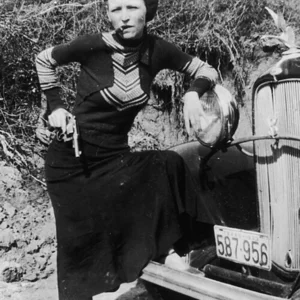

American criminal, companion of Clyde Barrow, with whom she formed the Barrow gang during the Great Depression. The couple committed a series of robberies and murders before being shot dead by police in 1934.
Bonnie Parker(1910 — 1934)
Bonnie Parker
États-Unis
6 min read
Frequently asked questions
Key Facts
- Born on October 1, 1910, in Rowena, Texas
- Met Clyde Barrow in January 1930, beginning their criminal partnership
- The Barrow gang carried out numerous robberies and murders across the central United States between 1932 and 1934
- The couple became a media legend fueled by press coverage during the Great Depression
- Killed in a police ambush on May 23, 1934, in Louisiana, along with Clyde Barrow
Works & Achievements
Intimate poems written during her years on the run, partially published after her death. These texts bear witness to her literary sensitivity and her reflection on crime, love, and the inevitable tragedy of her life.
Personal notes documenting the gang's daily life, robberies, fears, and hopes. This diary remains a unique record of the perspective of a woman caught up in organized crime.
Snapshots showing Bonnie and Clyde posing with guns and in their getaway cars, found after their deaths. These iconic photos fascinated the American public and shaped the legend of the couple.
Anecdotes
Bonnie Parker wrote poetry and kept a diary during her years of crime. Her poems, found in the car after her death in 1934, reveal an intelligent and sensitive woman aware of the spiral into which the Great Depression and her love for Clyde Barrow had drawn her.
Before meeting Clyde Barrow in 1930, Bonnie Parker was a waitress and dancer from a respectable Texas family. Her meeting with Clyde marked a radical turning point: from an ordinary young woman, she became the most wanted companion in the American Southwest, a symbol of rebellion during the economic crisis.
During the final ambush on May 23, 1934, in Louisiana, Bonnie and Clyde were riddled with bullets by law enforcement. Their bodies were publicly displayed, turning the couple into an urban legend and inspiring songs, films, and stories that fascinated America for decades.
Bonnie was often at the wheel during the Barrow gang's robberies, serving as the getaway driver. Although she was not armed during the heists, her role was crucial: she ensured the escape after the holdups, navigating the back roads of the American Southwest.
Primary Sources
Discovered in the gang's car after Bonnie and Clyde's death, her poems reveal an intimate reflection on a life of crime, love for Clyde, and the sense of inevitability facing their tragic fate.
Official documents describing the Barrow gang's robberies, shootouts, and capture attempts by federal and local authorities between 1932 and 1934.
The press of the time covered the gang's activities intensively, portraying Bonnie Parker as a dangerous and mysterious woman, often cited in witness appeals and reward announcements.
Images documenting the final ambush and its aftermath, showing bullet-riddled cars and testifying to the violence of the confrontation between the gang and authorities.
Key Places
Bonnie Parker's hometown and meeting place with Clyde Barrow. Dallas served as the gang's base between robberies, where Bonnie occasionally visited her family.
Secure hideout of the Barrow gang where Bonnie and her companions rested between operations. This camp represented a rare moment of stability in their life as fugitives.
Site of the final ambush on May 23, 1934, where Bonnie Parker and Clyde Barrow were killed by law enforcement. This quiet road became a symbol of the gang's tragic end.
Frequent robbery zone for the Barrow gang. The isolated rural roads offered easy targets and escape routes into neighboring Texas.
Strategically important border town for the gang, offering the ability to quickly cross from one state to another to evade local police.
Typical Objects

Iconic handgun of the Barrow gang, used in robberies and confrontations with police. Although Bonnie was not armed during heists, she was aware of the constant danger these revolvers posed.

The gang's preferred getaway car, powerful and fast for its time. Bonnie often drove these stolen vehicles to evade police on the roads of the American Southwest.
Bonnie smoked regularly, a common habit among modern women of the 1930s. Cigarettes were affordable even during the Great Depression and offered a momentary escape.

Bonnie recorded her thoughts, emotions, and wrote poems about her life as a fugitive. These personal writings, found after her death, are the most intimate documents about her state of mind.

Bonnie wore heavy makeup, adopting the styles of the day with bright red lips and powdered skin. Her well-groomed appearance contrasted with the violence of her criminal activities.

The gang collected articles reporting their exploits and police calls. These clippings reflected the growing media attention and their status as wanted 'public enemies.'

Proceeds from robberies, the money allowed them to eat, rent motels, and buy fuel. This cash also represented the fruit of their defiance against an economic system that had abandoned them.
School Curriculum
Vocabulary & Tags
Key Vocabulary
Tags
Daily Life
Morning
Bonnie woke up in cheap motels or makeshift hideouts, often after a short night due to anxiety. She washed quickly, applied makeup carefully as if to maintain an appearance of normalcy despite the circumstances, then smoked a cigarette while drinking bitter black coffee.
Afternoon
Afternoons were devoted to survival: casing banks, stealing cars, driving to heist sites. Bonnie often drove, navigating back roads to avoid police patrols, while her companions prepared weapons and escape plans.
Evening
In the evening, sitting in cars or seedy rooms, the gang played cards, shared quick meals, and listened to the radio. Bonnie used this time to write in her diary or compose poems, trying to turn her chaotic experience into personal art.
Food
Poor and opportunistic diet: black coffee, stale bread, stolen canned goods, cheap roadside food. Moonshine (hooch) was regular. Few regular meals, random nutrition dictated by availability and quick stops between heists.
Clothing
1930s dresses and suits stolen or bought with heist money: silk stockings, elegant dance shoes, cloche hats, thick coats. Bonnie wore bright red lipstick and powdered her face, trying to maintain a modern woman's look despite her fugitive life.
Housing
No real home, but a succession of seedy motels, cars, caves, and temporary hideouts. Bonnie likely dreamed of a normal house; instead, she spent her nights in uncomfortable environments, always ready to flee within minutes.
Historical Timeline
Period Vocabulary
Visual Style
Style visuel des années 1930 combinant la Grande Dépression sombre et la contre-culture criminelle : photographie contrastée en noir et blanc, vêtements époque, voitures chromées, atmosphère poussiéreuse et dangereuse du sud-ouest américain, glamour désespéré des hors-la-loi.
Sound Ambience
Ambiance sonore de la clandestinité dans le sud-ouest américain des années 1930 : mélange de bruits de moteurs, de sirènes lointaines, de fusillades et de musique radio crachotante échappée des motels miteux. Sons évoquant la tension permanente et l'isolement du couple de criminels.
Liens externes & ressources
Références
Œuvres
Recueil de poèmes personnels de Bonnie Parker
1931-1934
Journal intime de Bonnie Parker
1932-1934
Photographies personnelles du gang Barrow
1933-1934