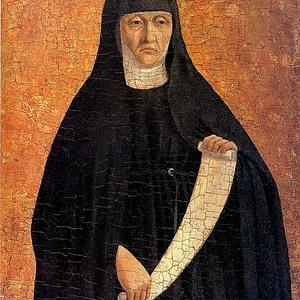

Mother of Saint Augustine, Monica is venerated as a saint in the Catholic Church for her unwavering faith. She prayed her entire life for her son's conversion. She died in Ostia in 387, shortly after witnessing his baptism by Saint Ambrose in Milan.
Monica(332 — 387)
Monica of Hippo
6 min read
Frequently asked questions
Famous Quotes
« Lay this body anywhere; be not troubled about it. Only this I ask of you, that you remember me at the altar of the Lord, wherever you may be. (reported by Augustine, Confessions IX, 11)»
Key Facts
- Born around 331–332 in Thagaste, in Numidia (present-day Algeria)
- Wife of Patricius, a Roman official, whom she converted to Christianity before his death
- Devoted decades of prayers and tears to the conversion of her son Augustine
- Witnessed Augustine's baptism by Saint Ambrose in Milan in 387
- Died in Ostia in 387, on her way back to Africa
Works & Achievements
Augustine dedicates this entire book to his mother: her upbringing, her piety, her role in his conversion, and her death at Ostia. It is the primary and most moving source on Monica.
For more than thirty years, Monica prayed without ceasing for her son. The Catholic Church regards this steadfast intercession as her most accomplished act of faith, a model for all Christian mothers.
A few days before her death, Monica shared with Augustine a contemplation on eternal beatitude. This moment is considered one of the pinnacles of Western Christian mysticism.
Anecdotes
When Monica lamented to a bishop over the conversion of her son Augustine, lost in Manichaean errors, he replied: “Go your way; it is impossible that the son of so many tears should perish.” These words became for her a sign of hope that she carried for the rest of her life.
In 383, Augustine deceived his mother by secretly boarding a ship for Rome under cover of night, leaving her weeping on the shore of Carthage. Inconsolable but tenacious, Monica crossed the Mediterranean to join him in Milan and never stopped praying for him.
In Milan, Monica was so struck by the authority of Saint Ambrose that she gave up a very ancient African custom: bringing wine and cakes to the tombs of the martyrs. Her piety was not rigid — she knew how to grow under the influence of great leaders of the Church.
Shortly before her death at Ostia, Monica shared a mystical contemplation with Augustine at a window overlooking a garden. Together, they rose in thought toward eternal beatitude in a dialogue known as the ‘Vision of Ostia’ — one of the most moving passages in all of Christian literature.
Primary Sources
She wept for me before Thee more bitterly than mothers weep for the bodily deaths of their children.
On the ninth day of her sickness, in the fifty-sixth year of her age and the thirty-third of mine, that devout and holy soul was freed from the body.
We were inquiring between ourselves, in the presence of the Truth which Thou art, of what sort the eternal life of the saints would be, which eye hath not seen, nor ear heard, neither hath it entered into the heart of man.
She would not return without me, and I had great difficulty persuading her to spend the night in an oratory close by the ship... The wind blew and filled our sails, and the shore vanished from our sight.
Key Places
Birthplace of Monica and Augustine. It was here that she lived her marriage to Patricius, raised her children, and began her prayers for her son's conversion.
The great Roman metropolis of Africa where Augustine studied and went astray, and where Monica pleaded with bishops to intercede for him. It was from here that she watched him secretly sail for Rome.
Capital of the Western Roman Empire, where Monica followed Augustine, regularly attended Ambrose's sermons, and was present at her son's long-awaited baptism.
The port of Rome where Monica died in 387, a few days after the celebrated Vision of Ostia she shared with Augustine. Her tomb was venerated there before her relics were transferred to Rome.
Typical Objects

After the death of Patricius, Monica wore the veil of Christian widows as a sign of mourning and devotion. It symbolized her consecration to prayer and intercession.

The oil lamp accompanied Monica's nightly vigils, as she often prayed in the dark for her son's conversion. It is her most discreet and intimate attribute.

Monica brought wine and bread to the tombs of martyrs according to African custom, a practice she abandoned in Milan on the advice of Ambrose — a testament to her evolving piety.

The standard writing and correspondence medium of late Roman antiquity. Monica followed her son's life and intellectual progress from afar through whatever news reached her.

The garment of the devout Christian matron of the Late Empire, a symbol of modesty and quiet recollection. Monica wore it throughout her travels across the Mediterranean.

Monica's tears are mentioned so often in the *Confessions* that they have become her principal iconographic attribute — a sign of tireless prayer and maternal tenderness raised to something transcendent.
School Curriculum
Vocabulary & Tags
Key Vocabulary
Daily Life
Morning
Monica rose before dawn each day to attend early morning Mass at the local basilica, a daily practice rooted in her North African faith. She prayed at length, often in tears, before turning to the management of her household.
Afternoon
She ran her household with discipline and sought out bishops and priests to intercede on her son's behalf. In Milan, she regularly attended the sermons of Ambrose, whose doctrine she deeply admired.
Evening
Her evenings were devoted to family prayer and meditation on Scripture. She sometimes conversed with Augustine about the soul and God, quietly nurturing her son's spiritual quest without ever pressing him.
Food
Monica ate simply, in the manner of devout Christians of the Late Empire: bread, vegetables, olives, fish, and little meat. She fasted regularly as an act of penance and intercession for Augustine's conversion.
Clothing
She wore the stola and palla of Roman matrons, in dark or natural wool, and covered her head with a modest veil. Her garments as a Christian widow bore no ostentatious ornament, a reflection of her inward piety.
Housing
In Thagaste, Monica lived in a modest Roman house with a central courtyard, garden, and well. In Milan, she lodged in a boarding house close to the Christian circles frequented by Augustine, before spending her final days in Ostia in a dwelling overlooking the sea.
Historical Timeline
Period Vocabulary
Visual Style
Iconographie paléochrétienne à palette byzantine : teintes ocre et terre cuite d'Afrique romaine, fond de mosaïque dorée, hiératisme serein d'une mère en prière.
Sound Ambience
Atmosphère de recueillement et de douleur pieuse : prière nocturne dans une maison africaine, psaumes d'une basilique milanaise, vent marin d'Ostie au crépuscule.
Liens externes & ressources
Références
Œuvres
Confessions d'Augustin, Livre IX (portrait de Monique)
397-400
Intercession pour la conversion d'Augustin
354-387
Vision d'Ostie (dialogue mystique avec Augustin)
387