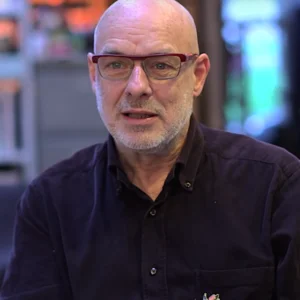

Brian Eno is a British musician, producer, and theorist born in 1948, regarded as the pioneer of ambient music. Originally a member of Roxy Music, he revolutionized music production by collaborating with David Bowie, U2, and Talking Heads.
Brian Eno(1948 — ?)
Brian Eno
Royaume-Uni
5 min read
Frequently asked questions
Famous Quotes
« The first Velvet Underground album only sold 30,000 copies in its first five years, yet everyone who bought it formed a band.»
Key Facts
- Born on 15 May 1948 in Woodbridge (Suffolk, England)
- Founding member of Roxy Music (1971-1973)
- Released Discreet Music (1975) and then Ambient 1: Music for Airports (1978), the foundational works of ambient music
- Produced David Bowie's Berlin Trilogy (Low, Heroes, Lodger, 1977-1979)
- Produced several major albums by U2 and Talking Heads in the 1980s
Works & Achievements
Eno's first solo album after Roxy Music, inventive and colorful art rock.
A pivotal album blending songs and instrumental pieces, foreshadowing ambient music.
A founding album of the ambient genre, conceived as atmospheric music for public spaces.
The first part of the Berlin Trilogy, combining rock and electronic experimentation.
An album produced by Eno, an innovative fusion of rock, funk, and African rhythms.
A U2 album co-produced by Eno, a huge worldwide success.
A short sonic signature composed for Microsoft, heard by millions of users.
A box set gathering the music created by Eno for his visual and sound art installations.
Anecdotes
In 1975, while bedridden after a car accident, a friend brought him a record of harp music. The volume was too low and one channel of the stereo was faulty: unable to get up, Eno listened to the music blend into the rain and the surrounding sounds. This experience inspired his idea of ambient music, an atmospheric music meant to be listened to absentmindedly.
To spark his own creativity and that of his collaborators, in 1975 Eno invented, together with the painter Peter Schmidt, a deck of cards called “Oblique Strategies”. Each card bears a cryptic instruction such as “Honour thy error as a hidden intention”. Drawn at random in the studio, they help unlock the imagination when you get stuck.
Eno composed the famous Windows 95 startup sound for Microsoft, a short piece just a few seconds long. He has recounted with amusement that he created it on an Apple Macintosh computer, and not on a PC running Windows.
In the 1970s, Eno described himself with humour not as a musician but as a “non-musician”, because he could not really play an instrument in the traditional way. He saw the recording studio itself as his true instrument instead.
At a Roxy Music concert in the early 1970s, Eno stood on stage covered in feathers and make-up, working a synthesizer from the mixing desk. He eventually left the band in 1973, tired of the rock star lifestyle and eager to explore music in a more experimental way.
Primary Sources
Ambient music must be able to accommodate many levels of listening attention without enforcing one in particular; it must be as ignorable as it is interesting.
Honor thy error as a hidden intention.
A personal diary published by Eno recounting his year 1995, blending reflections on art, music, and everyday life.
Key Places
Small town in England where Brian Eno was born in 1948 and spent his childhood.
Art school in the Suffolk region where Eno studied in the late 1960s, influenced by avant-garde ideas.
Berlin recording studio where Eno worked with David Bowie on the “Berlin Trilogy” in the late 1970s.
City where Eno developed the bulk of his career, starting out with Roxy Music and then as a producer and solo artist.
Typical Objects

A British analog synthesizer from the 1960s, with no keyboard, controlled via a patch-pin matrix. Eno used it to process and distort sounds in real time.

A multitrack magnetic-tape recorder, the heart of the 1970s studio. Eno used it for loops and layered soundscapes.

A deck of cards bearing enigmatic creative instructions, devised by Eno and Peter Schmidt. Drawn at random to unlock inspiration in the studio.

A mixing desk used to balance and process each recorded track. For Eno, the entire studio was an instrument in its own right.

An electronic machine generating programmed rhythms, popularized in the 1980s. Eno used it in his productions and experiments.

A visual-art device using light panels whose colors shift slowly and unpredictably, paired with ambient music.
School Curriculum
Vocabulary & Tags
Key Vocabulary
Tags
Daily Life
Morning
Eno likes to start his day early and quietly in his studio. He often describes the morning as the time when the mind is most free to experiment with new sounds without pressure.
Afternoon
The afternoon is devoted to studio work: recording, processing sound loops, and collaborating with other artists. Eno also spends time on his visual art installations.
Evening
In the evening, he reads, writes in his journal, and reflects on artistic ideas. He enjoys conversations about art, science, and culture.
Food
Eno leads a rather sober and organized life, without the excesses associated with the world of rock. He favors a regular routine conducive to concentration.
Clothing
In his **Roxy Music** days, he wore extravagant outfits, feathers, and glam rock makeup. Later on, he adopted a much more sober and understated style.
Housing
Eno lives and works mainly in **London**, dividing his time between his home and his personal studio equipped with electronic gear.