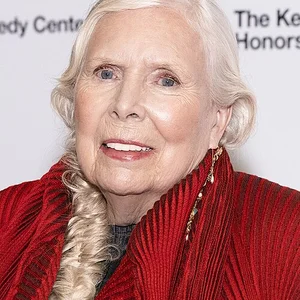

Canadian singer-songwriter and painter born in 1943, Joni Mitchell is one of the central figures of folk-rock and jazz fusion. Her album *Blue* (1971) is considered one of the greatest albums in the history of popular music.
Joni Mitchell(1943 — ?)
Joni Mitchell
Canada, États-Unis
8 min read
Frequently asked questions
Famous Quotes
« We are stardust, we are golden, and we've got to get ourselves back to the garden.»
« I've always thought of myself as a painter who became a musician.»
Key Facts
- Born on November 7, 1943, in Fort Macleod, Alberta, Canada
- Release of the album *Blue* in 1971, widely regarded as a folk masterpiece
- Wrote *Woodstock* (1970), an anthem of the hippie counter-culture
- Grammy Lifetime Achievement Award in 2002
- Return to the stage at the Newport Folk Festival in 2022 after years of health struggles
Works & Achievements
Joni Mitchell's debut album, produced by David Crosby. It reveals a deeply personal poetic world blending folk and musical impressionism, laying the foundations of a resolutely original style.
An album containing classics such as Big Yellow Taxi and Woodstock, marking the transition from the intimate folk of her early work to a more elaborate sound with carefully crafted arrangements.
Widely regarded as one of the greatest albums in the history of popular music, Blue explores heartbreak and solitude with unprecedented candor, establishing the confessional genre in popular song.
Mitchell's first major commercial breakthrough, this album fuses folk, rock, and jazz with remarkable harmonic sophistication, proving that artistic ambition and popular appeal can coexist.
An album of inner journeying recorded with jazz bassist Jaco Pastorius, whose fretless bass lines revolutionized Mitchell's sound. Hejira is considered her most experimental work.
An album that won two Grammy Awards, including Best Pop Album. The cover art — a self-portrait parodying Van Gogh with a severed ear — captures the humor and artistic depth of a Mitchell at the height of her maturity.
Alongside her musical career, Joni Mitchell produced a substantial body of visual art exhibited in galleries across North America and Europe; painting remained for her an artistic practice as fundamental as songwriting.
Anecdotes
At age nine, in 1952, Joni Mitchell contracted polio during an epidemic that swept through Canada. Doctors told her she might never walk normally again. She defied that prognosis, and during her convalescence at a Saskatoon hospital, she began to sing to pass the time — an experience that revealed her musical calling.
In 1964, a young art student in Calgary with no resources, Joni Mitchell gave birth to a daughter she had to place for adoption, unable to raise her alone. This painful separation would leave a deep mark on her life and work. Thirty-three years later, in 1997, mother and daughter were finally reunited: Kilauren Gibb, who had tracked down her biological parents, met the singer who had brought her into the world.
In 1969, as her friends and colleagues prepared for the Woodstock festival, Joni Mitchell could not attend: her manager David Geffen advised her not to cancel an appearance on The Dick Cavett Show. She listened to Graham Nash's enthusiastic accounts when he returned, and wrote the song Woodstock — which became the anthem of a festival she had never seen with her own eyes.
When she recorded the album Blue in 1971, Joni Mitchell bared her soul as few artists had done before. Her friend Neil Young told her she was “too unguarded.” But it is precisely that absolute vulnerability that makes Blue a revolutionary record, a founding work of the confessional genre in popular music.
Throughout her career, Joni Mitchell developed more than fifty entirely personal guitar tunings. This unique approach arose in part from a slight weakness in the fingers of her left hand — a lasting effect of polio — which forced her from the very start to find positions that suited her, turning a physical constraint into an unmistakable artistic signature.
Primary Sources
I've always felt that my biggest handicap as an artist in this business is that I take it too seriously. I'm a painter first and a musician second. The music just pays the rent.
These songs were written on the run. I had to get out on the highway. Movement is the only cure I know for certain kinds of sorrow.
I write about my own life. There is no distance between me and the song. When I sing it, I live it again — that is both the gift and the price.
I always thought of myself as a painter derailed by circumstance into the music business.
Key Places
Birthplace of Joni Mitchell, born on November 7, 1943. This small Canadian Prairie town shaped her relationship with nature and wide-open spaces, recurring themes throughout her work.
The city where Joni Mitchell grew up and contracted polio in 1952. She attended Saskatoon Technical Collegiate there, discovering her passion for visual art before music.
Toronto's bohemian neighborhood where Mitchell got her start performing in folk clubs in the late 1960s, a vibrant scene that also nurtured Neil Young and Gordon Lightfoot.
A wooded hillside neighborhood in Los Angeles where Mitchell settled in the late 1960s. This canyon was home to an extraordinary musical community — Crosby, Stills and Nash, James Taylor, Neil Young — and became the cradle of her most important work.
The legendary recording studio where Joni Mitchell recorded several of her landmark albums, including *Blue* (1971) and *Court and Spark* (1974), in collaboration with producer Henry Lewy.
A property on the Canadian Pacific coast where Joni Mitchell regularly retreated to write and paint, far from the bustle of Los Angeles, renewing her inspiration in the northern landscapes of her childhood.
Typical Objects

Mitchell uses more than fifty custom tunings throughout her career, including open tunings drawn from the Appalachian folk tradition, allowing her to achieve harmonies that reflect her unique musical vision.

Mitchell keeps separate notebooks for her lyrics and her visual artwork simultaneously, the two practices constantly feeding each other throughout her creative process.

From the 1970s onward, Mitchell incorporates piano into her compositions — most notably on *Court and Spark* — allowing her to explore jazz harmonies more complex than those achievable on guitar.

A trained painter, Mitchell designs her own album covers and exhibits her work in galleries; she regards painting as an artistic practice every bit as serious and fundamental as music.

Mitchell uses this distinctly American stringed instrument in some of her early folk compositions, lending a traditional, intimate quality to her pieces.

Like many artists of her generation, Mitchell records her compositions on magnetic tape — an invaluable working document for refining arrangements and lyrics before entering the studio.
School Curriculum
Vocabulary & Tags
Key Vocabulary
Tags
Daily Life
Morning
Joni Mitchell often starts her day late, after musical evenings or writing sessions that stretch far into the night. Mornings are devoted to coffee, cigarettes — her heavy smoking is well known — and painting, a morning activity that frees her mind before she turns to lyrics and compositions.
Afternoon
In the afternoons, Mitchell works on composition at the guitar or piano, exploring new tunings and improvising melodies for hours on end. At her house in Laurel Canyon, she frequently welcomes fellow musicians for informal sessions of exchange and collective improvisation.
Evening
Evenings in Laurel Canyon during the 1970s are often communal gatherings built around impromptu concerts and discussions about music and poetry. Mitchell is known for observing and listening as much as for playing, feeding her lyrics with the conversations and stories of her contemporaries.
Food
Like many artists of her generation, Mitchell lives informally, with no strict diet. She favors simple, natural food that reflects the countercultural values of her circle, and enjoys home-cooked meals shared with fellow musician friends.
Clothing
Mitchell wears the bohemian style of the Laurel Canyon scene: long dresses, printed fabrics, wide-brimmed hats, and ethnic jewelry. Her stage appearance is natural and unaffected, running counter to the conventional glamour of the music industry, and gradually shifts toward more refined outfits as her fame grows.
Housing
From 1968 to 1975, Mitchell lives in a wooden house in the hills of Laurel Canyon, a rustic enclave at the heart of Los Angeles, where she sets up a painting studio in a separate room. She also owns a property in Sechelt, British Columbia, on the Canadian Pacific coast, where she retreats to write and paint in the solitude of the northern landscape.