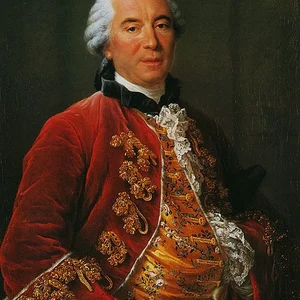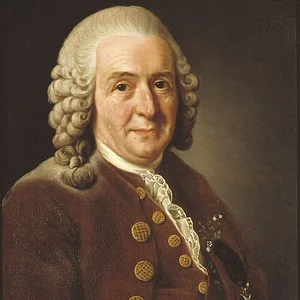

An 18th-century Swedish naturalist, Carl von Linnaeus revolutionized the classification of living organisms. He created a binomial nomenclature system that made it possible to name and organize all known species in a rational and universal way.
Carl von Linnaeus(1707 — 1778)
Carl von Linnaeus
Suède
7 min read
Frequently asked questions
Famous Quotes
« Deus creavit, Linnaeus disposuit (God created, Linnaeus organized)»
« Si numquam legisses, numquam doluisses (If you had never read, you would never have suffered)»
Key Facts
- 1735: Publication of Systema Naturae, the foundation of modern biological classification
- Creation of the binomial nomenclature system (genus + species) enabling universal naming of organisms
- Classification of the animal kingdom into classes, orders, genera, and species
- 1753: Publication of Species Plantarum, a landmark reference for plant classification
- 1766–1778: Professor of medicine and director of the Uppsala Botanical Garden
Works & Achievements
Foundational work that classifies the entire animal, plant, and mineral kingdoms. Revised twelve times during Linnaeus's lifetime, it became the basis of modern taxonomy.
First work to systematically apply binomial nomenclature to all known plant species. It constitutes the official starting point of botanical nomenclature.
Work describing the distinguishing characteristics of all known plant genera. It established the foundations of botanical classification by genera.
Theoretical manual that codifies the rules of plant nomenclature and description. It served as a reference for several generations of botanists.
Inventory of the plants of Lapland, the result of the 1732 expedition. The work also contains ethnobotanical observations on the uses of plants by the Sami people.
Complete catalogue of the plants of Sweden, a model national flora that inspired similar works throughout Europe.
The zoological counterpart to Flora Suecica, this work inventories and classifies all animals known in Sweden according to the Linnaean system.
Anecdotes
From the age of five, young Carl had his own garden on the family estate at Rashult. His father, a pastor with a passion for botany, would teach him the names of plants during walks. This early passion never left him and shaped his entire career.
During his expedition to Lapland in 1732, Linnaeus covered nearly 4,600 kilometres in five months, often on foot or on horseback, under extreme conditions. He nearly drowned crossing a flooded river. The journey allowed him to describe around a hundred new plant species and to publish his Flora Lapponica.
Linnaeus had a habit of giving species names as a tribute to his friends or to mock his rivals. He thus named a small foul-smelling plant Siegesbeckia after Johann Siegesbeck, a botanist who had sharply criticised his classification system based on the sexual organs of plants.
In 1758, Linnaeus was the first scientist to classify humans among the primates in his Systema Naturae, under the name Homo sapiens. This choice sparked fierce controversy across Christian Europe, with many finding it shocking to place humans alongside apes.
Linnaeus was so famous during his lifetime that King Frederick I of Sweden ennobled him in 1757, allowing him to take the name Carl von Linné. His lectures at Uppsala University drew hundreds of students from across Europe, an exceptional feat for the time.
Primary Sources
In the preface to the tenth edition, Linnaeus writes: "Deus creavit, Linnaeus disposuit" (God created, Linnaeus organized), thus summarizing his ambition to bring order to the entire natural world according to a rational system.
This work systematically applies binomial nomenclature to all known plant species. Linnaeus describes approximately 7,300 species, each designated by a genus name followed by a species name.
Linnaeus describes the plants discovered during his expedition to Lapland and notes: "I have seen the midnight sun, and the plants that bloom only under this perpetual light." The work also documents the uses of plants by the Sami people.
Linnaeus establishes the fundamental rules of botanical nomenclature: "The name of each plant must be composed of two words: the first designates the genus, the second the species." This principle remains in force today.
Key Places
Linnaeus's birthplace, where the family rectory and his first garden awakened his passion for botany. The childhood home is today a museum.
Linnaeus studied and then taught here for more than thirty years, transforming the botanical garden into a scientific centre of European renown. It was here that he trained dozens of disciples sent to explore the world.
A country estate acquired by Linnaeus in 1758, where he would retreat in summer to work and receive his students. His personal collection and private museum were housed there.
Linnaeus obtained his doctorate in medicine at Harderwijk in 1735 and stayed in Leiden, where he published his first major works thanks to the support of botanist Boerhaave and patron Clifford.
The destination of his 1732 expedition, where Linnaeus discovered Arctic flora and fauna. This five-month formative journey established his reputation as a naturalist explorer.
Typical Objects

Linnaeus assembled one of the largest herbariums of his time, containing approximately 14,000 specimens of dried and pressed plants. This herbarium, preserved in London by the Linnean Society, remains a worldwide scientific reference.

An indispensable instrument for observing the details of flowers and insects. Linnaeus used it daily to examine the reproductive organs of plants, which formed the basis of his classification system.

During his expeditions, Linnaeus meticulously recorded his observations in notebooks. Those from the Lapland expedition contain sketches, notes, and descriptions of new species.

Linnaeus brought back from Lapland a traditional Sami costume which he wore proudly and in which he had himself painted. This garment symbolised his Nordic adventure and his passion for exploration.

A tool consisting of two wooden boards tightened with straps, used to flatten and dry plant specimens. It was the basic equipment of every field botanist in the 18th century.

Linnaeus designed a garden-clock project where each bed corresponded to an hour, with flowers opening and closing at precise times of day. This concept illustrated his keen sense of observation of nature.
School Curriculum
Vocabulary & Tags
Key Vocabulary
Daily Life
Morning
Linnaeus rose very early, often at five in the morning, to make the most of the morning light in the Uppsala botanical garden. He would inspect the greenhouses and flowerbeds, noting new blooms and the condition of specimens. He would then receive students for botanical consultations in his study.
Afternoon
The afternoon was devoted to lectures at the university, delivered in Latin before a large and enthusiastic audience. Linnaeus also organized 'herborisations' — collective botanical excursions into the Uppsala countryside — which could attract up to two hundred participants. These outings sometimes ended with fanfares and cheering.
Evening
In the evening, Linnaeus would retire to his study to work on his manuscripts, classify specimens, and reply to his abundant international correspondence. He went to bed early, rarely after nine o'clock, as he suffered from migraines. His wife Sara Lisa managed the household while he worked.
Food
Linnaeus's diet was typical of the Swedish bourgeoisie of the 18th century: rye bread, dried or smoked fish, oat porridge, garden vegetables, and wild berries. He was particularly fond of strawberries, which he regarded as a remedy for gout. He drank coffee, a fashionable beverage in Sweden at the time.
Clothing
Linnaeus wore the traditional academic dress: powdered wig, dark frock coat, and white stockings for his lectures. On herborisations, he dressed more practically. He also owned his famous Sami costume, which he wore on special occasions and in which he sat for several portraits.
Housing
In Uppsala, Linnaeus occupied the official residence of the professor of botany, a house adjoining the botanical garden. In summer, he would retreat to Hammarby, his country estate a few kilometres from the city, where he had a small museum built to house his collections, safe from the risk of fire.
Historical Timeline
Period Vocabulary
Visual Style
Un style d'illustration botanique précis et élégant, mêlant la rigueur scientifique des planches naturalistes du XVIIIe siècle aux teintes chaleureuses du parchemin et à la lumière dorée des étés scandinaves.
Sound Ambience
L'ambiance sonore du jardin botanique d'Uppsala au XVIIIe siècle, entre chants d'oiseaux nordiques, bruissements de feuillages et travail méticuleux du naturaliste à sa table d'étude.
Liens externes & ressources
Références
Œuvres
Systema Naturae
1735
Species Plantarum
1753
Genera Plantarum
1737
Philosophia Botanica
1751
Flora Lapponica
1737
Flora Suecica
1745
Fauna Suecica
1746