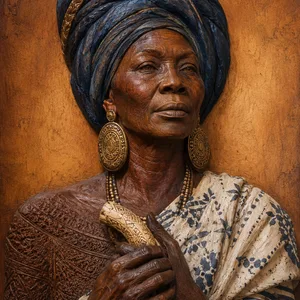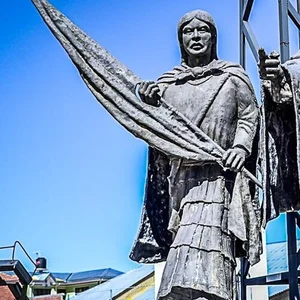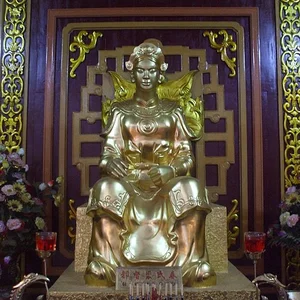

Vietnamese general (1752–1802), one of the five great heroines of the Tây Sơn dynasty. Wife of General Trần Quang Diệu, she commanded the war elephant corps and distinguished herself against Siamese and Manchu armies. Captured after the fall of the Tây Sơn, she was executed by elephant in 1802.
Bùi Thị Xuân(1752 — 1802)
Bùi Thị Xuân
Vietnam
9 min read
Frequently asked questions
Famous Quotes
« My child must die bravely to be worthy of being my daughter! (words reported by missionary De La Bissachère, 1807) [1]»
Key Facts
- 1752: born in Xuân Hòa (Bình Định); trained in martial arts, horsemanship, and war elephant handling from adolescence [1]
- 1771: saves General Trần Quang Diệu from a tiger attack; they marry and together join the Tây Sơn rebellion [1]
- 1785: takes part in the Battle of Rạch Gầm-Xoài Mút, a decisive victory against 20,000 Siamese soldiers; personally kills enemy general Lục Côn [1]
- 1789: commands the elephant corps of the central army during Nguyễn Huệ (Quang Trung)'s lightning campaign against the Qing (Manchus) [1]
- 1802: captured after the final defeat of the Tây Sơn; executed by elephant alongside her daughter on the orders of Gia Long (Nguyễn Phúc Ánh) [1]
Works & Achievements
Even before joining the Tây Sơn movement, Bùi Thị Xuân gathered several dozen women from her region and trained them in martial arts. Among her most remarkable students was Bùi Thị Nhạn.
When Nguyễn Nhạc was organizing the movement in its early stages, Bùi Thị Xuân was entrusted with managing its economy and finances alongside Nguyễn Thung and Nguyễn Lữ — a logistical role that was essential to the movement's military rise.
She led the ground forces in this decisive battle against 20,000 Siamese troops and personally killed the enemy general Lục Côn, contributing to a victory that secured lasting control of the Mekong Delta.
Bùi Thị Xuân commanded the elephant corps of Quang Trung's central army during the great offensive that crushed the Qing Manchu forces — one of the most celebrated military feats in Vietnamese history.
Appointed commander of Quảng Nam, she successfully repelled the offensive of Nguyễn Phúc Ánh, humiliating the future founder of the Nguyễn dynasty and delaying the collapse of the Tây Sơn.
Anecdotes
For three years, an unknown old woman came each night to teach Bùi Thị Xuân boxing and the handling of the double sword, from dusk until the first cock's crow, without anyone ever knowing who she was. By the age of fifteen, the young woman had reached a level of mastery that her contemporaries described as prodigious. Later, the notable Bùi Sơn Nhi of Xuân Hòa identified this mysterious teacher as the great-great-grandmother of the famous martial arts master Hương mục Ngạc of An Vinh.
In 1771, when she was twenty years old, Bùi Thị Xuân saved the warrior Trần Quang Diệu from a wild tiger attack by drawing her sword. The man came to her home to recover from his wounds, and the two fighters became husband and wife before joining the Tây Sơn forces together at the Phú Lạc encampment. It was thus that the legend of the warrior woman began.
In 1785, at the battle of Rạch Gầm-Xoài Mút, Bùi Thị Xuân commanded the land troops against an army of 20,000 Siamese soldiers. At the height of the fighting, she personally struck down the Siamese general Lục Côn with a sword blow, contributing to the total victory that annihilated this invasion force.
At the battle of the Trấn Ninh palisade in 1802, Bùi Thị Xuân charged on elephant-back from morning to evening, her armor soaked in blood and sweat. Seeing her soldiers waver, she herself seized the sticks to beat the war drums without respite. Her fury was such that Nguyễn Phúc Ánh and his generals nearly gave way, before the destruction of the Tây Sơn fleet at Nhật Lệ sealed the outcome of the battle.
At the time of her execution by elephant in 1802, the missionary De La Bissachère reported that she calmly stepped forward before the animal and let out a cry so powerful that the elephant recoiled in fright; the soldiers had to set off firecrackers and prod the beast to drive it into a fury. She had previously urged her daughter to die courageously so as to be “worthy of being my daughter.”
Primary Sources
Thanks to the layer of cloth wrapped around her body, she was spared from nudity. She walked very calmly toward the elephant's head and let out a great cry that made the frightened animal recoil. The soldiers had to set off firecrackers and drive pikes into its hindquarters to enrage it...
Trần Quang Diệu, together with his wife and daughter, leading a few survivors with him, fled northward along the mountain route through Laos. Upon reaching the châu of Quy Hợp, Diệu descended toward Hương Sơn and learned that Nghệ An had fallen. All his soldiers had abandoned him; a few days later, the couple was captured.
The mysterious old woman was the great-great-grandmother of Hương mục Ngạc, a renowned martial arts master from An Vinh during the French colonial period.
Key Places
Birthplace of Bùi Thị Xuân, located east of Phú Phong in the Tây Sơn district (Bình Định province). It was here that she grew up, received her nightly martial training, and taught her first students, including the remarkable Bùi Thị Nhạn.
Tây Sơn encampment where Bùi Thị Xuân and Trần Quang Diệu enlisted under Nguyễn Nhạc's banner in 1771. This was the starting point of their entire joint military career in service of the Tây Sơn dynasty.
Site of the 1785 battle where Bùi Thị Xuân commanded the infantry and killed the Siamese general Lục Côn, helping to annihilate 20,000 Siamese soldiers sent to support the Nguyễn lords.
Province whose military defense Bùi Thị Xuân took charge of following the death of Quang Trung (1792). She successfully repelled an offensive by Nguyễn Phúc Ánh, inflicting a humiliation he publicly vowed to avenge.
Fortification where Bùi Thị Xuân fought her final great battle in the spring of 1802. She charged on elephant-back from dawn to dusk and beat the war drums herself, before the fall of the Tây Sơn fleet at Nhật Lệ turned the battle into a rout.
The place where Bùi Thị Xuân and her husband Trần Quang Diệu were captured in 1802 during their flight north via the Laotian route, abandoned by their last remaining soldiers.
Typical Objects

Two short swords wielded simultaneously, an art taught to Bùi Thị Xuân over three years by her mysterious nocturnal mistress. Her mastery of the double sword allowed her to kill a tiger in 1771 and to fell the Siamese general Lục Côn at Rạch Gầm in 1785.

A combat animal that Bùi Thị Xuân trained and commanded personally; her unit comprised dozens of war elephants (voi chiến). She led them notably during the campaign against the Qing in 1789 and at the final battle of Trấn Ninh in 1802.

A large drum used to coordinate troop maneuvers and set the rhythm of charges. During the battle of Trấn Ninh in 1802, Bùi Thị Xuân herself seized the drumsticks and beat the drum relentlessly, striving to rally her faltering soldiers.

Combat armor worn by Bùi Thị Xuân in battle, lined with a layer of cloth wrapped around the body underneath. The missionary De La Bissachère explicitly mentions this lining, which spared her from being stripped at her execution in 1802.

A ranged weapon in which Bùi Thị Xuân was recognized as an expert according to the sources, alongside horsemanship and the training of elephants.

Implements used in long-jump training under the guidance of the nocturnal mistress: first a rigid pole, then a bent green bamboo whose spring propelled the jumper. This physical training technique is described in precise detail in the sources.
School Curriculum
Vocabulary & Tags
Key Vocabulary
Daily Life
Morning
The day began before dawn with the inspection of troops and war elephants under Bùi Thị Xuân's command. Her mahouts (quản tượng) tended to dozens of animals daily, which required constant care and training. Sources describe her as personally overseeing these exercises.
Afternoon
Afternoons were devoted to military maneuvers, weapons training, and — during the period when she administered Tây Sơn resources — logistics and army supply tasks. Her recognized skill in archery, swordsmanship, and horsemanship allowed her to train her troops directly.
Evening
Before her military career, the evenings of young Bùi Thị Xuân were spent teaching her female students the martial arts, continuing the instruction she had received by night from her mysterious mistress. Details of her evenings during her period of military command are not documented in available sources.
Food
Not documented in available sources.
Clothing
As a child, Bùi Thị Xuân deliberately wore boys' clothing to school, asserting her refusal of traditional female roles. Once she became a warrior, she fashioned her own outfit inspired by the heroic women depicted in history books. In battle, she wore armor (áo giáp) lined on the inside with a thick layer of fabric wrapped around the body.
Housing
Born into a prosperous family (khá giả) in the village of Xuân Hòa, east of Phú Phong (Bình Định), Bùi Thị Xuân grew up in a home typical of a 18th-century Vietnamese provincial notable. Sources note only the family's relative wealth; architectural details of her dwelling are not documented.
Historical Timeline
Period Vocabulary
Liens externes & ressources
Références
Œuvres
Formation d'un corps de femmes guerrières à Xuân Hòa
années 1760-1771
Responsabilité économique et financière du mouvement Tây Sơn
à partir de 1771
Commandement de l'infanterie à Rạch Gầm-Xoài Mút
1785
Commandement des troupes d'éléphants contre les Qing
printemps 1789 (Kỷ Dậu)
Défense militaire de la province de Quảng Nam
années 1790