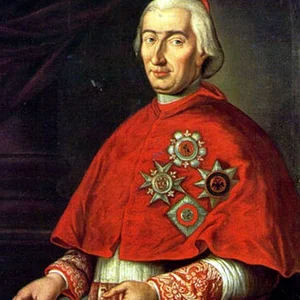

Neapolitan cardinal (1744–1827), known for reconquering the Kingdom of Naples in 1799 at the head of an army of Calabrian peasants, the Sanfedists. A symbol of counter-revolutionary reaction and the Bourbon restoration.
Cardinal Ruffo(1744 — 1827)
Fabrizio Dionigi Ruffo
8 min read
Frequently asked questions
Key Facts
- 1744: born in San Lucido, Calabria, into a noble family
- 1799: leads the reconquest of the Kingdom of Naples at the head of the Army of the Holy Faith (Sanfedists)
- 1799: negotiates a surrender with the Neapolitan republicans, later invalidated by King Ferdinand IV
- Takes part in the suppression of the Parthenopean Republic (1799)
- 1827: dies in Naples after a long ecclesiastical and diplomatic career
Works & Achievements
In five months, Ruffo marched across the entire Mezzogiorno at the head of his peasant army and restored the Bourbon throne. This unprecedented military campaign remains his most historically significant act.
An agreement negotiated by Ruffo with the republican defenders of the Neapolitan castles, guaranteeing their lives and freedom. The violation of this agreement by Nelson stands as one of the great moral debates in Neapolitan historiography.
Before his military career, Ruffo worked to rationalize the finances of the Papal States as treasurer-general. This administrative experience gave him the organizational tools he would later apply to his 1799 campaign.
Ruffo maintained active correspondence with representatives of the allied powers — notably British and Austrian — to organize resistance to Napoleon across the Mezzogiorno. These letters constitute a valuable primary source for the history of the Italian counter-revolution.
Anecdotes
On February 8, 1799, Ruffo landed in Calabria with only eight men and a banner bearing the cross. Within weeks, he had assembled an army of tens of thousands of peasants, brigands, and fanatical monks, which he named the “Army of the Holy Faith.” This spontaneous mass levy remains one of the most striking examples of counter-revolutionary popular mobilization.
In June 1799, Ruffo negotiated an honorable surrender with the republican defenders of Naples, guaranteeing safe conduct to the surrendering Jacobins. But Admiral Nelson, anchored in the bay with his fleet, refused to honor the agreement. Many Neapolitan republicans, including Admiral Caracciolo, were executed after trusting the cardinal’s word. Ruffo, outraged, protested in vain.
During the reconquest of Naples in June 1799, the lazzaroni — the common street people of the city — rose up spontaneously against the republicans even before the arrival of the Sanfedist troops. This social paradox, in which the very poorest defended the monarchy against revolutionaries drawn from the enlightened bourgeoisie, illustrates the deep complexity of the southern counter-revolution.
Ruffo had begun his career as an able manager of papal finances before becoming a cardinal. It was this reputation as a man of order and a skilled organizer that led Ferdinand IV to entrust him with the Calabrian mission in 1799 — not a career soldier, but an administrative prelate transformed into a warlord by circumstance.
After the final Restoration in 1815, Ruffo gradually fell from favor at the Bourbon court of Naples, deemed too moderate. The man who had saved the throne ended his days removed from power, a symbol of a counter-revolutionary reaction that its beneficiaries wished to forget as soon as it was no longer of use.
Primary Sources
In the name of His Majesty the King of the Two Sicilies, I call upon you to defend your faith, your king, and your homeland against the impious men who have defiled the city of Naples with their sacrilegious doctrines.
The persons and property of all those who submit will be respected; those who wish to leave the kingdom will be free to do so, provided with a safe-conduct pass.
I regard the capitulation signed by Cardinal Ruffo as illegal and void; no rebel can claim the protection of a treaty concluded without the King's consent.
The Cardinal's army was not an army in the ordinary sense; it was a human torrent driven by devotion, vengeance, and a fierce faith in the divine right of kings.
Key Places
A small town in the Kingdom of Naples where Ruffo was born in 1744 into a family of southern aristocracy. His origins bound him deeply to the rural world of the Mezzogiorno, the very people he would mobilize in 1799.
The southernmost province of the Kingdom of Naples where Ruffo landed in February 1799 to raise his peasant army. Deeply Catholic and hostile to revolutionary ideas, the region supplied the bulk of his troops.
Capital of the kingdom and seat of the Parthenopean Republic, which Ruffo retook in June 1799. It was here that the drama of the betrayed capitulation and the republican executions unfolded.
Capital of Sicily, where Ferdinand IV had taken refuge following the proclamation of the Parthenopean Republic. It was from here that Ruffo received his mission and his orders in 1799.
The city where Ruffo built most of his career before 1799, most notably as Treasurer General of the Apostolic Chamber. His knowledge of the Roman Curia and its networks earned him his cardinal's title.
Liens externes & ressources
Références
Œuvres
Campagne sanfédiste et reconquête du Royaume de Naples
Février–juin 1799
Capitulation du 23 juin 1799
23 juin 1799
Réforme de l'administration financière pontificale
Années 1780–1790
Correspondance diplomatique avec les cours européennes (1799–1815)
1799–1815