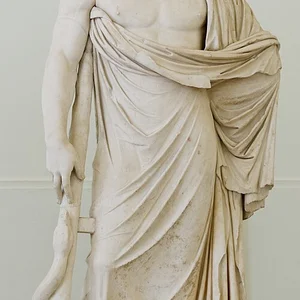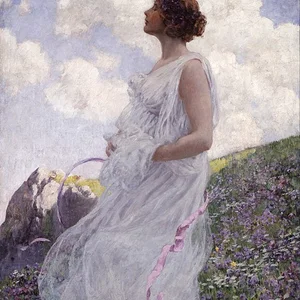

An Oceanid nymph of Greek mythology, Calypso rules over the island of Ogygia. In Homer's Odyssey, she holds Odysseus captive through her love for seven years, offering him immortality in exchange for his company. Forced by Zeus to release him, she embodies the figure of impossible love set against the longing to return home.
Calypso
Calypso
8 min read
Frequently asked questions
Famous Quotes
« "I loved him, I cherished him, I promised him immortality — and yet all he ever thought of was leaving." (words attributed to Calypso by the Homeric tradition, Odyssey, Book V)»
Key Facts
- Daughter of the Titan Atlas according to the Homeric tradition (Odyssey, around the 8th century BCE)
- Rules over the island of Ogygia, an isolated island in the middle of the seas
- Keeps Odysseus for seven years after the wreck of his ship
- Offers Odysseus immortality, which he refuses in order to return to Ithaca and Penelope
- Forced by Zeus's command, delivered by Hermes, to release Odysseus (Odyssey, Book V)
Works & Achievements
The foundational work that establishes the myth of Calypso. Book V is devoted entirely to her island, her speech before Hermes, and Odysseus's departure — it is the most complete and most poetic portrait of this character.
A pedagogical novel written for the Duke of Burgundy, revisiting the myth of Calypso. Fénelon turns her into an allegory of temptation and seductive power, leaving a lasting mark on how the character has been taught in French schools.
An opera-ballet set to music that revisits the Homeric episode, illustrating the popularity of the Calypso myth in 18th-century French Baroque culture.
A Symbolist painting depicting Calypso watching Odysseus depart, embodying romantic melancholy. The work is emblematic of the 19th-century Romantic reception of the myth.
An Irish modernist novel that freely transposes the Odyssey to 20th-century Dublin. The character of Molly Bloom partly carries Calypso's legacy as a symbol of the love that holds the hero back.
Anecdotes
Calypso offered Odysseus immortality and eternal youth in exchange for his stay on the island of Ogygia. This is one of the rare instances in Greek mythology where a mortal is offered the chance to become immortal out of love. Odysseus refused, choosing to return to his wife Penelope and his island of Ithaca, even at the cost of his own life.
According to some mythological traditions, Calypso was the daughter of the Titan Atlas, the one who holds up the sky on his shoulders. Her name in ancient Greek means 'she who conceals' or 'she who hides,' which perfectly matches her role in the Odyssey: she conceals and keeps Odysseus away from the world of men for seven long years.
When Hermes, the messenger of the gods, comes to order her to release Odysseus by decree of Zeus, Calypso expresses fierce anger and denounces the injustice of the Olympian gods. She points out that goddesses are always punished when they love mortals, while male gods are free to unite with mortal women. It is one of the rare feminist speeches in ancient Greek literature.
Calypso helped Odysseus build his raft with her own hands before he left the island. She provided him with tools, timber, provisions, and showed him the stars to navigate by. Despite her immense grief, she carried out this act of love knowing she would never see him again.
The island of Ogygia, Calypso's realm, is described in the Odyssey as a lush paradise, with fresh-water springs, forests of cedar and alder, vines heavy with grapes, and meadows blooming with violets and parsley. This enchanted place represents a timeless utopia, a symbol of perfect happiness stripped of freedom.
Primary Sources
Calypso, the divine goddess, kept Odysseus in her hollow caves, burning with desire to make him her husband. He wept, sitting on the shore, his eyes forever turned toward the barren sea.
The nymph Calypso, daughter of Atlas, long kept the unfortunate Odysseus in her deep caves, wishing to have him as her husband. But the time came when the gods decided he would return to his homeland.
Among the Oceanid nymphs born of Oceanus and Tethys are the powerful divinities of the waters and distant islands, who watch over young men and nurture them from their very cradle.
Odysseus, after the wreck of his raft, reached the island of Ogygia where Calypso, daughter of Atlas, lived. She welcomed him and kept him for seven years, promising him immortality if he consented to remain by her side.
Key Places
A mythical paradise island described in the Odyssey as the realm of Calypso, located 'at the navel of the sea.' Its exact location is unknown, but ancient traditions placed it to the west of Greece, perhaps somewhere in the western Mediterranean.
The seat of the Olympian gods, where Zeus decided to order the release of Odysseus following Athena's intercession. It was from Olympus that Hermes was dispatched to Calypso's island.
A Greek island, homeland of Odysseus and the destination of his long journey home (nostos). It was his overwhelming longing to return to Ithaca, Penelope, and Telemachus that led Odysseus to refuse Calypso's offer of immortality.
Some ancient scholars, including the geographer Strabo, placed Ogygia beyond the Pillars of Hercules, out in the Atlantic — at the very edge of the known Greek world, reinforcing the island's sense of utter remoteness.
Typical Objects

Calypso is described in the Odyssey weaving at her loom with a golden shuttle while singing. Weaving is a classic attribute of Greek female deities and symbolizes her power to ensnare Odysseus in her web.

As an immortal goddess, Calypso has access to nectar and ambrosia, the food and drink of the gods. She offered these substances to Odysseus, tempting him with the possibility of escaping his mortal condition.

Calypso personally gave Odysseus double-edged bronze axes and adzes to fell trees and build his raft. These objects embody the paradox of her love: helping the one she loves to leave her.

Calypso crafted and gave Odysseus a white linen sail to equip his raft. This sail represents the breath of departure and the goddess's painful consent to let her beloved go.

Calypso's cave is described as the heart of her realm, adorned with blooming vines, surrounded by springs and seabirds. It serves as both her palace and Odysseus's gilded prison.

In ancient descriptions of divine caves, fragrant resin torches light the nymphs' feasts. Calypso thus maintains a perpetual light within her grotto, beyond the cycle of the mortal sun.
School Curriculum
Vocabulary & Tags
Key Vocabulary
Tags
Daily Life
Morning
Each morning, Calypso lights a great fire of cedar and cypress in her cave, its fragrance perfuming the entire island. She sings as she weaves at her golden loom, surrounded by the nymphs who serve as her handmaidens. Odysseus, meanwhile, sits alone on the shore and weeps, gazing out to sea.
Afternoon
In the afternoon, Calypso prepares mortal food for Odysseus — bread, wine, and roasted meats — while she herself feeds on nectar and ambrosia, the food of the gods. She tries to distract him with stories, walks through flowering meadows, or baths in the clear springs that bubble up around her cave.
Evening
In the evening, in her vine-draped cave lit by torches and firelight, Calypso dines with Odysseus. She invites him to her bed each night, hoping the hero will forget Ithaca. Yet her love goes unreturned: Odysseus yields out of necessity, not desire.
Food
Calypso sustains herself on nectar and ambrosia, the divine substances that grant the gods their immortality. For Odysseus, she prepares mortal fare: wheat bread, wine from her own vines, fish, and game from the island. The shared table illustrates the unbridgeable divide between the divine and the human.
Clothing
In the Odyssey, Calypso is described wearing a shimmering veil (the peplos), fastened with a golden belt. Her garment is dazzling white or a silvery blue evoking the sea. Her hair is adorned with sea flowers, and her appearance embodies the ideal beauty of nymphs in the Greek tradition.
Housing
Calypso dwells in a spacious cave carved into the rock of the island of Ogygia. The entrance is framed by flowering vines; alders, poplars, and fragrant cypresses grow all around. Four freshwater springs bubble up nearby, and meadows of iris and parsley stretch as far as the eye can see — a setting of unearthly beauty.
Historical Timeline
Period Vocabulary
Visual Style
Style évoquant la Grèce archaïque et ses nymphes divines, dans une atmosphère à la fois paradisiaque et mélancolique : teintes marines, ors chaleureux et nature luxuriante d'une île hors du temps.
Sound Ambience
L'environnement sonore de l'île d'Ogygie mêle les sons de la nature méditerranéenne sauvage — vagues, oiseaux marins, sources — au chant mélancolique d'une nymphe divine tissant dans sa grotte.
Liens externes & ressources
Références
Œuvres
L'Odyssée — épisode de Calypso (Chants I, V, VII)
VIIIe siècle av. J.-C.
Les Aventures de Télémaque — Fénelon
1699
Ulysse et Calypso — Arnold Böcklin (peinture)
1883
Ulysses — James Joyce
1922