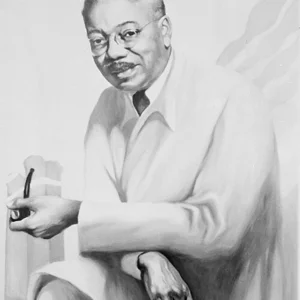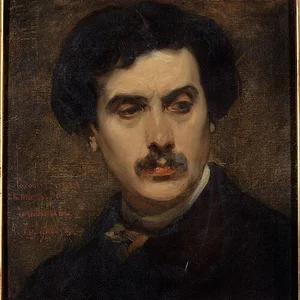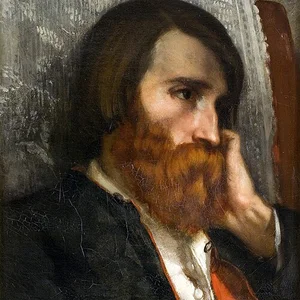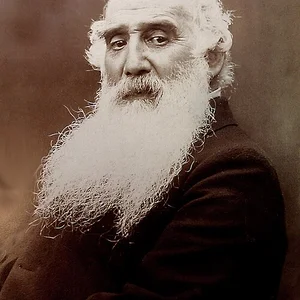

Camille Pissarro was a French-Danish painter, a major founding figure of Impressionism. The only artist to take part in all eight Impressionist exhibitions, he was a mentor to Cézanne, Gauguin and Van Gogh.
Camille Pissarro(1830 — 1903)
Camille Pissarro
France, Royaume de Danemark
6 min read
Frequently asked questions
Famous Quotes
« Blessed are they who see beautiful things in humble places where other people see nothing.»
« Paint the essential character of things.»
Key Facts
- Born in 1830 in Saint Thomas (Danish West Indies), died in 1903 in Paris
- Took part in the first Impressionist exhibition of 1874
- The only painter present at all eight Impressionist exhibitions (1874-1886)
- Turned toward Neo-Impressionism (Pointillism) around 1885-1890 under the influence of Seurat
- Took refuge in London during the Franco-Prussian War of 1870-1871, where many of his canvases were destroyed
Works & Achievements
A snowy countryside landscape that illustrates Pissarro's attention to atmospheric effects and shifting light.
A view of Pontoise where the fragmented brushwork and vibrant colours embody Pissarro's rural Impressionism.
A scene of a peasant garden that reflects his interest in rural life and working the land.
A peasant figure treated with dignity, reflecting the painter's social and humanist commitment.
A work from the Neo-Impressionist period in which Pissarro briefly applied Seurat's pointillist technique.
A bird's-eye view of a grand Parisian boulevard, from his urban series painted from hotel windows.
An album of satirical drawings denouncing social injustices, bearing witness to his anarchist convictions.
Anecdotes
Camille Pissarro is the only painter to have taken part in all eight Impressionist exhibitions, from 1874 to 1886. No other member of the group, not even Monet or Renoir, showed such loyalty to the movement.
During the Franco-Prussian War of 1870, Pissarro took refuge in London. On his return to his house in Louveciennes, he discovered that Prussian soldiers had occupied it: of the nearly 1,500 canvases stored there, the vast majority had been destroyed, some having been used as mats in the muddy garden.
Regarded as a true mentor, Pissarro guided younger artists such as Paul Cézanne, whom he invited to paint alongside him in Pontoise, as well as Paul Gauguin and Vincent van Gogh. Cézanne himself humbly described himself as a “pupil of Pissarro.”
Toward the end of his life, suffering from a chronic eye infection, Pissarro could no longer paint outdoors without risk. He then rented hotel rooms and apartments overlooking the great boulevards of Paris or the ports of Rouen and Le Havre, painting the cities seen from above through the window.
Pissarro was deeply committed to the anarchist ideas of his time. He created a series of drawings, *Turpitudes sociales*, intended for his nieces, to denounce the injustices of capitalist society.
Primary Sources
Work hard and constantly, do not go by principles and rules, but paint what you observe and what you feel.
Do not proceed according to rules and principles, but paint what you observe and feel. Paint generously and without hesitation, for it is best not to lose the first impression.
Camille Pissarro is among the exhibitors at the first collective show held at the studio of the photographer Nadar, on the Boulevard des Capucines.
One must have faith in a new society where art will no longer be a luxury reserved for the few.
Key Places
Pissarro's birthplace, then a Danish colony in the Caribbean, which explains his dual French-Danish nationality.
Town in the Val-d'Oise where Pissarro lived and painted the rural landscapes at length. He worked there alongside Cézanne.
Village where Pissarro was living in 1870; his house was occupied by the Prussians and most of his canvases were destroyed.
Pissarro's final home from 1884 onward; he set up his studio there and painted gardens and the Normandy countryside.
Pissarro's refuge during the war of 1870; there he discovered the English landscape painters Turner and Constable.
The center of artistic life where Pissarro exhibited and where he died in 1903. There he painted his series of the grand boulevards.
Liens externes & ressources
Références
Œuvres
La Route de Versailles à Louveciennes
1870
Les Toits rouges, coin de village, effet d'hiver
1877
Le Jardin potager à l'Hermitage, Pontoise
1879
La Bergère (Jeune fille à la baguette)
1881
L'Île Lacroix, Rouen, effet de brouillard
1888
Boulevard Montmartre, matinée de printemps
1897
Turpitudes sociales
1889