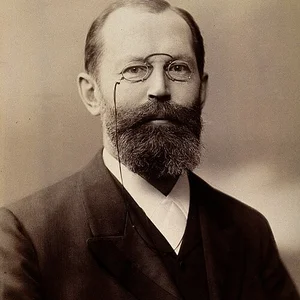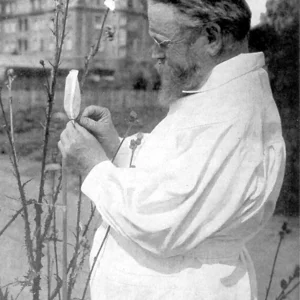

A German botanist and geneticist, he was one of three researchers who, in 1900, rediscovered Gregor Mendel's laws of heredity, which had been forgotten since 1865. His work on plants helped to found modern genetics.
Carl Correns(1864 — 1933)
Carl Correns
république de Weimar, royaume de Bavière
6 min read
Frequently asked questions
Key Facts
- Born in 1864 in Munich, died in 1933 in Berlin
- Rediscovers Mendel's laws of heredity in 1900, independently of Hugo de Vries and Erich von Tschermak
- Carries out his hybridization experiments on plants (notably maize and peas)
- Describes extranuclear (cytoplasmic) inheritance linked to plastids, a pioneer of non-Mendelian genetics
- Becomes in 1914 the first director of the Kaiser Wilhelm Institute of Biology in Berlin
Works & Achievements
Correns experimentally confirms Mendel's laws of heredity and publicly credits the monk's priority, helping to lay the foundations of modern genetics.
Work on the transmission of traits in maize kernels, showing that heredity follows regular and predictable proportions.
Demonstration of a mode of inheritance that does not pass through the cell nucleus (extranuclear), transmitted only by the mother: a foundational discovery for cytoplasmic genetics.
Study of the hereditary mechanisms that determine sex in certain plants, extending his work on the transmission of traits.
At the head of this prestigious research center in Berlin, he led a generation of work on plant heredity.
Anecdotes
In 1900, Carl Correns published his results on the heredity of peas and maize, unaware that two other botanists, Hugo de Vries and Erich von Tschermak, were making the same discovery at almost exactly the same moment. While reviewing the scientific literature, he came across Gregor Mendel's forgotten 1865 paper and realized that the Moravian monk had discovered it all thirty-five years earlier.
Correns had a strong personal connection to Mendel: his professor Carl von Nägeli, in Munich, had corresponded with Mendel during his lifetime but had never grasped the importance of his work. Correns thus indirectly inherited this story and became one of the first to do justice to the forgotten monk.
Rather than claiming the glory for himself alone, Correns honestly stressed Mendel's priority and called these principles the “laws of Mendel.” This act of scientific recognition has remained an example of intellectual honesty in the history of science.
Correns studied heredity in the four o'clock flower (Mirabilis jalapa) and discovered that certain traits, such as the color of variegated leaves, were not transmitted according to Mendel's laws but only through the mother. He thus revealed “extranuclear heredity,” a mode of transmission that does not pass through the cell's nucleus.
At his death in 1933, much of his notes and unpublished research was kept in Berlin, but many of his manuscripts were destroyed during the bombings of the Second World War, erasing part of the work of this quiet pioneer of genetics.
Primary Sources
The paper in which Correns announces in 1900 the rediscovery of Mendel's laws and explicitly acknowledges the priority of Mendel's work on pea hybrids.
An experimental study on the heredity of maize traits (xenia), confirming the regular transmission of characters according to predictable ratios.
Work on the four-o'clock flower showing that the variegated color of the leaves is transmitted solely through the maternal line, the first example of non-Mendelian inheritance.
Key Places
Correns's native city, where he studied botany under Carl von Nägeli, himself a former correspondent of Mendel.
Institution where Correns taught and carried out part of his research on plant heredity at the turn of the century.
Correns was a professor of botany here from 1909 to 1913 before taking charge of an institute in Berlin.
Correns became its first director in 1913; there he led cutting-edge research in plant genetics until his death.
City where Correns spent the final part of his career and where he died in 1933.
Typical Objects

An essential instrument for observing plant cells, pollen and chromosomes. Correns uses it to examine the structure of the plants he crosses.

A fine brush used to manually transfer pollen from one flower to another in order to carry out controlled crosses. A basic tool of experimental plant genetics.

A notebook in which crosses, generations and the ratios of observed traits are meticulously recorded. It makes it possible to compare results against the expected proportions.

Small paper or cloth bags placed over flowers to prevent any accidental pollination by wind or insects. They guarantee the purity of the crosses.

Seeds used as experimental material, chosen for their clear, easy-to-track traits (colour, shape). They are at the heart of demonstrations of heredity.

A collection of dried, labelled plants used as a reference for identifying and comparing species. A traditional tool of the botanist.
School Curriculum
Vocabulary & Tags
Key Vocabulary
Daily Life
Morning
The morning begins early in the laboratory or in the experimental garden, where Correns checks his plants, records the flowers that have bloomed, and prepares the day's crosses. Every observation is carefully logged in his notebooks.
Afternoon
The afternoon is devoted to the microscope, to analyzing results and calculating the proportions of inherited traits. He also discusses their ongoing experiments with his students and colleagues.
Evening
In the evening, he reads scientific journals, writes his articles, and keeps up his correspondence with other botanists across Europe. It is also the time to revisit older work, such as that of Mendel.
Food
Like a German academic of his time, he eats simple middle-class fare: bread, soups, meats, potatoes, and seasonal vegetables. Coffee often accompanies the long working days.
Clothing
He wears the strict attire of a university professor: a dark three-piece suit, a stiff-collared shirt, a tie or bow tie, and in the laboratory a lab coat to protect his clothes.
Housing
He lives in a comfortable town residence near the university or institute, with a study lined with books and notebooks. In Berlin-Dahlem, his work is tied to the institute's greenhouses and gardens.
Historical Timeline
Period Vocabulary
Liens externes & ressources
Références
Œuvres
Redécouverte des lois de Mendel
1900
Études sur les xénies du maïs
1899
Découverte de l'hérédité maternelle chez Mirabilis jalapa
1909
Recherches sur la détermination du sexe chez les plantes
1916-1928
Direction de l'Institut Kaiser-Wilhelm de biologie
1913