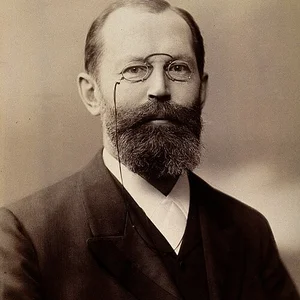

A Danish astronomer, he co-discovered the relationship between the brightness and temperature of stars. His work gave rise to the Hertzsprung-Russell diagram, a fundamental tool of modern astrophysics.
Ejnar Hertzsprung(1873 — 1967)
Ejnar Hertzsprung
Royaume des Pays-Bas, Royaume de Danemark
5 min read
Frequently asked questions
Key Facts
- Born in 1873 in Frederiksberg (Denmark) and died in 1967
- In 1905 and 1907, he established the distinction between giant and dwarf stars
- Around 1910, his work led to the Hertzsprung-Russell diagram, developed independently by Henry Norris Russell
- He introduced the concept of absolute magnitude to compare the true brightness of stars
- He worked for a long time at the Leiden Observatory in the Netherlands, of which he became director
Works & Achievements
The first to demonstrate that stars of the same color can have very different luminosities, founding the concept of giant and dwarf stars.
Plotted the first diagrams linking color and brightness for the Pleiades and the Hyades, the direct ancestors of the H-R diagram.
A fundamental tool of astrophysics that arranges stars according to temperature and luminosity and describes their evolution.
Used the period-luminosity relation of Cepheid stars to measure cosmic distances, a key step toward mapping the scale of the Universe.
The first estimate of the distance to an extragalactic object, paving the way for Hubble's work.
Vast campaigns of patient observation at Leiden, enriching our knowledge of binary stars.
Anecdotes
Before becoming an astronomer, Hertzsprung studied chemistry and worked as an engineer in photography. This experience proved decisive: he applied his knowledge of photographic plates to measure the brightness of stars with precision, a skill that few astronomers possessed at the time.
In 1905 and 1907, Hertzsprung published his groundbreaking discoveries in a German journal of... scientific photography (*Zeitschrift für wissenschaftliche Photographie*). Since almost no astronomer read this journal, his fundamental work at first went completely unnoticed by the astronomical community.
Hertzsprung distinguished two families of stars of the same color: very luminous giants and fainter dwarfs. To name them, he borrowed the vocabulary of fairy tales: these terms “giants” and “dwarfs” are still the everyday language of stellar astronomy today.
The American Henry Norris Russell independently reached the same conclusions around 1913, without knowing of Hertzsprung's work. This is why the famous graph bears both names: the Hertzsprung-Russell diagram, or “H-R diagram”.
Passionate about double stars, Hertzsprung kept observing relentlessly into very old age. He died in 1967, at 94, after a career of more than sixty years devoted to measuring the light of the stars.
Primary Sources
Stars of the same color do not all have the same intrinsic brightness; there exist stars of extraordinarily great luminosity alongside others that are far fainter.
Photographic measurement of the effective wavelength makes it possible to determine a color equivalent, and thus to classify stars according to their surface temperature.
It seems to me that the relationship between the color and the absolute brightness of stars is fundamental in nature and deserves a systematic study.
Key Places
Hertzsprung's birthplace, in the suburbs of Copenhagen, where he grew up in a family passionate about astronomy.
Small Danish observatory where Hertzsprung carried out his first astronomical observations as a passionate amateur.
Major astrophysics center where Hertzsprung worked alongside Karl Schwarzschild starting in 1909.
Institution where Hertzsprung spent most of his career, becoming a professor and then director.
Town where Hertzsprung retired and died in 1967, after returning to Denmark at the end of his life.
Typical Objects

Glass plate coated with a sensitive emulsion, exposed at the telescope's focus to permanently record the light of the stars. Hertzsprung used it to measure the brightness of celestial bodies with unrivaled precision.

A fixed telescope aligned with the plane of the meridian, used to measure the exact position of stars as they pass overhead. A basic tool of observatories such as Leiden.

An instrument that breaks a star's light into a colored spectrum, revealing its temperature and composition. It made it possible to link a star's color to its type.

A device used to compare and measure the light intensity of stars. Hertzsprung made it the key to his measurements of absolute brightness.

A graph that plots each star according to its temperature (color) and its luminosity. It became the universal tool for understanding the life and evolution of stars.

A register where the astronomer noted by hand the times, coordinates, and conditions of each photograph. Indispensable before computers for keeping track of thousands of measurements.
School Curriculum
Vocabulary & Tags
Key Vocabulary
Daily Life
Morning
In the morning, Hertzsprung often devoted himself to examining the photographic plates taken the previous night, measuring the brightness of hundreds of stars with a magnifying glass. Meticulous, he could spend hours on a single plate.
Afternoon
The afternoon was reserved for calculations, scientific correspondence with his European colleagues, and teaching once he became a professor at Leiden. He also prepared the instrument settings for the coming night.
Evening
As soon as night fell and the sky was clear, he climbed up to the dome to observe, guiding the telescope and taking long exposures. Observation evenings could stretch until the early morning.
Food
Hertzsprung shared the middle-class diet of Northern Europe: rye bread, fish, potatoes, butter, and coffee, with a simple and regular Danish and then Dutch cuisine.
Clothing
Like the scholars of his time, he wore a dark suit, a waistcoat, a stiff-collared shirt, and a tie. During the long cold nights under the dome, a thick coat and a scarf were essential.
Housing
He lived in the official buildings of the Leiden Observatory, large residences adjoining the domes, blending family home and scientific workplace.
Historical Timeline
Period Vocabulary
Liens externes & ressources
Références
Œuvres
Distinction géantes / naines (Zur Strahlung der Sterne)
1905-1907
Diagramme couleur-magnitude des amas stellaires
1911
Diagramme de Hertzsprung-Russell
1911-1913
Calibration des Céphéides
1913
Mesure de la distance du Petit Nuage de Magellan
1913
Catalogue d'étoiles doubles et de mouvements propres
1920-1947