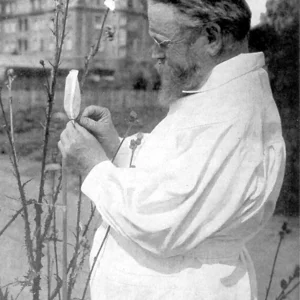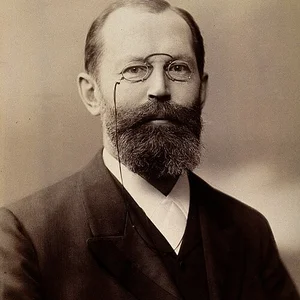

Emil Fischer (1852-1919) was a German chemist regarded as one of the founders of modern organic chemistry. His work on sugars, purines, and proteins earned him the Nobel Prize in Chemistry in 1902.
Emil Fischer(1852 — 1919)
Emil Fischer
Allemagne, Empire allemand
6 min read
Frequently asked questions
Key Facts
- Born in 1852 in Euskirchen, near Cologne (Germany)
- Elucidated the structure and stereochemistry of sugars (glucose, fructose) starting in 1884
- Awarded the Nobel Prize in Chemistry in 1902 for his work on sugars and purines
- Formulated the “lock and key” model in 1894, explaining the specificity of enzymes
- Died in 1919 in Berlin
Works & Achievements
A compound that became the universal tool for studying sugars; it underpins Fischer's entire method of analysis.
First laboratory production of natural sugars, proving that chemistry can recreate the molecules of life.
Fischer connects and synthesizes caffeine, theobromine and uric acid, founding the chemistry of a large family of biological molecules.
A foundational concept of biochemistry: it explains the specificity of enzymes and is still taught today.
Awarded for his work on sugars and purines; he is the second laureate in the history of this prize.
Fischer links amino acids into chains, paving the way for understanding the structure of proteins.
A graphical notation for representing the spatial configuration of molecules, which became a standard of organic chemistry.
Anecdotes
In 1875, as a young chemist, Emil Fischer discovered phenylhydrazine, a compound that would become his favorite tool for studying sugars. Cruel irony: this very substance he handled throughout his life caused him serious health problems (chronic eczema and digestive troubles), illustrating the little-known dangers of chemistry at the time.
In 1890, Fischer achieved the total synthesis of glucose, fructose, and mannose from glycerine. This tour de force proved that molecules until then reserved for living things could be made in the laboratory — a decisive blow against the idea of a mysterious “vital force” unique to living beings.
To explain how an enzyme precisely recognizes the molecule it acts upon, Fischer proposed in 1894 the famous image of the “lock and key”: each enzyme fits into its substrate like a key into a lock. This metaphor is still taught today in every biology course.
The First World War shattered Emil Fischer: two of his three sons died, one in combat, the other by suicide after grueling military training. Overwhelmed by grief, ill, and depressed, the great chemist took his own life in 1919.
When Fischer received the Nobel Prize in Chemistry in 1902, he was only the second laureate in the history of this newly created award. His name remains attached to countless concepts in organic chemistry: the Fischer projection, the Fischer esterification, and the Fischer indole synthesis.
Primary Sources
To use an image, I would say that enzyme and glucoside must fit together like a key and its lock, in order to be able to exert a chemical action on one another.
The artificial synthesis of grape sugar (glucose) and of several related sugars shows that these compounds, long regarded as produced exclusively by living nature, are within reach of the chemist.
The transformations I was able to carry out in the purine group led me to the synthesis of caffeine, theobromine and uric acid, establishing the kinship of these natural substances.
By linking amino acids to one another through an amide bond, I was able to obtain chains that I call polypeptides, which in their properties resemble natural proteins.
Key Places
Fischer's birthplace, near Cologne, where he grew up in a family of prosperous merchants.
Here Fischer earned his doctorate in 1874 under Adolf von Baeyer and discovered phenylhydrazine.
Professor of chemistry from 1885 to 1892, Fischer carried out here his decisive work on the synthesis of sugars.
From 1892 onward, Fischer held the prestigious chair of chemistry here, where he studied purines and proteins and built one of the largest laboratories in Europe.
Here Fischer followed von Baeyer and began his career as a researcher, amid the excitement of the Bavarian school of organic chemistry.
Typical Objects

Chemical reagent discovered by Fischer in 1875, used to identify and characterize sugars by forming osazone crystals. Handling it ruined his health.

Basic glassware of the organic chemistry laboratory, where Fischer heated, mixed, and crystallized his compounds. Patient work at the bench was at the heart of his method.

Graphical representation invented by Fischer to draw on paper the spatial configuration of sugars and other molecules with asymmetric carbons. A tool still taught today.

An indispensable instrument for accurately weighing reagents and the products obtained, ensuring the quantitative rigor of Fischer's analyses.

A device measuring the deviation of polarized light by a solution, essential for distinguishing the mirror-image sugars (optical isomers) that Fischer studied.

Notebook in which Fischer meticulously recorded protocols, observations, and results from his hundreds of experiments on sugars and proteins.
School Curriculum
Vocabulary & Tags
Key Vocabulary
Daily Life
Morning
Fischer arrived early at his chemistry institute, walking along the lab benches to follow the progress of experiments by his many students and assistants. He discussed protocols and results, demanding rigor and precision in every procedure.
Afternoon
Afternoons were spent in the laboratory and his office, designing new syntheses, analyzing the crystals he obtained, and writing his papers. He led one of the largest research groups in Europe, training dozens of future great chemists.
Evening
In the evening, Fischer read the scientific literature, corresponded with other European scholars, and prepared his lectures. He also took part in Berlin's academic life and in learned societies.
Food
A well-off member of the bourgeoisie in Wilhelmine Germany, Fischer ate hearty meals typical of German cuisine: meats, potatoes, and bread, accompanied by wine or beer. His chronic digestive troubles, linked to his exposure to chemicals, nevertheless forced him to watch what he ate.
Clothing
Like every university professor of the imperial era, he wore a dark three-piece suit, a stiff collar, a tie or bow, and at the laboratory a coat to protect his clothes. His neatly groomed beard and mustache were a must among the notables of the *Kaiserreich*.
Housing
Fischer lived in a comfortable bourgeois house in Berlin, close to his university institute. Widowed very early, he raised his three sons there and received colleagues and students.
Historical Timeline
Period Vocabulary
Liens externes & ressources
Références
Œuvres
Découverte de la phénylhydrazine
1875
Synthèse des sucres (glucose, fructose, mannose)
1890
Élucidation de la chimie des purines
1882-1899
Modèle « clé-serrure » de l'action enzymatique
1894
Prix Nobel de chimie
1902
Synthèse des polypeptides
1901-1907
Projection de Fischer
1891