 flip
flipØllebrød — Rye Bread Porridge with Beer
Øllebrød — Rye Bread Porridge with Beer
Why this dish? In a Sortelung cottage where every penny counted, warm øllebrød was the winter morning breakfast: it recycled stale rye crusts and filled the stomach before fieldwork. Nielsen, the twelfth child of a penniless painter-musician family, grew up with this taste of rye and mild beer.
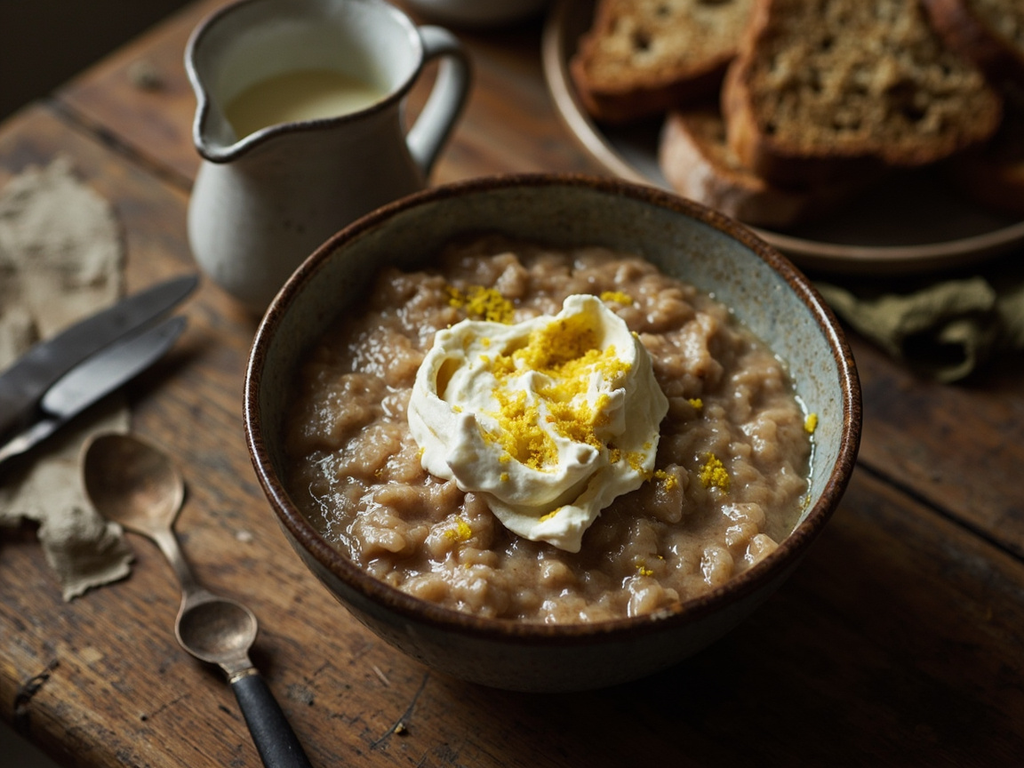
A creamy porridge of rye bread soaked then cooked in mild white beer (hvidtøl), sweetened and served with cold milk or cream. Comforting, slightly tangy, it is the quintessential Danish peasant breakfast.
At home in Sortelung, nothing was wasted — especially not bread. Mother would soak the rye crusts in a little mild beer the night before, and in the morning she'd stir it all on the fire until it became smooth and brown as peat. We'd pour cold milk over it, and believe me, on frosty Funen mornings, that porridge was worth any symphony. I was the twelfth child and there was hardly any money, but a steaming bowl of øllebrød kept you warm until evening violin practice.
- •Stale rye bread (rugbrød) — a good handful of crusts (base of the porridge)
- •Mild white beer (hvidtøl) — enough to cover the bread (aromatic cooking liquid)
- •Water — a little (loosens the porridge)
- •Sugar or syrup — to taste (sweetener)
- •Lemon zest — a pinch (flavoring)
- •Milk or cream — at serving (cold accompaniment)
Øllebrød — Rye Bread Porridge with Beer
A creamy porridge of rye bread soaked then cooked in mild white beer (hvidtøl), sweetened and served with cold milk or cream. Comforting, slightly tangy, it is the quintessential Danish peasant breakfast.
Why this dish? In a Sortelung cottage where every penny counted, warm øllebrød was the winter morning breakfast: it recycled stale rye crusts and filled the stomach before fieldwork. Nielsen, the twelfth child of a penniless painter-musician family, grew up with this taste of rye and mild beer.
At home in Sortelung, nothing was wasted — especially not bread. Mother would soak the rye crusts in a little mild beer the night before, and in the morning she'd stir it all on the fire until it became smooth and brown as peat. We'd pour cold milk over it, and believe me, on frosty Funen mornings, that porridge was worth any symphony. I was the twelfth child and there was hardly any money, but a steaming bowl of øllebrød kept you warm until evening violin practice.
Ingredients (period version)
- Stale rye bread (rugbrød) — a good handful of crusts (base of the porridge)
- Mild white beer (hvidtøl) — enough to cover the bread (aromatic cooking liquid)
- Water — a little (loosens the porridge)
- Sugar or syrup — to taste (sweetener)
- Lemon zest — a pinch (flavoring)
- Milk or cream — at serving (cold accompaniment)
Ingredients
- Dense rye bread (pumpernickel or rugbrød) — 200 g stale, in pieces
- Mild light beer, low alcohol — 33 cl (if hvidtøl unavailable, use table beer)
- Water — 25 cl
- Sugar — 2 to 3 tbsp to taste
- Lemon zest — 1/2 lemon
- Cold milk or whipped cream — at serving
Method
- The night before, soak the rye bread pieces in beer and water until well softened.
- The next day, pour everything into a saucepan and heat gently, stirring.
- Whisk or mash to a smooth porridge, add lemon zest and sugar.
- Simmer for 10-15 min, stirring, until thick and creamy.
- Serve hot in bowls, drizzled with cold milk or topped with a spoonful of whipped cream.
How it was made : Øllebrød is a dish of domestic economy attested in 19th-century Danish kitchens: it transformed hard rye bread into a nourishing meal using household beer (hvidtøl), brewed low in alcohol. It was eaten in the morning or as an evening soup, especially among the modest classes.
The contemporary twist : Served in a glass with a quenelle of vanilla whipped cream and a few toasted rye bread crumbles for crunch — a 'Nordic porridge' that embraces its peasant origins.
Sources : Kristine Marie Jensen, Frøken Jensens Kogebog (1901) · Carl Nielsen, Min fynske barndom (1927)
Carl Nielsen · Charactorium