 flip
flipTamales de mole
Tamales de mole
Why this dish? The tamal is the quintessential nomadic food: wrapped in its corn husk, it can be transported, steamed to reheat, and eaten anywhere—from market to train station. For Fuentes the diplomat, a man of multiple residences—Panama, Washington, Geneva, Paris, Mexico City—this portable corn packet is the very image of Mexico carried into exile, a homeland folded in a leaf.
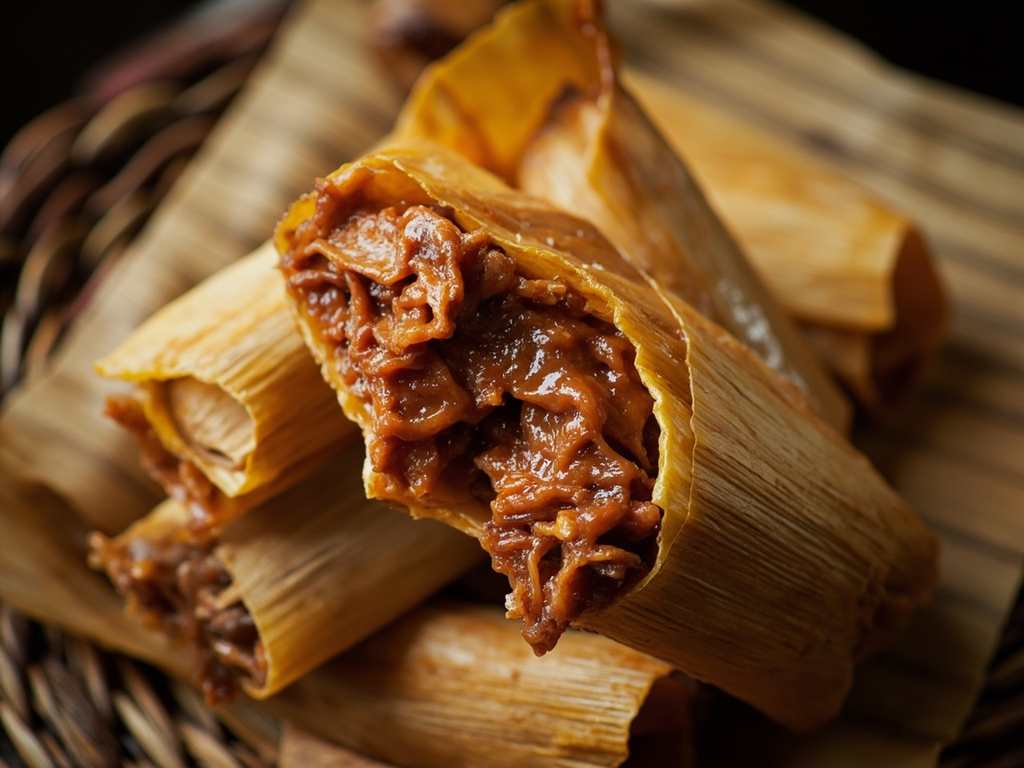
A corn dough (masa) beaten until airy, filled with chicken in mole, wrapped in corn husks, and steamed.
Here, take one for the road: the tamal travels like me, folded in its husk, ready to cross borders. I have eaten them in embassies and markets, and always the same marvel: the masa beaten until a dumpling floats in water, a sign it is ready. My grandmother said a tamal can tell when you are angry and then refuses to cook—so we would sing to the steam. Untie the husk patiently: it is a little Mexico you unwrap far from home.
- •Nixtamalized corn masa — a large amount (wrapping dough)
- •Lard — generously (fluffiness and tenderness of the masa)
- •Chicken broth — to thin (liquid for the dough)
- •Shredded chicken — according to number of tamales (filling)
- •Mole (dried chiles, spices, seeds, a little bitter chocolate) — one ladle per tamal (sauce for the filling)
- •Dried corn husks — as many as tamales (wrapping, soaked)
Tamales de mole
A corn dough (masa) beaten until airy, filled with chicken in mole, wrapped in corn husks, and steamed.
Why this dish? The tamal is the quintessential nomadic food: wrapped in its corn husk, it can be transported, steamed to reheat, and eaten anywhere—from market to train station. For Fuentes the diplomat, a man of multiple residences—Panama, Washington, Geneva, Paris, Mexico City—this portable corn packet is the very image of Mexico carried into exile, a homeland folded in a leaf.
Here, take one for the road: the tamal travels like me, folded in its husk, ready to cross borders. I have eaten them in embassies and markets, and always the same marvel: the masa beaten until a dumpling floats in water, a sign it is ready. My grandmother said a tamal can tell when you are angry and then refuses to cook—so we would sing to the steam. Untie the husk patiently: it is a little Mexico you unwrap far from home.
Ingredients (period version)
- Nixtamalized corn masa — a large amount (wrapping dough)
- Lard — generously (fluffiness and tenderness of the masa)
- Chicken broth — to thin (liquid for the dough)
- Shredded chicken — according to number of tamales (filling)
- Mole (dried chiles, spices, seeds, a little bitter chocolate) — one ladle per tamal (sauce for the filling)
- Dried corn husks — as many as tamales (wrapping, soaked)
Ingredients
- Masa harina (nixtamalized corn flour) — 500 g (dough)
- Lard (or butter/coconut oil) — 180 g (fluffiness)
- Warm chicken broth — 400-500 ml (hydration)
- Baking powder — 1 tsp (lightness (modern trick))
- Salt — 1 tsp (seasoning)
- Cooked chicken breast, shredded — 300 g (filling)
- Mole poblano paste (store-bought, to thin) — 150 g + broth (filling sauce)
- Dried corn husks (hojas) — 20-24 (wrapping)
Method
- Soak the corn husks in hot water for 30 minutes to soften.
- Beat the lard until whitish and fluffy. Gradually incorporate the masa harina, salt, baking powder, then the warm broth, until the dough is smooth and light. Test: a small ball of dough should float in a glass of water.
- Thin the mole with a little hot broth and mix in the shredded chicken.
- Spread a layer of masa on each husk, place a spoonful of chicken mole in the center, then fold the husk, folding in the sides and bottom.
- Stand the tamales upright, open end up, in a steamer. Steam for 50-60 minutes: they are ready when the dough pulls cleanly away from the husk.
- Let rest 5 minutes before unwrapping—they keep and reheat well in the steamer, ideal for travel.
How it was made : The tamal is pre-Hispanic: as early as the Mexica period, nixtamalized corn masa was wrapped in corn or banana leaves and steamed, as ritual and travel food. Mole, on the other hand, is *mestizo*—it marries indigenous chiles, Old World spices, and a hint of cacao. Beating the masa with lard by hand for a long time was the guarantee of a light tamal.
The contemporary twist : Modern versions offer "tamalitos"—mini tamales for appetizers, served with warm mole as a dip.
Sources : Diana Kennedy, The Art of Mexican Cooking · Ricardo Muñoz Zurita, Diccionario enciclopédico de la gastronomía mexicana
Carlos Fuentes · Charactorium