 flip
flipSun-Dried Tasajo Enchilado
Sun-Dried Tasajo Enchilado
Why this dish? During the French intervention, Juárez governed from a black carriage, dragging the Republic from town to town as far as Paso del Norte. Tasajo — beef sliced thin, salted, sun-dried — is precisely the travel meat of Oaxaca, the one carried in the itacate because it keeps without ice and grills in an instant at a stop.
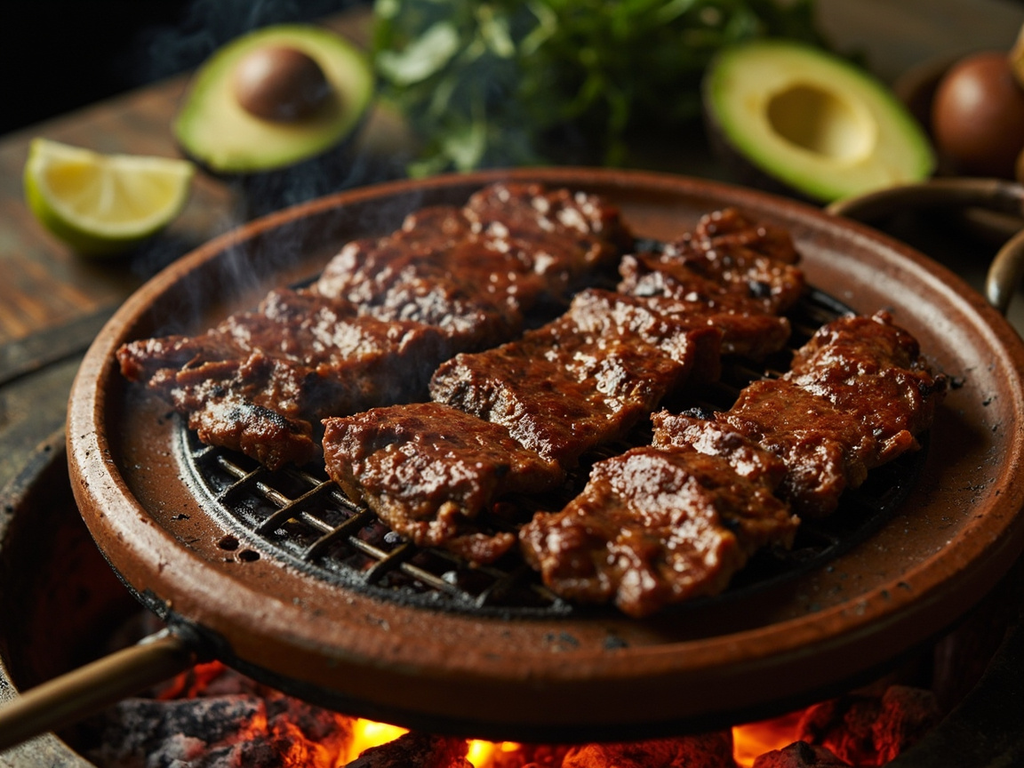
Thin strips of beef rubbed with salt and chile paste, sun-dried then grilled on the comal. Salty, smoky, deeply savory, it is the meat of markets and long roads in Oaxaca — and that of a president forced to govern on the move.
When the invader drove us from town to town, the Republic fit in a black carriage — and we ate what the road allowed. Tasajo, you see, the good Oaxacan prepares it in advance: the meat sliced thin as a leaf, rubbed with salt and chile, set to dry in the sierra sun. It keeps without anything, grills on any comal, and a little lime suffices. A state on the march must eat standing: that was my campaign table.
- •Beef in large thin slices — according to the piece (meat)
- •Salt — generously (preservation)
- •Dried chile paste — to coat (seasoning, preservation)
- •Garlic — a little (aromatic)
- •Lime juice — at serving (acidity)
Sun-Dried Tasajo Enchilado
Thin strips of beef rubbed with salt and chile paste, sun-dried then grilled on the comal. Salty, smoky, deeply savory, it is the meat of markets and long roads in Oaxaca — and that of a president forced to govern on the move.
Why this dish? During the French intervention, Juárez governed from a black carriage, dragging the Republic from town to town as far as Paso del Norte. Tasajo — beef sliced thin, salted, sun-dried — is precisely the travel meat of Oaxaca, the one carried in the itacate because it keeps without ice and grills in an instant at a stop.
When the invader drove us from town to town, the Republic fit in a black carriage — and we ate what the road allowed. Tasajo, you see, the good Oaxacan prepares it in advance: the meat sliced thin as a leaf, rubbed with salt and chile, set to dry in the sierra sun. It keeps without anything, grills on any comal, and a little lime suffices. A state on the march must eat standing: that was my campaign table.
Ingredients (period version)
- Beef in large thin slices — according to the piece (meat)
- Salt — generously (preservation)
- Dried chile paste — to coat (seasoning, preservation)
- Garlic — a little (aromatic)
- Lime juice — at serving (acidity)
Ingredients
- Beef flank or sirloin tip — 500 g (meat)
- Salt — 2 tbsp (curing)
- Guajillo + ancho chiles — 3 + 2 (coating paste)
- Garlic — 2 cloves (aromatic)
- Cumin and oregano — a pinch each (spices)
- Lime — 2 (acidity at serving)
- Onion and avocado — for serving (garnish)
Method
- Slice the beef into very thin large strips (place in freezer for 30 min to make slicing easier).
- Blend the soaked chiles, garlic, cumin, oregano, and salt into a thick paste.
- Coat each strip of meat with the paste; marinate at least 2 hours (or overnight).
- Traditional version: sun-dry on a rack for a few hours. Safe modern version: dry 3-4 hours in the oven at 60-70°C, door ajar, until the meat is firm but pliable.
- When ready to eat, grill the strips 1-2 minutes per side on a comal or very hot skillet.
- Serve with lime, onion, avocado, and tortillas — the snack of the road.
How it was made : Tasajo is a staple of Oaxacan markets: the meat, sliced into long ribbons then salted and sun-dried, kept for days without refrigeration — essential before industrial ice. It was grilled to order on comals in covered passages, as still today at the 20 de Noviembre market.
The contemporary twist : Roll the grilled tasajo in a crispy tlayuda with beans and avocado, 'road taco' style, to be eaten standing, faithful to its nomadic use.
Sources : Ricardo Muñoz Zurita, Diccionario enciclopédico de la gastronomía mexicana (2012) · Diana Kennedy, Oaxaca al Gusto (2010)
Benito Juárez · Charactorium